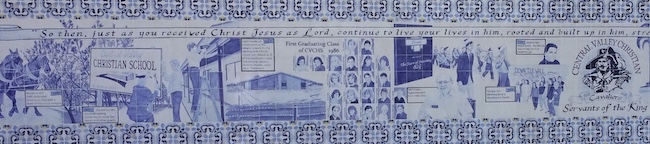
Murals on walls or floors bring spaces to life, convey a message, or act as giant canvases for art. Whether installing a hand-crafted mosaic or a pre-designed image or pattern, glass and tile mural installers need to employ a range of skills, from design to prep work to installation itself.
Sam Bruce of Visalia Ceramic Tile in Visalia, Calif., Chairman of the Board for NTCA, has tackled a number of murals and has some tips for those considering the craft. Most of the murals his company has installed are pre-designed from suppliers like Boston-based Artaic.
“There’s a LOT to consider when you are putting these pieces in,” he said. First off, the installation instructions from the mural manufacturer are essential. Often the instructions demand the installer cut the last row off the section and piece it in, he added. This technique is crucial for making the pre-designed lines vanish, ensuring a cohesive and continuous image. Ignoring this step can create a checkerboard pattern in the design instead of the intended artistic flow.
A creative eye makes or breaks the mural
A flat substrate is also critical, since bumps or ridges will open up the grout joints and make unsightly shapes within the pattern, Bruce said. “Conformity is key,” he noted. “Prep [for a mural] is as important as with gauged porcelain,” he said. Visalia frequently uses ARDEX AM100, a pre-tile ramping and smoothing mortar, for both interior and exterior applications, praising its mud-like texture.
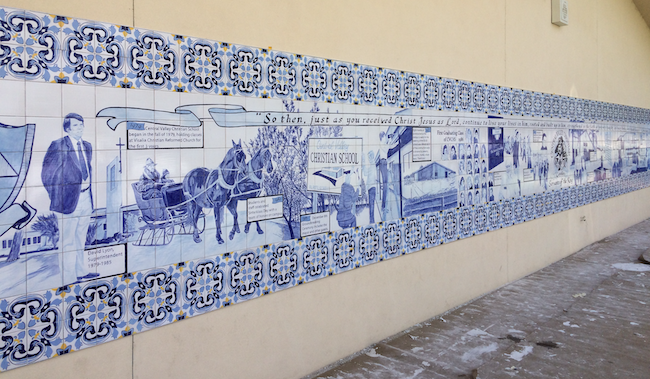
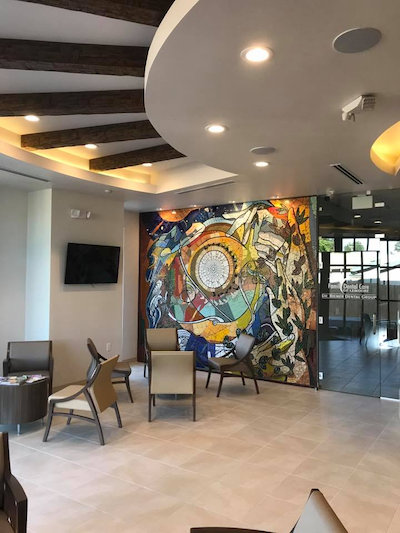
Besides appropriate material, Bruce said, “You need someone who has a creative, artistic eye. I have 45 tile setters in my crew, but I can’t give these jobs to every setter.” A meticulous approach – and an eye for detail – are key skills for setters who work with mosaic murals.
Bruce recalled a white-on-white mesh-mount mural at a very expensive custom home. The wall had some curvature to it that required the crew to cut strips out and not install the pieces as they were. “Pieces were falling apart,” he said. “It took the right guy to recognize it and install pieces by eye. It was one of the more difficult mosaic installations we’ve done.”
Mesh mount is also tricky when working in wet areas, he said, since the moisture dissolves the glue and the pieces start to fall off the mesh. He again emphasized reading the instructions.
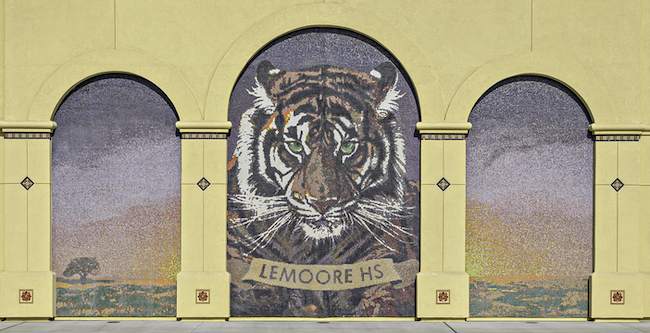
Another challenging mosaic mural was the intricate tiger face mosaic Visalia tackled for Union High School in Lemoore, Calif. This design was delivered with paper-faced mounted tiles, which made it hard to see where the grout joints were in order to match them, Bruce said. According to the instructions, the crew didn’t pull the paper until the mosaic was set. So to even up the grout joints, the crew went in with a grout stain to tie in all the colors and make the grout joints fade away.
A final note from Bruce is to be realistic about the pace of a mural installation. For those who are used to installing a lot of square feet in a day, he said, “be prepared to not do a lot of square footage on murals.” Patience is paramount, he concluded.
Size matters
NTCA member Angie Ré, award-winning mosaicist, muralist and owner of Unique Mosaics LLC in South Salt Lake, Utah, echoed Bruce’s sentiments about preparation, adding her own insights for those who are creating their own designs.
“The image in the mural needs to be scaled to actual size,” she advised, “whether hand-drawn or printed.” While projectors are an option, she prefers creating larger murals on the floor or a tabletop. Often she hand-draws basic guidelines and builds the mural within them.
The right material for the right application
Both Bruce and Ré stressed the importance of material selection based on the mural’s location. For exterior murals, UV-compliant materials are essential to withstand weather exposure, Ré said. The same applied to wet areas like swimming pools, where specific thinsets and tile materials were required.
“For tile or glass, I would use the same standards that you would use for regular tile installation,” Ré explained. “You want the mural to last, just like a regular tile installation. Sometimes artisans will just jump into a project and if they don’t have tile installation experience, they may get in over their head, and use improper materials. That’s a lot of work to put into something to have it fail. I would uphold our national tile standards and use standards as much as possible.”
Ré designs and fabricates her own mosaic murals, using a range of mounting methods – paper face, mosaic tape and the pre-mounting methods described in the NTCA Reference Manual. What she chooses depends on where the tile and mural are going and what materials are in use. “Some material, the tape doesn’t stick to,” she said. “For wet areas or swimming pools, you can’t use mesh, you need paper face. I make my murals to meet the needs of the end location.”
Ré has a lot of confidence in paper facing her mosaics. She takes progress pictures prior, cuts and numbers the sections for shipping and provides a clear schematic diagram and instructions for installers to follow on site. “You can set the sheet and within a few minutes, spray the paper face and pull it off, so there is time to make adjustments while the thinset is still wet.”
Award winning mural
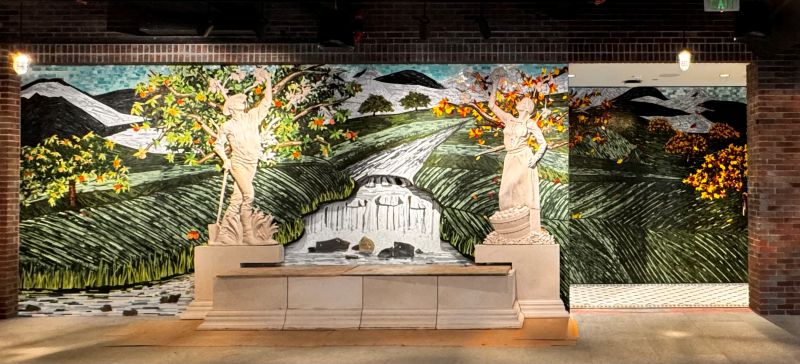
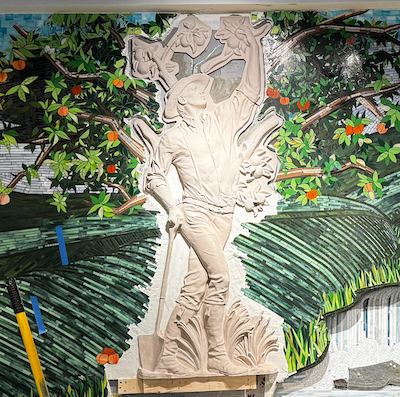
Ré received the Coverings Installation and Design (CID) Award for Artistic Installation in April for her Wavetronix Glass Murals. Two-and-a-half years in the making for the small business campus in Springfield, Utah, the murals encompassed a 10′ x 21′ main wall and a 10′ x 13′ vestibule wall. The theme was “Seasons of our Careers” with over 31 colors and thousands of pieces of hand-cut mosaics that portrayed the transition from summer to the autumn harvest. The mural has a recessed wall with water cascading over the mural, coupled with a continuous image that wrapped around a vestibule wall, which demanded on-site improvisation.
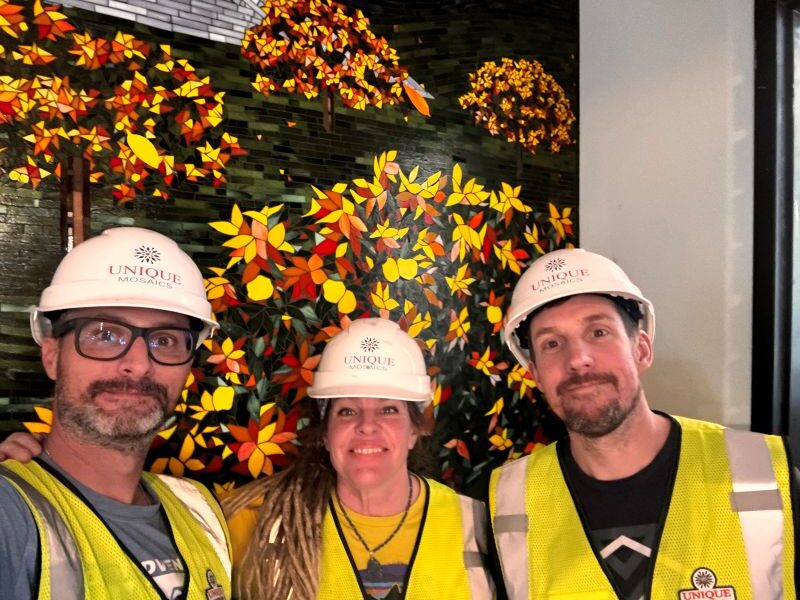
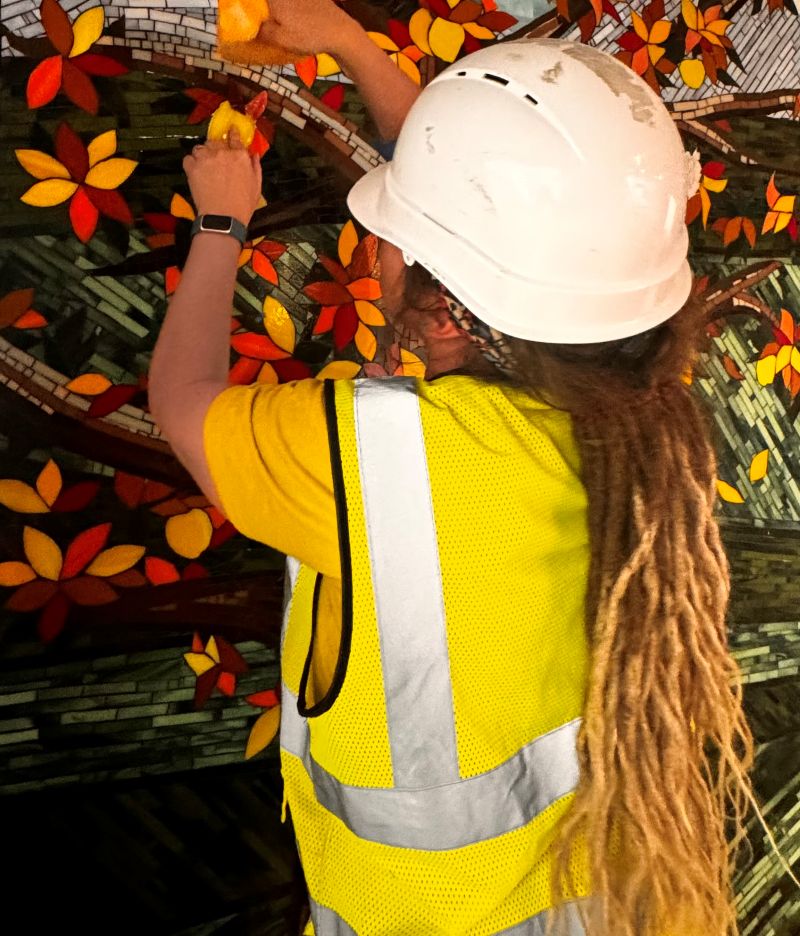
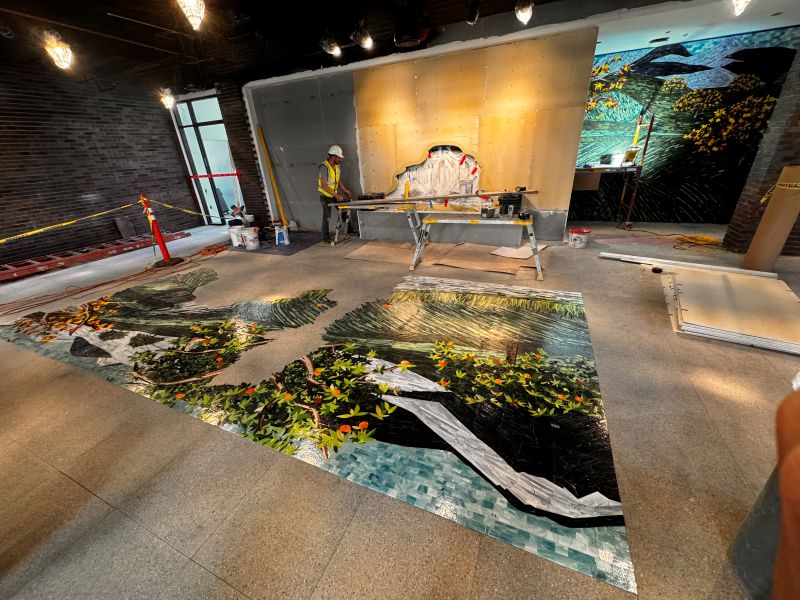
Since she hadn’t known where sculptures and fountain would land on the mosaic in her studio, she wound up needing to demo part of her own mural. She worked on a scaffold, scribing from scrap glass around the sculptures, “making up the image as she went.” She also incorporated 3D glass elements in placing kiln-fired leaves, peaches, apples and canyon rocks at strategic points in the mural. The fruit was inspired by the lyrics “Peaches in the summertime, apples in the fall,” which Jerry Garcia and David Grishman added when covering the Shady Grove song in their performances. The lyrics allude to the beauty and cyclical nature of each season.
Ace tile contractors Mark Christensen and James Morris, as well as her husband Jason, lent essential help on the project. The result combines art, engineering, storytelling and innovation in a stunning masterpiece.



Lesley Goddin has been writing and journaling since her first diary at age 11. Her journey has taken her through a career in publishing and publicity, landing her the editor position of TileLetter and its special publications in 2006. Her goal is to educate, inspire, recognize and encourage those in the tile industry -- especially the tile and stone contractor.