
In this interview, NTCA Deputy Director Jeremy Sax spoke with Angela DiGianfelice, the Nashville South Health Compliance Supervisor for Tennessee Occupational Safety and Health Administration (TOSHA) with the Tennessee Department of Labor and Workforce Development. A Certified Safety Professional (CSP) with the Board of Certified Safety Professionals, she has spent more than 19 years working in the Safety and Health field, and is a Veteran of the United States Army.
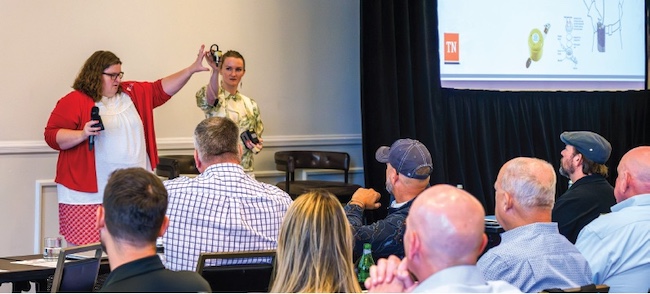
DiGianfelice was a presenter at the NTCA Five-Star Summer Meeting, which took place in Nashville. Here, Sax delves deeper into key points she raised in her talk, “Navigating the New Silica Safety Landscape,” focusing on recommendations to keep workers safe.
In your presentation, you emphasized that “silicosis is preventable.” If you had to name the single most important step contractors can take to protect their workforce, what would it be?
Control the dust at the source before it becomes a problem. That means investing in engineering controls like wet-cutting systems or local exhaust ventilation. Don’t wait for the dust to settle—literally or metaphorically. Once those tiny silica particles are in the air, you’re already on the defensive, and so are your workers’ lungs. And settled dust causes additional exposure during housekeeping.
Too often, I’ve seen workplaces rely on respirators to solve their problems or assume that “just a little dust” won’t hurt. But silicosis doesn’t care about good intentions or shortcuts. Dust control isn’t just a best practice – it’s an obligation.
California has been at the forefront, with stop-work orders and even proposals to ban dry cutting. Will we see similar legislative or regulatory momentum spread nationwide in the next few years?
CalOSHA’s rulemaking has taken a leading role in addressing the health risks of dry cutting, particularly in industries like stone fabrication where exposure to silica dust is high. That state’s aggressive measures – such as emergency stop-work orders and a ban on dry cutting – reflect growing concern over silicosis and other occupational lung diseases.
As data from California starts to show real-world impact, it may serve as a model for broader adoption.
Many contractors rely heavily on Table 1 methods under the OSHA silica standard. What are the most common mistakes you see when employers attempt to follow Table 1?
Table 1 can be a great resource – if it’s followed the way it’s written. But a lot of people treat it like a checklist and not a system, and that’s where things go wrong.
One of the biggest mistakes is poor use of water delivery systems. Either the water pressure is too low to be effective, the spray nozzles are clogged, or the equipment is damaged and nobody’s noticed. Another common issue is ignoring the tool manufacturer’s instructions. Table 1 assumes that tools are being used correctly and maintained regularly. If you’re skipping maintenance or using off-brand parts, you’re not in compliance – no matter how closely you think you’re following the table.
Dust collection systems: same story. I’ve seen systems that barely draw air, have overloaded filters, or haven’t been emptied in weeks.
And of course, none of it works if workers don’t know what they’re doing. Too many employers skip the training and assume “turn on the vacuum” is a safety strategy. It’s not. The bottom line is that Table 1 only works when all the pieces are in place.
Your presentation also discussed medical surveillance and long-term recordkeeping requirements. For small contractors who may find these obligations overwhelming, what practical steps can they take to stay compliant without being buried in paperwork?
It can feel overwhelming, but you don’t need to drown in paperwork to stay compliant. You just need a smart system – and maybe a little help.
Go digital. There are affordable compliance apps and software tools that can track medical exams, send reminders, store documents, and even flag upcoming deadlines.
Outsource where it makes sense. Occupational health service providers can handle the medical side – exams, records, compliance – so you can stay focused on running the job.
Keep your system simple and consistent. Establish cloud-based folders labeled by employee name and year. Update them regularly, and don’t overcomplicate it. You just need to be able to find what OSHA requests with ease.
Train your people. When your crew knows why this stuff matters and what their role is, you’ll spend less time chasing signatures and more time staying ahead. Don’t treat compliance like an afterthought or a once-a-year panic attack. Build it into your culture of how you operate day-today, and the paperwork won’t feel so heavy.
You encourage employers to treat silica like asbestos – with strict engineering controls, monitoring, and health tracking. Could you expand on that comparison, and why it’s so important for the tile industry specifically?
When I say we need to treat silica like asbestos, I’m not being dramatic – I’m being accurate. Both are invisible, airborne killers. Both cause incurable, progressive lung disease. And both have long histories of being ignored until it was too late.
Asbestos got the regulatory response it deserved – but only after decades of worker deaths. Silica has been on that same path for just as long, and we still haven’t caught up. That’s what the silica rule is trying to prevent.
The tools for prevention already exist: wet cutting, HEPA vacuums, proper PPE, medical surveillance. What’s missing is the mindset. Asbestos didn’t kill people because it was more dangerous than silica – it killed people because we underestimated it for decades. There’s no reason to let history repeat itself. So yes, treat silica like asbestos. Treat it as if it’s deadly, because it is.
For companies that want to get ahead of compliance and truly make silica safety part of their culture, what are three practical “first steps” they can take right now?
1. Know your numbers. Do air monitoring or follow OSHA’s Table 1 and see where silica exposure is happening. You can’t fix what you’re not measuring.
2. Control the dust, not just the symptoms. Don’t just toss workers a respirator and hope for the best. Use water-fed tools, vacuums with proper filters, or fully enclosed systems. This isn’t about looking safe – it’s about being safe. If the dust never goes airborne, you’ve already won half the battle.
3. Make it normal to talk about silica safety. Do regular toolbox talks. Break down what silicosis is and why it matters. When workers understand the ‘why,’ they take the ‘how’ seriously. Safety should be part of a workplace culture, baked into how the company operates. Then it becomes second nature. That’s the goal.
The State of Tennessee has a TOSHA Consulting Services Division. What other states have a similar program?
All 50 states and several U.S. territories offer onsite assistance. OSHA’s Consultative Services is a free, confidential program designed to help small- and medium-sized employers across industries such as construction and manufacturing. Services include:
- Identifying and controlling workplace hazards
- Improving safety and health management systems
- Site-specific education and training
- Written recommendations for compliance and best practices
- Air sampling for workplace contaminants

Unlike enforcement inspections, consultation visits do not result in citations or penalties and are kept separate from enforcement activities.
All 50 states and several territories operate similar onsite consultation programs. Scan to find your local consultation office here.
Angela DiGianfelice is the Nashville South Health Compliance Supervisor for the Tennessee Occupational Safety and Health Administration (TOSHA) with the Tennessee Department of Labor and Workforce Development.



Jeremy Sax
Jeremy Sax started his career in the tile industry, back in 1998, as the Director of Domestic Sales for Tamiami Tile in Miami, Florida. An accomplished leader with over 26 years of experience in strategic management, scaling businesses and servant leadership, Jeremy brings a wealth of expertise to NTCA. His previous roles have included significant leadership positions where he demonstrated exceptional skills in organizational growth, strategic planning, and stakeholder engagement ranging from roles within Manufacturing, Distribution and most recently Private Equity.
As Deputy Director, Sax will be instrumental in supporting NTCA’s objectives to enhance industry standards, foster professional growth, and advocate for the tile contracting community. His proven track record in managing complex projects and driving strategic initiatives aligns perfectly with NTCA’s goals of innovation and excellence in the tile industry.
Sax holds a Bachelor’s degree in Business Administration with an emphasis in Organizational Management from St. Louis University. He is known for his strategic vision, dedication to excellence, and his ability to cultivate strong relationships within the industry. Sax’s commitment to advancing professional standards and his deep understanding of market dynamics is invaluable in his role as NTCA Deputy Director.