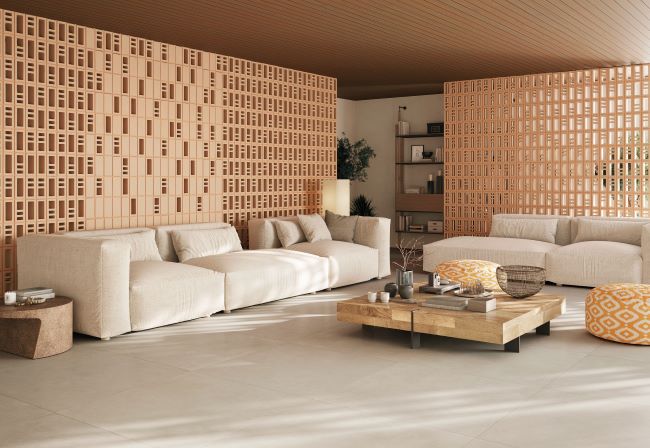
For centuries, lattice screens have been part of the Mediterranean building language as a resource capable of regulating the relationship between interior and exterior. With Lumina, Durstone revives this element and reinterprets it through a collection of extruded stoneware designed to respond to the needs of contemporary architecture.
Conceived as a modular system, Lumina makes it possible to create visual filters, space dividers, lightweight enclosures, and transitional elements capable of adding depth, privacy, and dynamism to spaces.
The collection is made up of six pieces grouped into two complementary geometric families: Cube 0, Cube 1, and Cube 2, all in a 15cm x 15cm format; and Brick 0, Brick 1, and Brick 2, all in a 30cm x 15cm format. The combination of both typologies makes it possible to develop compositions with different densities and levels of transparency, adapting to the scale and needs of each project.
Beyond its constructive function, Lumina understands the lattice screen as a design tool capable of giving identity to architecture. Its modules allow the creation of geometric patterns that define without enclosing and protect without isolating, generating a richer relationship between light, material, and space.
Ceramic materiality with strong expressive character
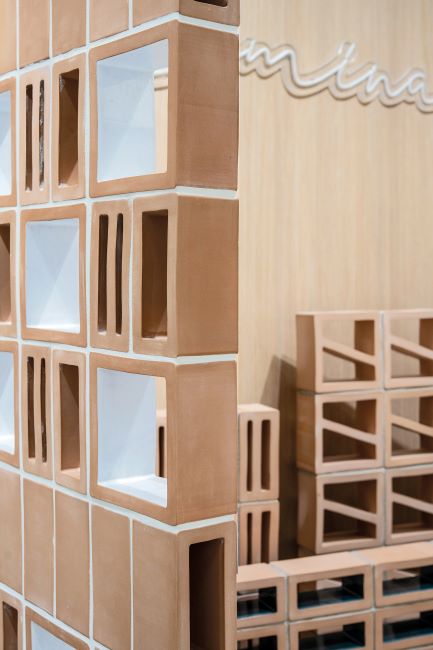
Materiality plays a leading role throughout the collection. Manufactured through ceramic extrusion, the pieces feature a natural matte finish, Sand, which highlights the authenticity of the material and the small variations inherent in ceramic processes.
In addition to this natural Sand base, versions with internal glazing are available in the Cube 0 and Brick 0 models, offered in Blue, Olive, and White. These finishes introduce chromatic nuances inside the pieces and create interesting depth effects when light passes through the structure, adding an additional visual dimension to the compositions.
Thanks to its resistance, durability, and versatility, Lumina can be integrated into façades, patios, terraces, porches, shops, offices, hotels, or homes, enabling the creation of everything from small partition elements and intermediate spaces to large architectural lattice screens.
With Lumina, Durstone reaffirms the relevance of the lattice screen as a resource capable of adding both functional and expressive value to contemporary architecture, demonstrating how ceramics can continue to offer relevant solutions based on elements deeply rooted in Mediterranean tradition.
About Durstone
Founded in 2004, Durstone is a ceramic company specialized in the development of surfaces for architecture and interior design. The company structures its activity through different brands, including Durstone, focused on ceramic and porcelain floor and wall tiles; Durslab, centered on large-format porcelain surfaces; and D’Bath, oriented toward the design of ceramic bathroom elements. With a presence in more than 90 countries, the company operates mainly in Spain, the European Union, and the United States, working with an international distributor network and collaborating with architecture and interior design studios as well as construction professionals.