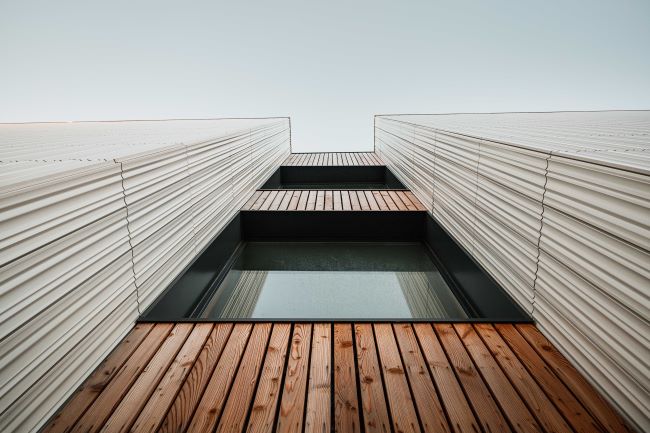
As the technical requirements of building envelopes have evolved, fire performance has become a key criterion in the design of ventilated façades. Given this situation, analyses no longer just focus on the individual reaction of materials, but on the joint response of the whole building envelope in possible scenarios of external fire propagation.
In line with this, in 2019 FAVEKER-Gres Aragón developed a tiled ventilated façade system and voluntarily tested it out, using an international full-scale fire propagation test method based on the NFPA 285 standard in order to evaluate the global performance of the assemblies to vertical and lateral fire propagation—keeping one step ahead of the building requirements of various countries.
With this test method, a joint analysis is made of the reaction of the extruded tiles, mechanical anchorage system, metal sub-structure, rockwool insulation, and the components used to compartmentalize the air cavity. The certificate was issued by Thomas Bell-Wright International Consultants (Dubai), an ISO/IEC 17065 accredited body.
Fire performance as a property of the whole system
In a ventilated façade, fire safety is not solely dependent on the individual reaction of each of its materials, but on the joint interaction of all the components of the building envelope: the tile cladding, mechanical anchorage system, sub-structure, insulation, cavity barriers and geometry of the air cavity.
The cavity itself can give rise to certain dynamics, tied in with the circulation of air and possible vertical fire spread. That is why in the case of this kind of building envelope, the evaluation of the whole system is particularly important since an analysis of the individual performance of each component does not offer an insight into the system’s real joint fire response.
In Europe, SBI (Single Burning Item) tests can be used to assess the individual contribution that materials or components make to the growth of fire. However, in complex systems such as ventilated façades, increasing priority is being given to an analysis of the global performance of their assemblies, particularly with regard to external fire propagation through the air cavity.
FAVEKER-Gres Aragón’s approach is inspired by this global vision of systems, where the materials, fastenings, and compartmentalization and performance of the air cavity are all designed in a coordinated way.
Extruded ceramic tiles and non-combustible materials
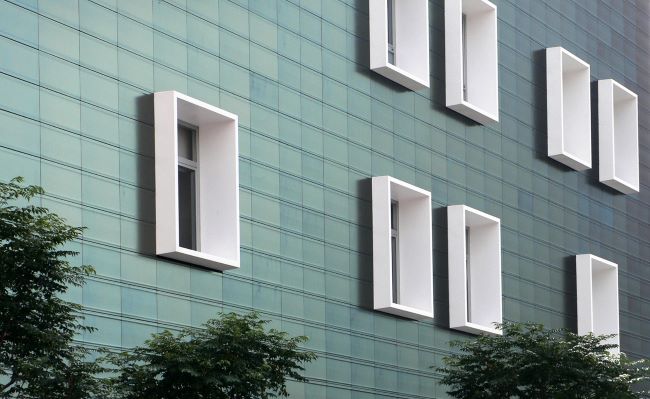
FAVEKER-Gres Aragón’s ventilated façades are based on the use of extruded vitrified porcelain tiles, a mineral-based material rated A1 in accordance with the UNE-EN 13501-1 standard: the highest European fire rating given to non-combustible materials.
Not only do extruded porcelain tiles (fired at a high temperature of 1200 ºC) not contribute to the development of fire or to the building’s fire load, but they also stand out for their dimensional stability, low water absorption, and high durability—qualities that are particularly important in ventilated façades exposed to changing environmental conditions.
Thanks to extruded manufacturing systems, tiles with optimized shapes and cross-sections can be developed, adapted to the specific needs of individual architectural projects, integrating technical performance and architectural definition in the same building envelope.
Compartmentalization and control of the chimney effect
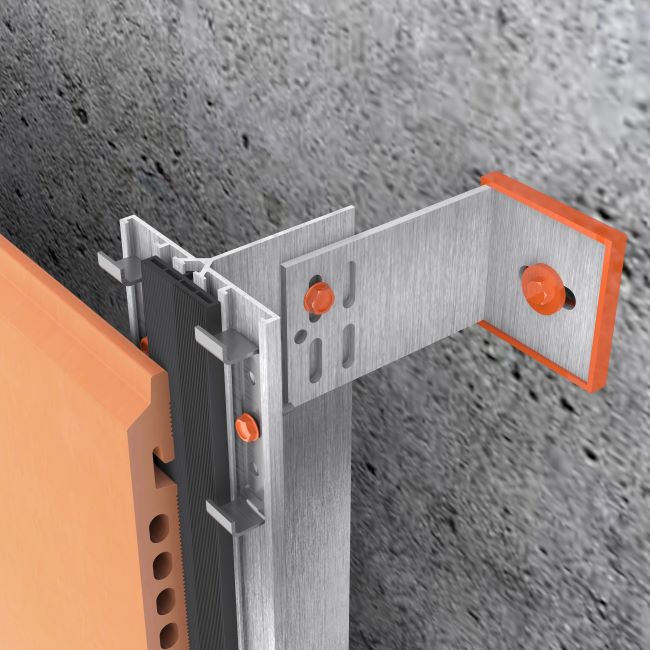
FAVEKER-Gres Aragón’s ventilated façade systems integrate specific solutions for controlling the air cavity and compartmentalizing the system in the event of fire. These features include intumescent barriers that expand when exposed to heat, sealing off the air cavity and limiting the air flow in order to avoid vertical fire propagation due to the chimney effect.
Normally, these barriers remain open so as to ensure the hydrothermal performance characteristic of ventilated façades, as well as continuous ventilation of the air cavity.
These solutions are combined with mineral rockwool insulation and mechanical anchorage systems designed to guarantee stability, control of the building system and its technical coherence.
With this integrated approach, ventilated façades are no longer regarded as a combination of various different individual components but as a coordinated building system whose materials, passive safety, hydrothermal performance, and technical coherence all form part of the same architectural solution.
About FAVEKER-Gres Aragón
GRES ARAGÓN provides sustainable ceramic architectural solutions—high-quality, innovative and healthy—in collaboration with clients and prescribers, creating stable employment and high added value. Under FAVEKER®, it offers ventilated ceramic façade systems by extrusion for use in both renovation and new-construction and unique projects. These systems achieve more sustainable, efficient and comfortable buildings thanks to better thermal and acoustic insulation, while providing the building with healthy materials for people and the environment, 100% recyclable systems and at least 40% recycled content in their manufacture.