Coverings visit leads to collaboration related to similarities and differences of installation best practices for diverse markets
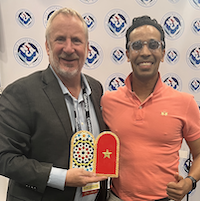
Mohamed Azizi, a highly-engaging young professional from Morocco, goes by the name of Mr. Carrelage (Mr. Tile). He oversees public relations and is a strategic consultant for the newly-established Moroccan Tile Contractors Association Union. After a fascinating conversation with him at Coverings, our shared ideas have led to multiple discussions on installation best practices. We’ve talked about everything from recruiting new people into the trade to successfully installing Zellige tile, a product that has become increasingly popular in the U.S., despite its unique and challenging characteristics. Azizi will be bringing representatives from his organization to meet with leaders from the NTCA and other international trade associations at the Cersaie show in Bologna, Italy, this September. Here are some highlights from our talks.

Tell us a little about Mr. Tile in Morocco and how you became the Tile Contractors Association Union’s public relations and strategic consultant.
I come from a family that has been running tile showrooms all over Morocco for more than 20 years. This has given me extensive experience interacting with tile professionals. In my role, I assist tile installers with business education, professionalism, marketing, and promotion. I also help create awareness of our union and its members both in Morocco and internationally, which is why I visited you at Coverings in the U.S.
Explain to us a little bit about the tile market in Morocco with an emphasis on installation.
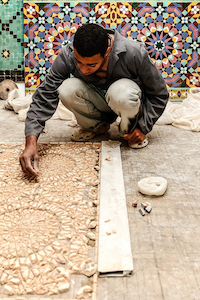
Installation holds an important place in our economy, and is a core part of our cultural identity. Zellige is a huge part of our heritage, and I want to extend an open invitation for all tile professionals to visit us and see the incredible installations of Zellige throughout our country. Tile installation is a respected trade that has been passed down through generations for over 1,000 years, using traditional techniques for installing Zellige tiles. It’s a respected trade, but it has its challenges. Most installers start their careers through informal apprenticeships, learning on the job in family businesses and showrooms. We are now working to grow a more formal system of apprenticeship and training through vocational schools.
How and when was the Moroccan tile union established and what are its strategic objectives?
We are relatively new, established just a few years ago. Before our union, there were many smaller, regional associations. One of our main goals is to create a unified national curriculum for tile installation. We also plan to develop a national certification, which will help professionalize our trade, attract more youth, and raise consumer confidence to increase the consumption and market share of ceramic tile. The union includes members from over 18 tile associations, stretching from Tangiers to the Moroccan Sahara, and is structured similarly to associations in the United States.
How do you intend to market tile installation to the next generation of young professionals in Morocco?
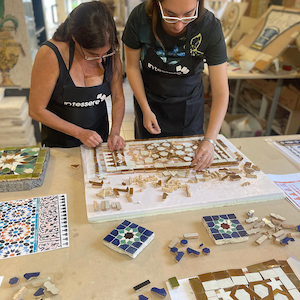
Historically, many young people entered the tile trade through family members or friends already in the business. It’s common to see multi-generational tile craftspeople here, and this model is powerful because it embeds a deep respect for the craft. At the same time, we’re seeing more newcomers entering the trade through tile distributors and showrooms. As a union, we’re working with vocational and technical schools to add tile installation to their curriculums, creating formal pathways into apprentice training. Fortunately, we’re seeing more interest from young people who are excited about pursuing a career working with their hands in construction.
What does the construction market look like today in Morocco?
The market is increasingly dynamic. In urban areas, you’ll find a mix of new construction, including upscale villas and innovative renovation work in historic districts. Most tile installations on floors and walls are done on concrete substrates. We spend a lot of time ensuring these substrates are level, flat, and treated with the appropriate primers and waterproofing membranes. Adhesive and grout selection is critical to a successful installation. Morocco has significant temperature swings, from cold climates in the north to arid desert climates in the south, so following installation instructions is imperative.
Remodeling projects can be quite challenging, especially in buildings that are centuries old. You often encounter irregularities in flatness, moisture, and mold while trying to preserve historic elements. Our union organizes site visits and workshops where workers learn to combine historic construction elements with new techniques and installation standards.

Describe Zellige and why it has become so popular around the world.
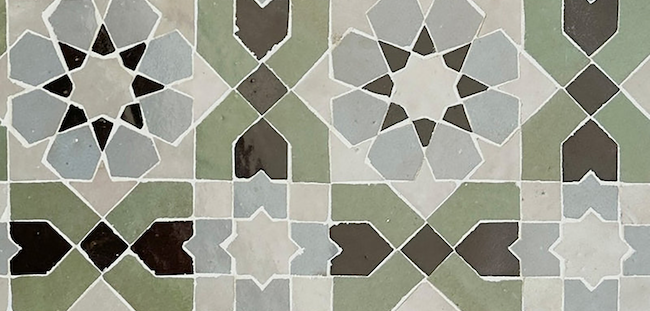
While we do import tile from other countries, Zellige is our most celebrated category. Its origins date back to the 10th century when Andalusian artists brought tile-making techniques across the Strait of Gibraltar. It is Morocco’s most celebrated export. Zellige is still crafted and glazed by hand, fired in wood kilns, and each piece is chiseled by hand. As a result, it is unique in its irregular size, thickness, and color variations.
Globally, Zellige has captured the imagination of designers and architects with its geometric elements, use of color, aesthetics, and historical significance. The U.S. has especially embraced Zellige in recent years, and you can find it in upscale hotels, boutiques, and high-end residential and commercial projects as a symbol of beauty and artistry in ceramic tile design and architecture.
Many U.S. installers have been frustrated when working with Zellige tile. What are the best practice tips for installing this product?
Naturally, there are installation challenges with these products due to the way they are manufactured, fired, and cut. They are not rectified porcelain tiles; their edges are irregular, and their corners are uneven. Installing Zellige requires a different mindset. My top recommendations include:
• Perfecting your substrate: Make the area as level and flat as possible. Self-leveling is a best practice, as is floating mud bed floors and walls.
• Backbuttering each tile: This is also a best practice. It compensates for thickness variations and ensures full mortar contact with the back of the tile.
• Embracing the irregularity: Allow for a natural one millimeter or more of grout width. The grout is a major part of Zellige’s design. It’s important to communicate with the client that the beauty of Zellige lies in its imperfections, which creates a more natural and charming effect.
The NTCA has included information on Zellige tile in the 2025-2026 NTCA Reference Manual. Our association leaders will continue to collaborate with Azizi and the Moroccan Tile Union to share best practices.

Bart Bettiga is the Executive Director of the National Tile Contractors Association. Bettiga is a member of the Board of Governors of Coverings, one the largest tradeshows in North America. He has over 30 years of experience in the tile and stone industry and has served as the NTCA Executive Director since 2002. He is a well known speaker and author on ceramic tile and natural stone distribution and installation. He oversees the financial operations of the NTCA, TileLetter and the Ceramic Tile Education Foundation.