The United States has imposed a new tariff of up to 12.5% against 60 countries it accuses of failing to effectively enforce bans on goods made with forced labor.
According to the Brazilian Natural Stone Association (Centrorochas), the measure increases the challenges facing the sector, which has already been subject, since July 22, to a 25% tariff on certain Brazilian natural-stone products under a separate U.S. trade investigation.
The additional tariff strengthens the competitive position of Italy and India relative to Brazilian natural stones in the U.S. market. While Italy remained outside the scope of the investigation and India was assigned a 10% tariff rate, Brazil was placed in the 12.5% category, alongside China and Turkey.
Although the two measures may ultimately be applied cumulatively, potentially resulting in a combined 37.5% additional tariff, this possibility still depends on implementation guidance to be issued by U.S. Customs and Border Protection (CBP), the agency responsible for enforcing U.S. import tariffs.
Reshaping the playing field
The new tariff structure reshapes the competitive landscape among Brazil’s key competitors in the U.S. market. Italy, the leading supplier of marble and other high-value natural-stone products, has maintained its access to the U.S. market without being subject to the new tariff. India, a global leader in granite production, is now subject to a 10% tariff, lower than Brazil’s 12.5% rate, strengthening its competitive position in market segments where it competes directly with Brazilian companies.
According to the U.S. government, the preferential treatment granted to India reflects the measures adopted by the country during the investigation to strengthen its forced-labor prevention and enforcement mechanisms.
For China and Turkey, the competitive impact is expected to be more limited, as both countries were assigned the same 12.5% tariff rate as Brazil. In China’s case, however, the business environment continues to be influenced by previously imposed U.S. trade measures.
In addition to being the world’s largest producer of natural stone, China plays a strategic role in the global supply chain by importing large volumes of stone blocks—particularly from Brazil—for processing and subsequent re-export. In 2025, China accounted for 17.6% of Brazil’s natural-stone exports, importing $260.1 million USD worth, primarily in quartzite and granite blocks.
“Although the political decision has already been made, several operational aspects still require clarification from CBP,” emphasized Tales Machado, President of the Brazilian Natural Stone Association (Centrorochas). Among the key issues still pending are the methodology for applying tariffs when different Section 301 measures coexist, implementation within the U.S. customs system, the treatment of goods in transit, the application of exceptions established in the decision, and clarification regarding specific tariff classifications. Historically, measures of this nature are typically followed by supplementary technical guidance in the weeks after they take effect.
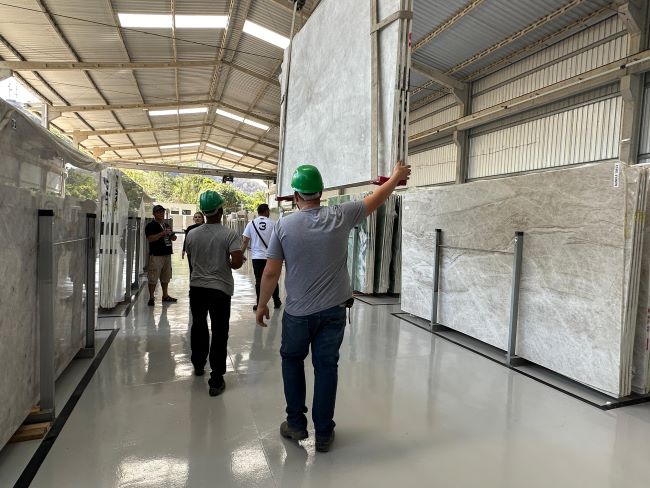
Brazilian natural-stone sector strengthens its international strategy
Since the beginning of the investigations conducted by the U.S. government, Centrorochas has established a permanent task force to monitor developments in U.S. trade policy.
“Our work combines specialized consulting support in Washington, ongoing dialogue with U.S. institutional and business partners, and continuous monitoring of decisions issued by the authorities responsible for implementing these measures,” said Fábio Cruz, Vice President of the Brazilian Natural Stone Association. “This approach has enabled the sector to anticipate potential scenarios, interpret complex regulatory developments, and provide Brazilian companies with reliable technical guidance.”
While the new scenario requires close attention, Machado said it does not undermine the fundamental strengths of Brazil’s natural-stone industry.
“The tariff differential is certainly a factor that must be closely monitored, especially in a market as strategic to us as the United States,” he said. “However, one important advantage remains: purchasing decisions are not based solely on tariffs. Buyers also value attributes such as the uniqueness of our materials, product quality, reliable supply, and consistent availability. Those are competitive advantages that Brazil continues to offer.”
Along the same lines, Cruz stressed that the issue extends beyond tariffs and highlights the growing influence of geopolitics on international trade.
“The Brazilian natural-stone industry is increasingly operating in a global environment where geopolitical factors directly influence business. Producing a high-quality product is no longer enough,” he explained. “We must understand international developments, maintain ongoing engagement with our key markets, and strengthen our institutional presence to protect the competitiveness of Brazilian companies.”
Current tariff status of the Brazilian natural-stone sector
Quartzite
Quartzite products were not included in the additional 25% tariff, which took effect on July 22 under the U.S. investigation specifically targeting Brazil. Under the new forced labor-related measure, however, they are now subject to an additional 12.5% tariff.
Granite, marble, slate, and other non-metallic minerals
These products remain subject to the 25% additional tariff enacted on July 22. They are also covered by the new 12.5% tariff, although the manner in which the two measures will be applied together is still awaiting implementation guidance from CBP. If both measures are ultimately applied cumulatively, the combined additional tariff could reach 37.5%.
About Centrorochas
The Brazilian Natural Stone Association (Centrorochas) addresses all national demands to enhance the competitiveness of the ornamental stone sector. The entity provides direct support in processes related to the presence of Brazilian businesses abroad, combining commercial and operational activities to drive the development and growth of Brazilian companies.