

Federal OSHA’s Crystalline Silica National Emphasis Program (NEP) is driving rigorous enforcement across the trades. For tile contractors operating on active jobsites, managing respirable crystalline silica is no longer an afterthought—it is a frontline operational requirement.
When your crews are cutting, grinding, or scoring porcelain, ceramic, or stone tile, they generate microscopic respirable dust. In addition to the health threat your crews face from the physical dust, your operation also must grapple with a serious threat from the administrative execution gap: the disconnect between field reality and your company’s safety documentation.
Failing to bridge this gap exposes your business to avoidable compliance penalties. Inspectors are looking for strict adherence to the standard. Here is the tactical blueprint to align your operations with OSHA requirements and protect your tile contracting business.
The administrative blind spots on the jobsite
When an OSHA compliance officer reviews your operations, they evaluate your exposure controls against the Permissible Exposure Limit (PEL) of 50 micrograms per cubic meter of air (50 µg/m³) and an Action Level (AL) of 25 µg/m³.
For tile contractors, safety failures often stem from generic paperwork that does not reflect actual field conditions. Key administrative requirements include:
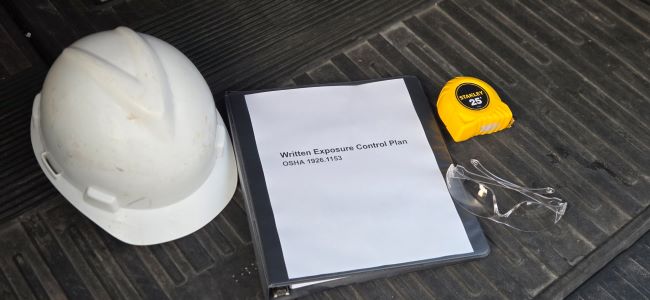
- Accurate written exposure control plans (WECPs): OSHA requires a written plan that accurately addresses your company’s specific tasks and engineering controls. While it does not require drafting a completely new plan for every single project, your documentation must accurately reflect the specific tasks and equipment your crews use on active jobsites.
- Designated competent person: You must designate a competent person on-site who is capable of identifying existing and foreseeable silica hazards and has the authorization to take prompt corrective measures.
- Proper housekeeping: Housekeeping practices must be managed carefully. Dry sweeping or compressed air is prohibited unless feasible alternatives are not possible, and practices must be structured to prevent contributing to employee silica exposure.
Controlling exposure: OSHA’s Table 1 and assessment realities
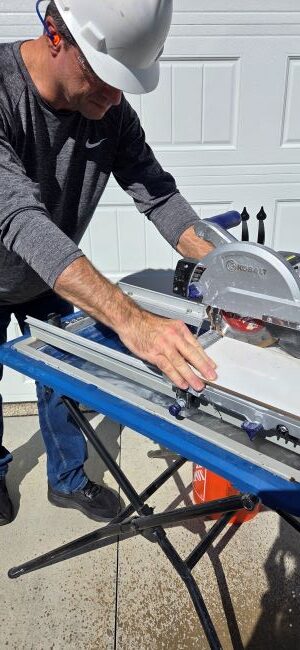
Your primary defense on the jobsite is compliance with OSHA’s Table 1 (29 CFR 1926.1153), which matches specific tools—such as tile saws and grinders—with required engineering controls, such as integrated water delivery systems or shroud-enclosed vacuums.
- Table 1 adherence: If you are fully and properly implementing Table 1, you are not required to conduct independent baseline air monitoring.
- Alternative exposure assessments: If you deviate from Table 1 controls, OSHA requires you to perform an exposure assessment to evaluate employee exposure levels using objective data or air monitoring. While utilizing an independent third-party industrial hygienist is an elite best practice for litigation defense and liability reduction, OSHA’s baseline standard allows employers flexibility in how those assessments are conducted.
Managing the medical surveillance trigger
A heavily-scrutinized area during silica audits is medical surveillance. This is a rigid requirement tied directly to respirator usage in the field.
- The 30-day trigger: If an employee is required by the standard to wear a respirator for 30 or more days out of a rolling 365-day calendar year, they must be enrolled in a medical surveillance program.
- The baseline examination: When the 30-day threshold is met, the employer must provide a medical examination—including a chest X-ray interpreted by a NIOSH-certified B-reader and pulmonary function tests—within the timelines mandated by the standard.
Understanding the regulatory landscape
It is vital to view the current NEP in its proper historical context. OSHA originally issued a Crystalline Silica NEP back in 2008, which was subsequently cancelled in 2017 following the adoption of the updated 2016 silica standards.
The current Respirable Crystalline Silica NEP was issued in 2020. It establishes inspection procedures for enforcing the existing 2016 standards rather than creating new employer mandates. Knowing this history helps contractors understand that enforcement is focused on executing established rules, not moving goalposts.
The executive verdict
Compliance is not about paperwork theater; it is about protecting the health of your workforce and saving your business from catastrophic fines. By maintaining an accurate WECP, strictly utilizing task-specific engineering controls like HEPA-equipped vacuums or water feeds where required, and tracking respirator days, you turn your safety program into an operational shield.

Neil Schmitz
Neil Schmitz is a 33-year stone and hard-surface industry veteran, CEO, and Independent Safety Director of Midwest Industrial Resource Group (MIRG). Operating strictly as a fully mobile consultant, he specializes in stone fabrication compliance and Expert Witness Services, protecting fabrication shops and tile contractors from regulatory penalties through exact, mechanical risk mitigation. To bulletproof your operation, call or text him directly at 612-290-8769 or email [email protected].








 is driving rigorous enforcement across the trades. For tile contractors operating on active jobsites, managing respirable crystalline silica is no longer an afterthought—it is a frontline operational requirement. Safety expert Neil Schmitz breaks down what you need to know.)