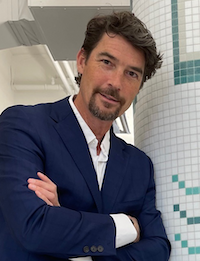
Artaic, a Boston-based designer and manufacturer, is revolutionizing the commercial mosaic industry by blending human artistry with advanced robotic technology. “We are an art company, and tile is our medium,” stated Founder and CEO Ted Acworth.
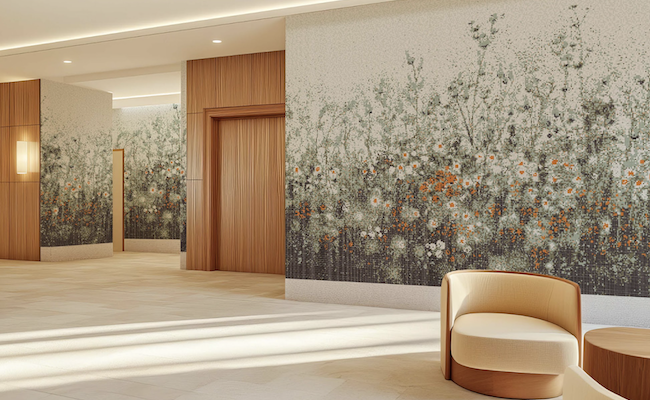
Acworth’s unique background in precision engineering, coupled with his deep love for art and mosaics, fueled the creation of Artaic. The company’s mission is to expand access to mosaic art by using technology to transform drawings, paintings, photographs, and other imagery into stunning, durable tile creations. These mosaics are crafted from materials like vitreous glass, sintered glass, glazed porcelain tile, and stone.
Some might assume that robots diminish the artistic soul of mosaic creation. Early on, Acworth even faced rejection from a national mosaics convention, accused of “destroying the art form” with robotics. However, this couldn’t be further from the truth. “Our craftspeople make the mosaics, not the robots,” Acworth clarifies. He sees robots as simply “larger scale tools for creatives” that ultimately lead to a wider appreciation of mosaic art. Robots handle the “grunt work,” allowing human artistry to flourish. In fact, 70-80% of Artaic’s projects originate from custom artwork, while the remaining 20-30% stem from patterns within their 12 customizable Mosaic Design Collections.
The early days
Acworth was inspired by seeing his mother, a commercial artist, create vibrant murals. Later, backpacking through Europe, the physical and enduring nature of ancient Italian mosaics captivated him. This artistic passion, combined with his precision engineering background from MIT and Stanford – where he specialized in mechanical systems design, optics, digital imagery processing, and robotics for NASA’s space telescope program – formed the perfect foundation for Artaic. The convergence of engineering, commercial art, and his love for mosaics formed the “three-legged stool” that became Artaic.
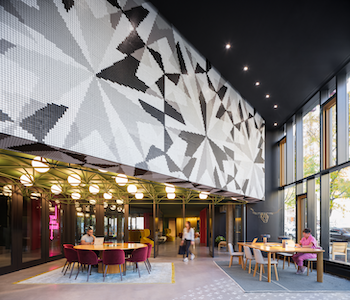
Evolution of location and innovation
In Artaic’s early days, Acworth personally hauled tiles in and out of a Saugus, Mass., warehouse. In 2007, he and his wife Martha, Artaic’s President, moved the company into the prestigious Boston Design Center within the Seaport District’s Innovation Design Building. This period was crucial for business plan development and product refinement. However, soaring rents and high parking fees for employees eventually prompted a move.
In 2020, amidst the COVID-19 pandemic, Artaic found its ideal new home in the historic Biscuit Building on the iconic Schrafft’s Campus in Charlestown. This waterfront location offered perfect light for design and manufacturing, essential loading docks, a basement warehouse, a short walk to downtown Boston and convenient access to public transportation and Logan Airport.
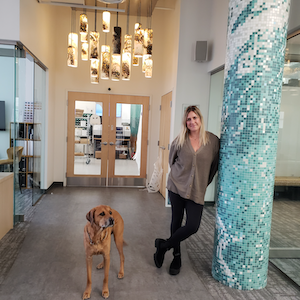
Making mosaics accessible: the Artaic advantage
Ted Acworth’s core belief that technology could bring mosaics into easy reach of more people has materialized in several key areas:
- Design flexibility: Artaic’s proprietary Tylist™ software empowers designers to translate virtually any image into a mosaic. Acworth once demonstrated this at a pivotal meeting with Robert A.M. Stern Architects LLP by generating a mosaic portrait from a Google image of the founder in minutes, showcasing the software’s speed and capability. Today, mosaic renderings can be produced in as little as a day.
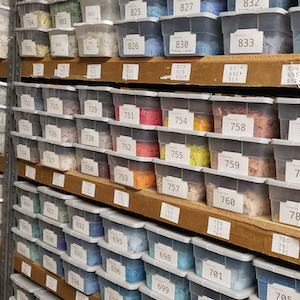
- Accelerated lead times: Traditional mosaic creation can take months. Artaic’s “Print-to-Fit” technology and robotic assembly drastically reduce production time and cost. Each mosaic is precisely produced to the exact dimensions of its intended surface, minimizing material waste. The On-Demand palette of 52 locally-inventoried vitreous glass colors allows for 4-6 week production turnarounds for custom projects.
- Enhanced value and price: By optimizing the entire design and fabrication process, Artaic delivers high-quality, custom mosaics at a more competitive price, making this art form accessible to a broader audience.
- Technical Performance: Artaic offers a range of materials suitable for various applications, from indoor installations to rigorous outdoor environments.
Materials and Production
Artaic works with a diverse array of materials, chosen for their unique properties and aesthetic appeal:
- Vitreous Glass: Including specialized Italian glass from the Modena region.
- Sintered Glass: Made from 100% post-consumer windshields, this durable, zero-VOC material is ideal for high-traffic commercial floors and pools. It recently saw a 40% price reduction thanks to a partnership with a Turkish supplier.
- Glazed Porcelain: Offered in various sizes including 1″ x 1″ to 4″ x 4″.
- Stone: This is often sourced from pre-consumer waste globally.
Artaic also utilizes domestic options and absorbs the impact of tariffs, understanding that raw material cost is only a fraction of the overall value provided through design, rendering, sampling, and kitting.
Collaboration between robots and humans
At the heart of Artaic’s production is the synergistic blend of robotics and human artistry. The Artemis robot, introduced in 2018, is five times faster than the original Arty machine. Other robots – including the newest Apollo (online since late last year) – represent the continuous technological evolution.
These robots manage repetitive, high-volume “pick and place” tasks, enabling human craftspeople to focus on intricate aspects of the process. Manual assembly stations, guided by digital blueprints, are used for smaller, quick-turnaround projects or materials requiring human dexterity, like hand-cut waterjet pieces. Acworth likens it to a high-end French clothing atelier: machines handle the bulk, while human artisans add the exquisite, handcrafted details.
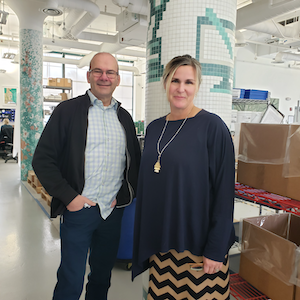
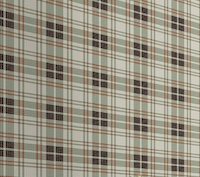
This integrated approach was evident during a facility tour I took last November after Total Solutions Plus, where Martha Acworth provided insights into how artists, design, and production staff collaborate with robotics to create custom works of art.
Client and installer partnerships

Artaic champions a highly collaborative approach, partnering directly with clients, designers, architects, and specifiers as well as with artists on public art programs, building relationships often facilitated through virtual conferencing.
Recognizing the crucial role of installation, Artaic provides installers with comprehensive, ready-made kits (with mounting techniques specific to the needs of the project) complete with detailed guides, diagrams, and palletized layouts. They maintain a network of preferred installers, offering no-charge pre-installation conferences and on-site technical consulting.
Artaic understands that mosaic installation is a specialized skill. They recommend trusted setting materials like LATICRETE, BOSTIK, and MAPEI, encouraging clients to consult manufacturer technical representatives for system recommendations. This allows Artaic to confidently offer a 25-year warranty.
The future of mosaics
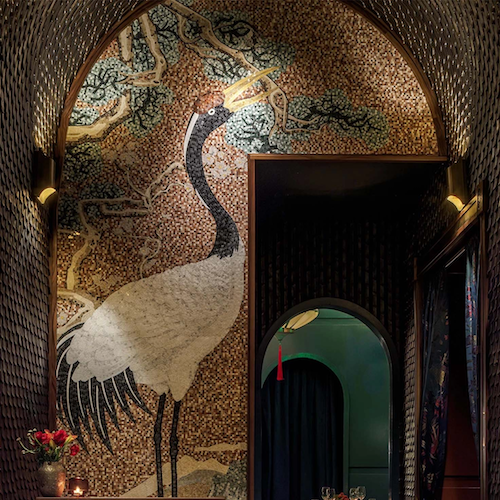
From its humble beginnings to a state-of-the-art facility, Artaic has reshaped the mosaic industry. Ted Acworth’s vision, driven by engineering prowess, artistic passion, and a commitment to accessibility, offers new possibilities for this ancient art form in the modern world. By focusing on human creativity, custom design, rapid production, and collaborative partnerships – all powered by proprietary software and advanced robotics – Artaic has made mosaic art truly attainable for clients at every level. Explore their diverse design collections and custom artwork at artaic.com.

Lesley Goddin has been writing and journaling since her first diary at age 11. Her journey has taken her through a career in publishing and publicity, landing her the editor position of TileLetter and its special publications in 2006. Her goal is to educate, inspire, recognize and encourage those in the tile industry -- especially the tile and stone contractor.