
The 2025 Flooring Sustainability Summit took place at the historic Mayflower Hotel in Washington, D.C., drawing professionals from across the flooring, design, manufacturing, and sustainability sectors. The two-day event provided a platform for technical insight, cross-sector dialogue, and collaboration across the flooring industry’s sustainability value chain. Chaired by Bill Griese, Deputy Executive Director of the Tile Council of North America (TCNA), the summit featured a mix of policy updates, keynote addresses, technical panels, and collaborative workshops designed to generate both clarity and action.
Highlights included a keynote with Peter Templeton of the U.S. Green Building Council and Corey Clayborne, Senior VP of Knowledge and Practice at the American Institute of Architects (AIA). Scott Conwell of IMI moderated a designer-focused panel and Alessandro Filipponi (Confindustria Ceramica) offered a policy overview. The event also included the WFCA’s posthumous Hall of Fame induction of sustainability pioneer Ray Anderson, honoring his lasting legacy in green manufacturing.
Interactive learning in action
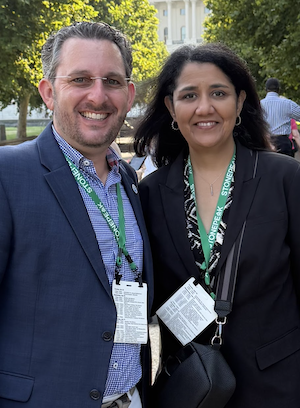
One new addition this year was a “Sustainability 101” session to help attendees get grounded in key terminology and frameworks before diving into more advanced discussions.
As a participant, one of the most engaging parts of the summit for me was the interactive workshop experience. My group selected a scenario focused on the circular economy and were asked to take on the role of a resilient flooring manufacturer. The challenge? Address a once-reliable recycled content stream that had become contaminated and cost-prohibitive. We had to weigh our options including strategic partnerships, alternate sourcing, internal R&D, and discuss how to navigate shifting client expectations, cost pressures, and cross-departmental coordination. The diversity of perspectives at the table led to insightful, real-world strategies. Other groups tackled equally complex topics, choosing from a range of scenarios designed to mimic actual business and sustainability dilemmas, crafted to spark cross-sector dialogue and problem-solving.
Industry voices on the contractor’s role
In a post-summit interview, Bill Griese underscored the vital but often overlooked role of the flooring contractor in sustainability conversations. “A major takeaway from this year’s summit was the need for better communication across the entire value chain – including manufacturers, designers, specifiers, owners, dealers, distributors, and contractors – to ensure that sustainability goals are truly met,” Griese said. “Too often, the flooring contractor is left out of the dialogue, despite being the one who brings the project to life and the one interacting directly with both suppliers and general contractors. Meanwhile, distributors and dealers connect with manufacturers, and general contractors engage with specifiers, designers, and owners. With better coordination, the flooring contractor can be in a unique position to help bridge the entire value chain, as they have real influence over which products are used and how they’re installed.
“They also often serve as the key link between the vision established by designers and owners and the product knowledge held by manufacturers,” he added. “Their perspective is essential to closing the loop and preventing disconnects that can lead to unsustainable outcomes. We’re hopeful that future efforts, like a dedicated summit-derived task force, will help formalize these connections and give contractors a stronger, more consistent voice in sustainability conversations.”
William Paddock, CEO and Managing Director of WAP Sustainability Consulting, said installers play a critical and “often underrepresented” role in the sustainability process.
“Their hands-on experience gives them unique insight into which materials perform best over time, generate the least waste, and are easiest to install with minimal environmental impact,” Paddock said. “Installers are also on the front lines of jobsite practices – decisions around adhesives, grouts, waste sorting, and water use often come down to the installer. By promoting low-VOC materials, efficient cutting techniques, and proper installation to maximize product life, tile installers directly influence the carbon footprint and longevity of flooring systems.”
Paddock added that to better represent installer voices at events like the Flooring Sustainability Summit, these aspects should be discussed with seasoned installers participating in panels. “Their lived experience or preferences in material selection can ground sustainability conversations in practical application, bridging the gap between product innovation and real-world performance,” he said. “Including installer perspectives also signals to the industry that sustainability is not just about product specifications – it’s also about how those products are applied, maintained, and valued over time [which] can get lost in the discussion.”
Ron Nash, President and COO of LATICRETE, also spoke to me about tile installation contractors and their role in the future of sustainable building. “Sustainability isn’t just an issue for manufacturers or architects, it’s a practical, on-the-ground opportunity for tile contractors to lead,” Nash said. “Whether you’re working on a commercial build with a firm like Gensler or guiding a homeowner on material choices, installers are uniquely positioned to make decisions that reduce waste and increase the life of the project. That’s real environmental impact.”
Nash pointed out that the growing complexity of eco-labels, over 450 in circulation, makes clarity and partnership essential. “The industry is backing Green Squared® to simplify the path forward, but it’s still confusing. That’s why contractors should align with manufacturers who are not just talking about sustainability, but actually building tools and systems to support it.”
He emphasized that it’s not just LATICRETE making progress: “We sat down with competitors at the Sustainability Summit who are also using recycled materials, streamlining logistics, and reducing landfill waste. This is a shared effort across the tile industry.”
Nash believes that tile contractors should not only implement sustainable practices but use them as a competitive edge. “Reducing waste isn’t just green, it’s gold. It cuts costs, improves efficiency, and strengthens your pitch. When you tell a client, ‘This is the last shower you’ll ever need,’ you’re selling durability and responsibility at the same time.”
He referenced a message from his childhood. “With all the eco-label chaos, it’s time we took a feather from Woodsy the Owl. His message still holds up: Give a hoot, don’t pollute. Let’s keep it simple, honest, and focused on what tile does best, lasting a lifetime, and then some.”
Looking ahead
As the flooring industry continues to align around shared sustainability goals, the summit reinforced a key takeaway: success will require better integration of all voices, from manufacturers and designers to contractors and end users. For more coverage of the event visit tileletter.com.

Elena Grant
Elena Grant is the Assistant Executive Director of Marketing, Communications and Public Relations for the National Tile Contractors Association and Publisher of its publication TileLetter. Grant has over 20 years of experience leading marketing initiatives, programs, and operational enhancement strategies. As Publisher of TileLetter, she oversees all print and digital communications for the publication.