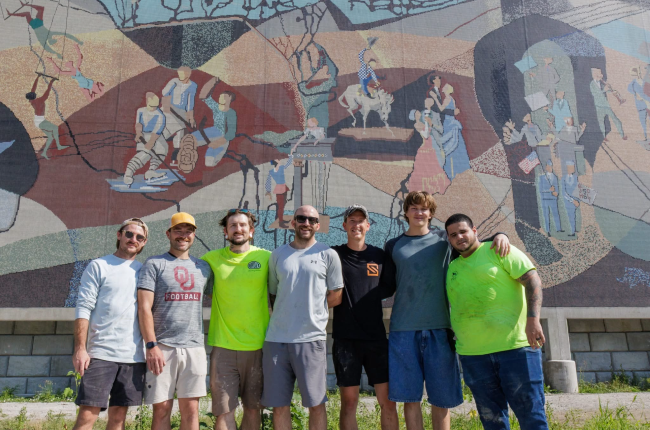
This month’s Artisan story is an epic tale—dare I say odyssey?—of a monumental mosaic mural restoration in Lincoln, Neb.
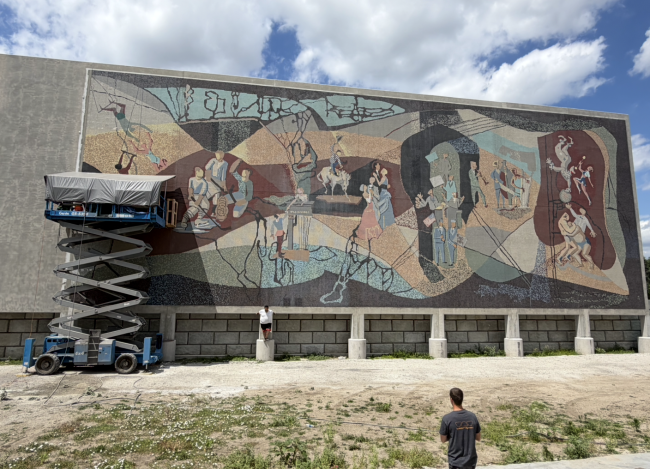
In 1955, Omaha artist Leonard Thiessen, together with Bill J. Hammon, designed and installed a mural on the Pershing Center Auditorium in Lincoln. The venue was the site of concerts, sporting events, graduations, theater events, and more over the years, and the mural depicted an array of those special moments. When the Pinnacle Bank Arena replaced the auditorium, the building was slated for demolition.
But there was great love for the mural. The Pershing Mural Reinstallation Board was formed to preserve it, headed by Liz Shea-McCoy, a mover and shaker in the arts in Nebraska and a fundraising wizard.
The first step was to remove all the tile. This effort was funded purely from public donations. Contractor Michael McCollough joined the board, and his company removed the tiles, taping the front surface of the tile in 1-sq.-ft. sections and chipping it off the wall with a hammer drill equipped with a spade bit. These sections were transferred to 4’ x 8’ sheets of plywood for storage.
The next phase was cleaning the adhesive off the back of the tiles and preserving them. Women to the rescue! Angie Hernandez and Elizabeth Meza, the wives of two of McCollough’s concrete workers, spent two years mechanically removing grout and adhesive off the tiles with nippers and a bench grinder outfitted with a stone wheel—while keeping the tile’s cherished layout intact.
A local warehouse owner, Steve Meyer, donated 10,000 sq. ft. of warehouse space to house the mural.
Enter Superboy Construction
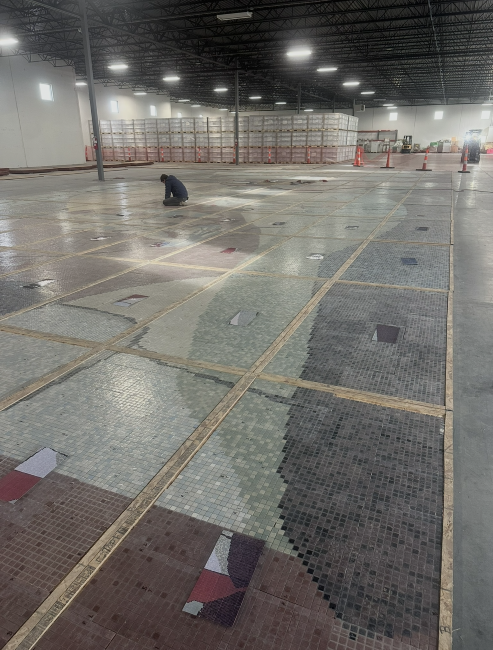
Meanwhile, the search for an installer to commit to the project rolled on. The project needed someone willing to accept the risk and have a large enough crew to complete the work relatively quickly.
Around August 2025, McCollough reached out to Luke Holle, owner of Superboy Construction in Lincoln. Though Superboy almost exclusively did tile work for big high-end homes and commercial projects, Holle had never tackled anything like this before.
“But I have a strong crew, with between four and seven subs available; some talented installers and great helpers,” Holle said. “We were young and had energy and ambition,” he added. He believed if his crew could arrange the project into a form they were used to, installation wouldn’t be that complicated.
Innovation to desheet and resheet the tiles
The first breakthrough came when Holle realized that all the tiles needed to be desheeted since they couldn’t get the mural pieces to run square. So, six workers started peeling tiles off the existing sheets, one by one. “We didn’t even do a single board in a day,” he said.
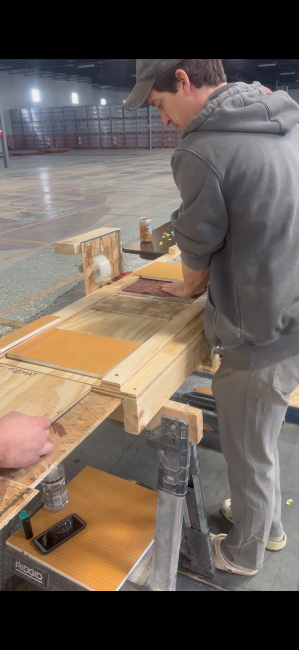
Holle and his cousin Dan then developed a table system with a “track as wide as a sheet and a hand crank that would roll the existing plastic up, pull sheets of tile through, and spit out free-floating tile at the end of the machine.” This innovation allowed them to desheet the entire mural in less than four weeks—leaving 800,000 sq. ft. of free-floating individual 1” x 1” tile lying on the warehouse floor on 4’ x 8’ pieces of plywood.
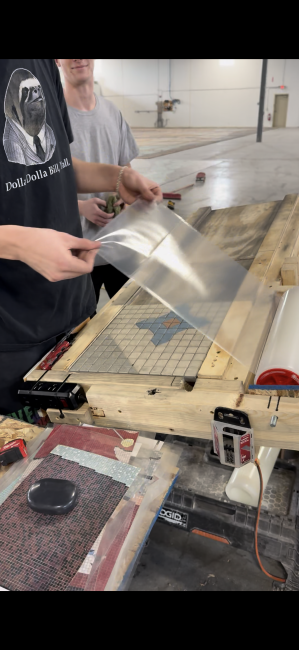
Then came the resheeting process. Using a method that Hernandez and Meza developed, the crew created more precise fixtures milled of aluminum that would fit 144 tiles in a square to create installable sheets. These were remilled several times to account for slight discrepancies in tile sizes.
This new machine allowed workers to scoop 144 tiles, drop them into the fixture, and affix them into sheets with LDPE Mosaic Tile Tape. This efficient process enabled the entire mural to be resheeted in about a month, and cut into 4’ x 8’ sections.
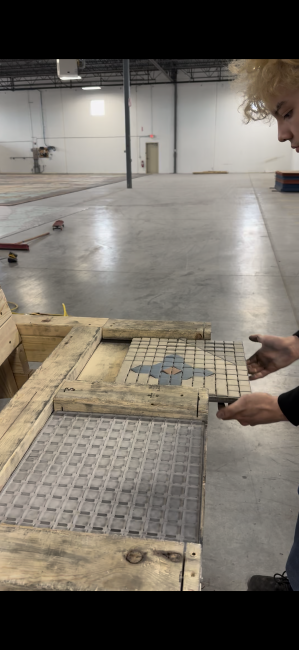
The original tile used for the border included almost every color in the mural, Holle said. The decision was made to shrink the border slightly, both to better fit the new concrete wall where the mural would be installed and to fill in missing tiles needed to maintain the integrity of the design. This original tile was a mix of porcelain and ceramic tile from Nebraska-based Cambridge Tile, which eventually moved to Cincinnati but is now defunct. Thanks to the decision to shrink the border ever so slightly, only about 2% of tile needed to be replaced with a mixture of tile sourced from Maven Tile and Stone LLC in Lincoln.
The crew took the taped sheets off the plywood and laid them out on the floor to see how the mural would fit together and how big it would be. They determined the center of the mural, then labeled the tile with a letter and number system in 14’ to 15’ sections, bottom to top, to accommodate the 16’ width of the lift. The process was: label, move the lift, repeat.
The top sheet of each stack of tile was labeled, and care was taken that all stacks were facing the same direction. Every nine courses went into a shipping box and then were loaded on a trailer to transport to the site and start the installation.
The installation
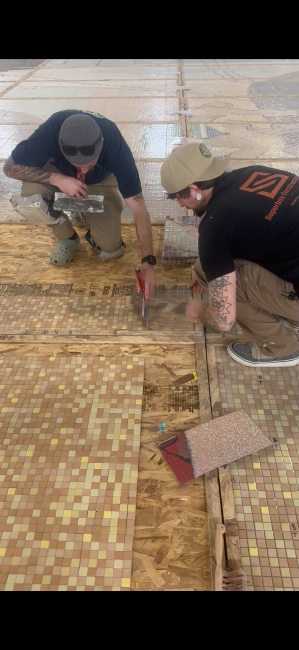
In April 2026, the crew commenced installing the 38’ x 140’ mural on a south-facing concrete wall at Wayuka Park, a section of the state cemetery that was being developed as a festival space for the arts, complete with stage and landscaping.
The restored mural would be slightly smaller than the original due to the streamlined border and tightened grout joints. The crew used a massive scissor lift provided by McCullough, which was adapted with a railing so the crew could work between the railing and the wall. The crew screwed a laser mount into the concrete wall every three courses, which allowed the crew to level to the top of the third course by pulling the laser mount off and adhering to the next sheet where the laser had been.
Eventually, the crew found it cooler to work at night, and chose nightwork for four courses. This also helped them more easily manipulate the fast-setting materials.
One curious problem the crew noted was that joints tended to grow or shrink during installation. It was discovered that the 50’ wall was slightly convex. Staying horizontally level was easier, but finding the vertical level was trickier. But the crew made it work, and the mural came together beautifully.
In the midst of the installation, the warehouse flooded, and an 8’ section to the left of the mural got wet. This affected the adhesion of the tape, and in an effort to keep it together, the crew baked the tape on with a heat gun. “We handled it like a bomb,” Holle said. “We prayed when we handled [the sections].”
Jake Swoboda, ARDEX’s Midwest Technical Rep, was a huge help to Superboy Construction. The crew used all ARDEX products for the project: ARDEX 8+9™ Rapid Waterproofing and Crack Isolation Compound; ARDEX X90 OUTDOOR™ MicroteC3 Rapid-Set, Flexible Tile and Stone Mortar; and ARDEX FL™ Rapid Set, Flexible, Sanded Grout.
The Superboy workers who recreated the mural in its new home included: Luke Holle, Dan Holle, Hunter Cole, Ethan Radenslaben, Tyler Vanderslice, Bentley Johnson, Bryan Bernard, and Eli Bryan.
The local media was on hand on July 17 when Luke Holle set the last section of the mural. It was a giant celebration with families attending the event and the community enjoying a beloved mural that had been given new life.

Lesley Goddin has been writing and journaling since her first diary at age 11. Her journey has taken her through a career in publishing and publicity, landing her the editor position of TileLetter and its special publications in 2006. Her goal is to educate, inspire, recognize and encourage those in the tile industry -- especially the tile and stone contractor.