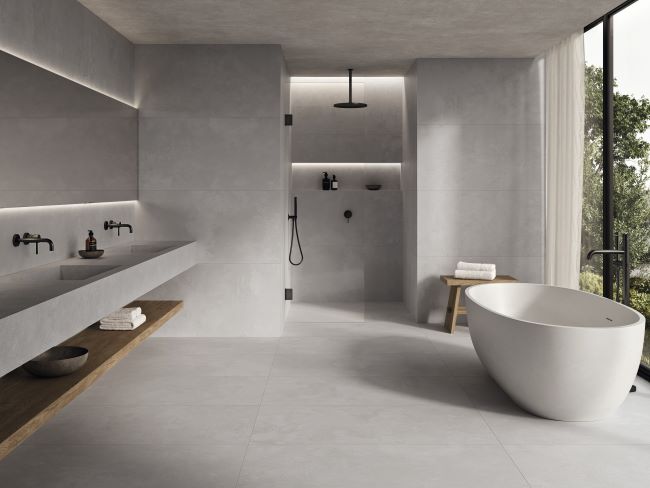
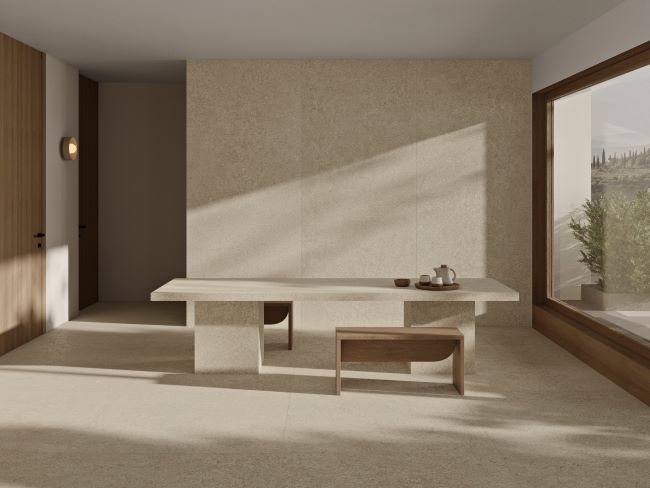
Argenta presents Vecta, a ceramic surface system that extends a single material concept from floors to wallcoverings, integrated furniture, and outdoor spaces. Unveiled at Cersaie 2026, it brings together modular tile sizes and coordinated slabs, allowing the layout to be adapted to each scale while maintaining consistency in the project’s patterns and colors.
Vecta starts with a 120cmx120cm (roughly 47”x47”) production module with a nominal thickness of 8 mm. This produces six modular sizes: 120cmx120cm, 60cmx120cm (roughly 23.6”x47”), 60cmx60cm and 30cmx60cm (roughly 11.8”x23.6”), with 30cmx120cm (roughly 12”x47”) and 15cmx120cm (roughly 6”x47”) also available to order. The tiles share a dimensional grid and are designed to be combined with a 2mm joint. This precision makes it possible to plan the tile layout and consider junctions between sizes from the outset of the project.
The system is complemented by 120cmx280cm (roughly 47”x110”) slabs, 6 mm thick, coordinated with the collections. These can clad large wall surfaces and extend the use of ceramics to furniture fronts, counters, and other architectural volumes.
Five collections develop the system’s aesthetic possibilities. Essenza draws on clays and aggregates; Forum reinterprets terrazzo through small mineral fragments; Trace explores the look of cement and includes a large-format relief option; Luma evokes Campaspero stone; and Roma offers an Italian-inspired terrazzo. Luma and Roma share coordinated color palettes, allowing the two material expressions to be combined.
In a hotel, Vecta can connect the sequence of spaces from the entrance to the guest rooms. In the lobby, large floor tiles establish the character of the scheme. At reception, a large wall surface and the counter front pick up the same collection. The tile layout adapts to the rhythm of the corridors, while in the guest rooms, wallcoverings or integrated furniture can echo its palette at a more intimate scale. In this way, the material accompanies the transition from public to private spaces while respecting the function of each.
In a home arranged around a courtyard, Vecta can establish a color connection between the floors of the living areas and the terrace through the 60cmx120cm ‘Out’ version. Indoors, Luma and Roma allow stone and terrazzo effects to be used according to the light and character of each room. The project thus maintains a recognizable composition from the living room to the courtyard, with variations that respond to each space.
A showroom presents a different challenge. The display may change over time, while the architecture needs to retain a recognizable order. The modular floor layout can establish a grid for circulation; large wall surfaces can provide a backdrop for the pieces on display; and a clad volume can bring together reception and consultation functions. Vecta allows these elements to form part of a coherent spatial structure that can accommodate different exhibition layouts.
Vecta also reflects an approach to responsible engineering: the shared base module and optimized thickness aim to promote efficient use of materials and resources. This technical foundation translates into the freedom to choose sizes, adjust layouts, and resolve junctions precisely to suit each space.
About Argenta
Argenta is a Spanish company specializing in the design, manufacture and marketing of ceramic solutions for architecture and interior design. With six production centers and 100% of its manufacturing based in the province of Castellón, the company has established a strong international presence through its commitment to innovation, design, and quality. Part of Grupo Argenta, it develops collections for residential, commercial, and hospitality projects, combining industrial capacity, advanced technology, and a firm commitment to people and the environment.