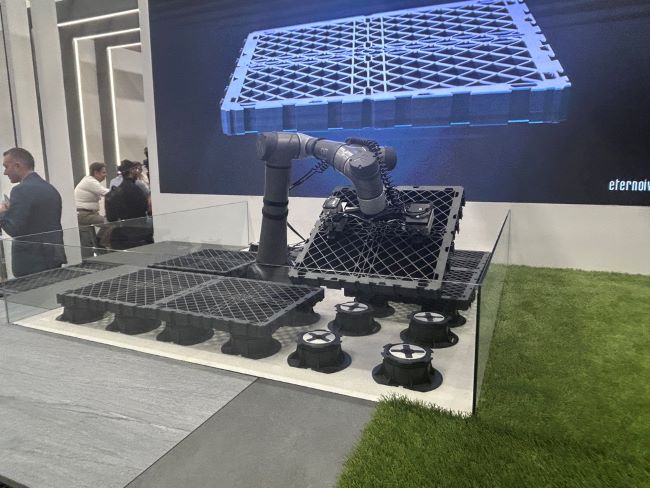
The tile industry has always advanced through innovation. We have seen major changes in setting materials, substrates, waterproofing systems, large-format tile, gauged porcelain panels, uncoupling membranes, leveling systems, digital printing, and installation tools. Each of these advancements has created opportunity, but each has also required education, standards, training, and professional judgment.
That same mindset guides how our industry evaluates robotics. The National Tile Contractors Association (NTCA) doesn’t dismiss new technology simply because it is unfamiliar. At the same time, we have the responsibility to assess new technology with an open mind regarding what it offers the trade. Every tool, method, product, and system must be evaluated against the same standard: does it help produce a successful tile installation?
Why tile contractors may be cautious
For many tile contractors, the idea of a robot installing tile may feel distant, unrealistic, or even threatening. In some ways, that reaction is understandable. Tile contractors are not typically early adopters of emerging technology. Our trade has historically been built on hands-on skill, apprenticeship, experience, and jobsite problem-solving. Most successful contractors have built their companies not by chasing trends, but by delivering work that performs, looks beautiful, and stands the test of time.
That said, robotics are no longer simply a futuristic concept. Around the world, companies are introducing robotic systems designed to move, place, align, mark, or assist with tile and flooring installation. Some are being marketed for large, open commercial floors, airports, train stations, schools, shopping centers, and repetitive-layout conditions. Others are being developed to support layout, lifting, material handling, or other physically demanding tasks.
It’s important for NTCA members to be aware of these developments. Awareness, however, is not the same as acceptance without scrutiny.
Tile installation is a system
The most important point for contractors, manufacturers, architects, general contractors, and owners to understand is this: tile installation is not simply the act of placing tile on a floor or wall. Tile installation is a system. It involves substrate evaluation, movement accommodation, surface preparation, layout judgment, mortar selection, coverage requirements, environmental conditions, expansion joints, waterproofing, transitions, penetrations, lippage management, grout selection, curing, protection, and final use conditions.
A robot may be able to repeat a motion. A qualified tile contractor understands why that motion matters.
Potential benefits
There are certainly potential advantages to robotics. Robots may eventually help with repetitive tasks, material handling, layout transfer, lifting heavy units, or placing tile in large, open areas. They may reduce physical strain on workers, improve consistency in controlled environments, and help contractors address labor shortages.
Robotics may also attract younger generations into the trade. The future workforce has grown with technology. If automation, digital layout, scanning, or robotic assistance helps present tile installation as a modern and technically advanced career, that could benefit the industry. The most successful contractors of the future may not reject technology; they may learn how to use technology while preserving the judgment and craftsmanship that define professional tile work.
Significant concerns
But there are significant concerns.
The technology is still new. Many of the systems being promoted today appear best suited for ideal conditions: open areas, repeatable patterns, consistent substrates, predictable tile sizes, and controlled jobsite environments. That is not how most tile projects unfold.
Every experienced tile contractor knows the truth about the jobsite. Floors are not always flat and walls are not always plumb. Slabs have cracks, curling, contamination, moisture concerns, and movement joints that must be honored. Plans change, layouts conflict with field dimensions, and other trades damage prepared surfaces. Materials arrive with shade variation, warpage, sizing concerns, or handling limitations. Owners make changes, general contractors compress schedules, and weather affects exterior work. Additionally, showers, balconies, pools, commercial kitchens, healthcare environments, and exterior assemblies all carry different performance risks.
A qualified tile contractor adapts to those conditions. A robot does not yet replace that decision-making.
The standard does not change because the tool changes
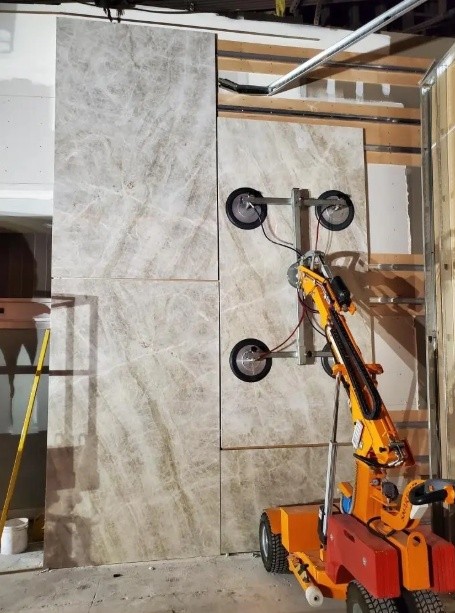
Whether tile is installed by hand, assisted by a machine, or placed with the help of robotics, the expectations do not change. The installation must still comply with industry standards, manufacturer instructions, project specifications, and accepted methods.
Even when a robotic system can place tile accurately, the larger question remains: is the installation being performed in accordance with industry standards? Is the mortar properly selected and keyed into the substrate? Is coverage being achieved? Are wet areas and exteriors receiving the required level of coverage? Are movement joints properly located and carried through the tile assembly? Is substrate preparation adequate? Is the installation being evaluated by someone who understands ANSI standards, TCNA Handbook methods, manufacturer instructions, and project specifications?
Until those questions can be answered consistently, it’s key to robotics view as emerging technology, not as a substitute for qualified labor.
Questions contractors need to ask
Contractors also need to ask practical questions before any robotic system is accepted on a tile project.
- Who verifies that the substrate is ready?
- How does the system confirm mortar coverage?
- How are movement joints identified and protected?
- How does the equipment respond when field dimensions differ from the plans?
- Who documents the installation process?
- Who owns the liability if the installation fails?
- Does the manufacturer recognize the method?
- Has the system been tested under real jobsite conditions, not only in controlled demonstrations?
These are not anti-technology questions; they are professional questions. Contractors ask these same questions about products, methods, employees, subcontractors, and project specifications every day. Robotics must be held to the same level of accountability.
Manufacturer risk and product claims
The tile industry must also be careful about marketing claims. Speed alone is not quality, just as a fast installation that does not meet standards is not progress. A machine that places tile quickly but fails to achieve proper mortar coverage, fails to accommodate movement, or ignores substrate conditions can create failures at scale. In that scenario, the industry does not gain efficiency, it gains claims.
This is especially important for the manufacturing community. If robotic installation expands before the technology is proven and properly integrated with industry standards, manufacturers may face increased product claims that are not truly product related. A tile, mortar, grout, membrane, or setting material could be blamed for failures caused by poor substrate evaluation, improper mortar application, inadequate coverage, lack of movement accommodation, or incorrect installation sequencing. The more automated the process becomes, the easier it may be for some parties to assume the product failed rather than examine whether the installation system was properly executed.
Manufacturers must pay close attention to this development. They may need to clarify written instructions, testing expectations, approved methods, warranty conditions, and the responsibilities of contractors using automated systems. They may also need to determine whether robotic methods are compatible with specific products, tile formats, substrate types, and environmental conditions. As with any new installation method, performance must be demonstrated, documented, and aligned with recognized industry standards.
NTCA and the contractor’s role
For contractors, the message is not to fear robotics. As a trade association, the NTCA is responsible for creating a platform for our members to view new technology and systems that help the tile contractor make sound business decisions based on what is best for their company. Our message is to lead the conversation.
The professional tile contractor is the person most qualified to evaluate whether a robotic tool belongs on a tile project. Contractors understand the difference between a helpful tool and a risky shortcut. They know when the substrate is not ready. They know when the layout must be adjusted. They know when a specification is incomplete or when a job condition will compromise performance. They know that a beautiful tile installation is not created by placing tile alone, but by managing the entire assembly from preparation to protection.
There may come a day when robotics become a meaningful part of tile installation. It may help with layout, lifting, transport, repetitive placement, or documentation. It may become another tool in the contractor’s toolbox. But the industry would be wise to resist the idea that robotics can replace the trained eye, skilled hand, and professional judgment of a qualified tile contractor.
Tile is a finished material, but it is also a performance system. When installed correctly, it can last for generations. That durability is not accidental. It is the result of standards, training, experience, and craftsmanship.
Closing
The future of tile installation may include robotics, automation, scanning, digital layout, and other technologies that we have not yet fully imagined. NTCA cannot ignore that future. It’s up to us to help shape it.
But we must also be clear: technology must serve the standard. It must support qualified labor, not undermine it. It must improve performance, not simply increase speed. It must reduce risk, not create a new wave of failures and product claims.
The professional tile contractor has always been more than an installer. The professional tile contractor is a problem solver, craftsperson, system manager, and protector of the finished installation. Robotics may change some of the tools used on the jobsite, but that does not change the value of trained judgment, proper methods, and pride in craftsmanship.
The future may be more automated, but quality tile installation will still require qualified people leading the work.

Jeremy Sax
Jeremy Sax started his career in the tile industry, back in 1998, as the Director of Domestic Sales for Tamiami Tile in Miami, Florida. An accomplished leader with over 26 years of experience in strategic management, scaling businesses and servant leadership, Jeremy brings a wealth of expertise to NTCA. His previous roles have included significant leadership positions where he demonstrated exceptional skills in organizational growth, strategic planning, and stakeholder engagement ranging from roles within Manufacturing, Distribution and most recently Private Equity.
As Deputy Director, Sax will be instrumental in supporting NTCA’s objectives to enhance industry standards, foster professional growth, and advocate for the tile contracting community. His proven track record in managing complex projects and driving strategic initiatives aligns perfectly with NTCA’s goals of innovation and excellence in the tile industry.
Sax holds a Bachelor’s degree in Business Administration with an emphasis in Organizational Management from St. Louis University. He is known for his strategic vision, dedication to excellence, and his ability to cultivate strong relationships within the industry. Sax’s commitment to advancing professional standards and his deep understanding of market dynamics is invaluable in his role as NTCA Deputy Director.