
A contractor (let’s call her Sara) just landed a new job. Maybe it’s a custom tile shower and kitchen backsplash for a remodel client. Maybe it’s a hotel lobby or a multi-unit residential project. The plans arrive and the clock starts ticking. Now she needs to price it, but the materials aren’t organized. That’s where the real work begins.
The takeoff: where the job is first won—or lost
Sara starts measuring. Whether manual or digital takeoff, the stakes are high. With tile, she wrangles with patterns, grout joints, trims, and transitions, driving quantities and waste. Add stone and the equation shifts to slabs, seams, and yield, where layout efficiency directly impacts cost.
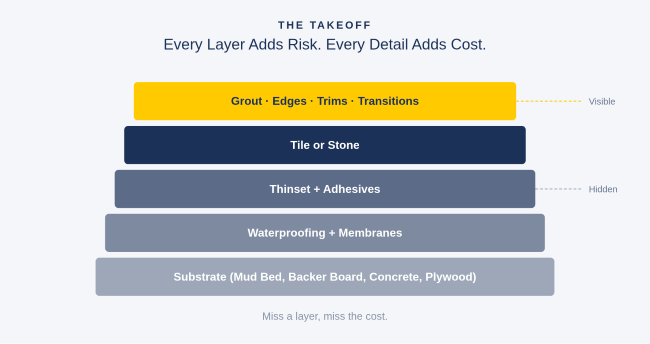
Layout: where waste becomes real
Layout isn’t a finishing step; it’s the job. For tile, layout decisions directly affect material counts. A diagonal pattern can add 15-20% material waste, while large-format tiles in tight spaces increase cuts. These variables don’t live in generic pricing tools.
For stone, seams, vein alignment, and slab optimization are cost drivers, not preferences. Poor layout increases material waste, and mistakes are expensive. Especially in stone countertop fabrication, this planning lives in sketches or separate tools, making optimization difficult before ordering.
The job gets rebuilt, again and again
Then, the quote or bid goes in, and things change. Materials shift, designs change, clients revise. That means reworking layouts, recalculating yield or waste, adjusting quantities, and rebuilding pricing—often in systems not built for iteration. Each revision becomes fragmented, with layouts, quantities, and pricing updated in different places. On complex jobs, this is constant. By the time the job reaches fabrication or installation, multiple versions of the truth exist. Takeoffs, layouts, POs, and drawings don’t fully align.
That’s where rework shows up:
- Ordering extra material
- Re-cutting or re-fabricating
- Delays on replacements
- Last-minute field fixes
Material waste is expensive, and time is even costlier. Mishaps with miscommunication, unclear data, and constant coordination add up.
Where “good enough” systems start costing real money
Most contractors rely on disconnected systems.
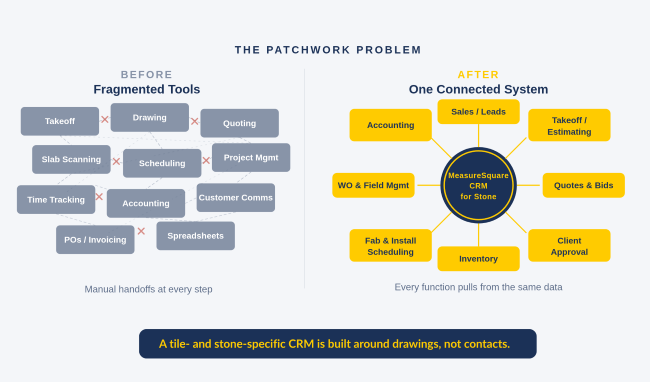
This plays out differently depending on scale. For a solo contractor, it might mean jumping between a tile estimating software tool, a spreadsheet for pricing, and a text thread with the client. At the larger end, it can mean about a dozen separate tools for takeoff, layout, quoting, slab inventory, scheduling, project management, time tracking, and accounting—not to mention spreadsheets, email, and texts.
The details differ, but the core problem is the same: the job has to be rebuilt at every step. Generic CRM (customer relationship management) and ERP (enterprise resource planning) systems fall short. They track contacts and pipelines, not tile layouts, slab optimization, or revision history. They can’t calculate layout-based material waste or connect drawings to quotes and POs.
So after takeoff, the job isn’t done. It’s rebuilt repeatedly, scattered across spreadsheets for pricing, documents for proposals, systems for scheduling and purchasing. Each step introduces errors.
A unified digital thread
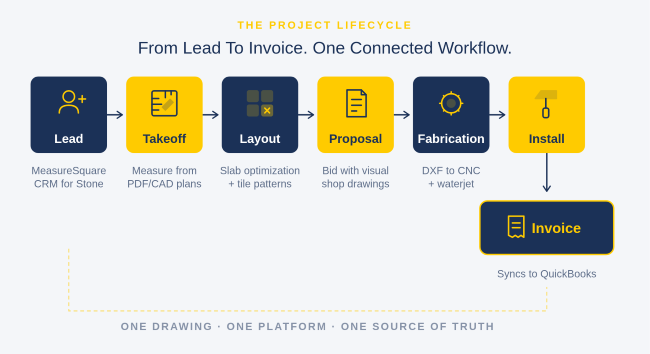
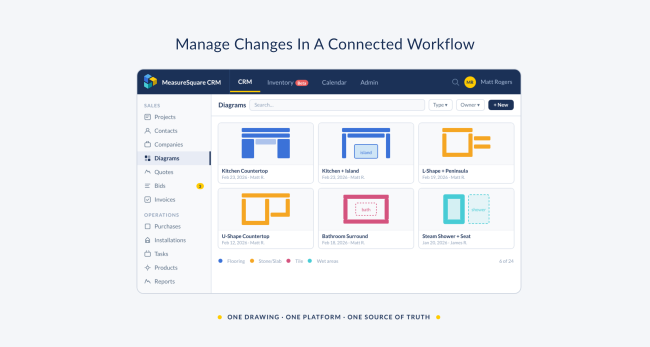
MeasureSquare CRM for Stone is a CRM connected to the drawing, where changes made in one place are automatically reflected elsewhere. The workflow flows seamlessly from lead → digital takeoff → layout → proposal → fabrication or installation → invoice, with nothing needing to be rebuilt.
From measurement to invoice, without starting over
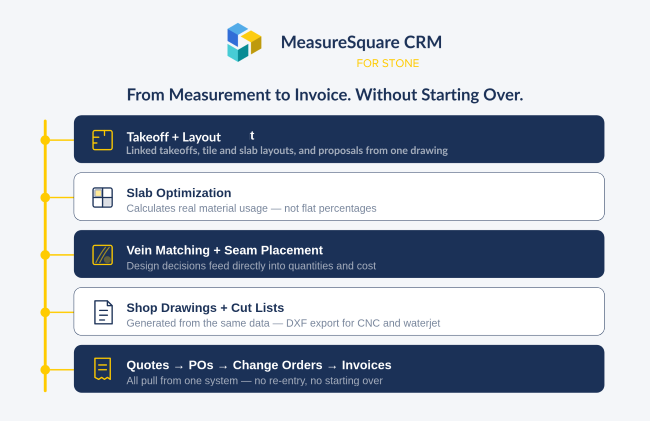
Because MeasureSquare CRM for Stone pulls directly from the drawing, every downstream step stays connected:
- Takeoffs, layouts, and proposals link to a single drawing.
- Material usage comes from real layout data.
- Layout decisions feed quantities and cost.
- Shop drawings and cut lists generate from the same source.
- Quotes, POs, change orders, and invoices stay connected.
For tile installers: same problem, same solution
Tile contractors face the same fragmentation—multiple tools, duplicate entry, and version confusion.
MeasureSquare CRM works with MeasureSquare Stone & Tile, which handles tile-specific digital takeoff and layout: pattern planning, grout optimization, and waste calculation. That data flows directly into the CRM, creating a connected lifecycle from lead to invoice.
Whether it’s a bathroom remodel or a multi-floor project, the system carries job data forward instead of forcing re-entry.
Job changes? A one-and-done update streamlines the process
Changes happen. Materials shift, scope expands, tile becomes unavailable, slabs become discontinued. In disconnected workflows, that means rebuilding the job across multiple, disjointed files.
In a connected workflow, there’s only one place to update. Layout, tile estimating, and quoting stay tied together. Slab usage is calculated within the estimate. Project data feeds directly into scheduling, purchasing, and accounting. No duplicate versions, no manual re-entry, because in a tile- and stone-specific CRM, everything lives in a single, connected file:
- Layout, estimating, and quoting are tied together.
- Slab usage is calculated within the estimate, not after.
- Project data flows directly into scheduling, purchasing, and accounting.
Small shops, large firms: same problem, same opportunity
For smaller or residential contractors, this might mean:
- Faster, more accurate quotes
- Fewer missed details
- Clearer job tracking
For larger or commercial operations, it means:
- Better material allocation across projects
- Stronger coordination between teams
- Reduced over-ordering and shortages
Back to the beginning
Sara, the contractor, is still at her desk. The plans are open, and the deadline looms. Whether pricing tile or stone, the difference isn’t speed; it’s whether she has to start over.
In one workflow, the job is rebuilt repeatedly. In the other, it’s built once and carried forward. Same project, less rework, more control.
To learn more about MeasureSquare CRM for Stone, email Matt Rogers at matt@ measuresquare.com or visit measuresquare.com.

Matt Rogers
Matt Rogers built his expertise in the stone and tile industry as a draftsman, estimator, and project manager, tackling high-rise condos and casinos across Texas, New York, and Boston. Since 2021, he’s helped countless customers find the right Measure Square solutions to work smarter and more efficiently. Based in Pasadena, Calif., Measure Square provides takeoff, estimating, and CRM software for the flooring, stone, and tile industries. MeasureSquare Stone & Tile handles slab optimization, tile layout, pattern planning, and shop drawings, while MeasureSquare CRM for Stone manages the full project lifecycle from lead to invoice in one platform. Visit www.measuresquare.com to learn more.