In today’s tile installations, especially with large- and super-large-format tile, the conversation around substrate flatness continues to be one of the most important—and sometimes most misunderstood—topics on the jobsite. While every trade faces real-world challenges, the success of the finished tile installation often comes down to how well the concrete substrate is prepared from the very beginning.
Preparing the concrete substrate
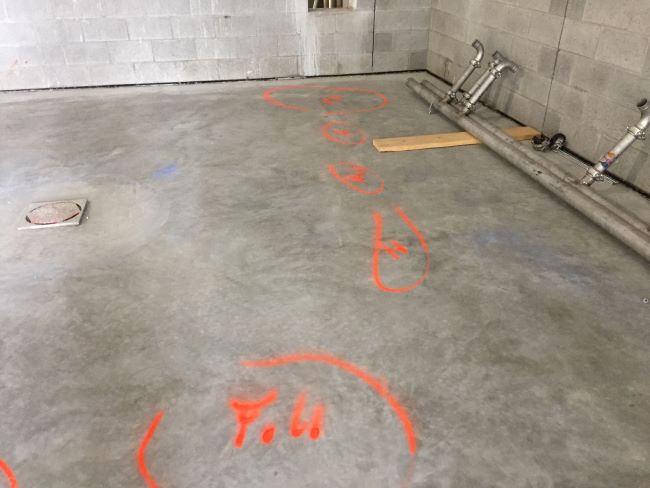
Concrete placement is a complex process, and variables such as mix design, placement conditions, curing, and finishing techniques all influence the final result. However, when flatness measurements such as FF (floor flatness) and FL (floor levelness) are taken no later than 72 hours after placement, and when measurements are not permitted within 2’ of walls or at columns, many tile contractors question whether these practices fully reflect the conditions they ultimately face. From the perspective of the tile installer responsible for delivering a flat finished surface, these measurement limitations can feel disconnected from installation realities.
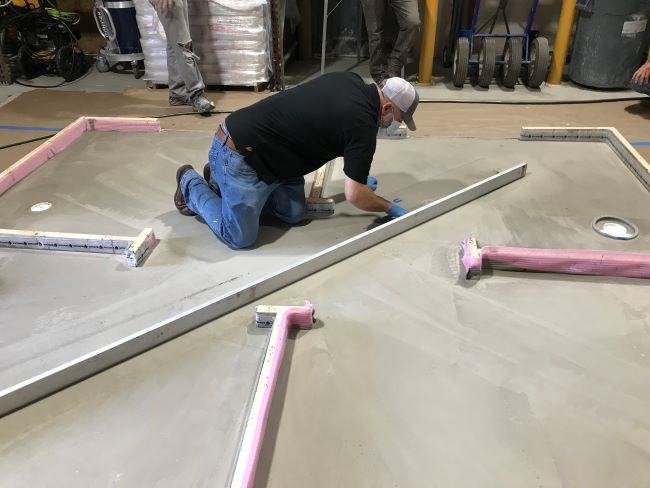
This disconnect is one reason why some concrete contractors are not enthusiastic about the 10’ straightedge method commonly used by tile professionals to evaluate slab flatness, particularly at saw-cut or true cold joints, where variation is often most pronounced. The difference in evaluation methods can create tension between trades, even though both ultimately share the goal of delivering a successful floor system.
Flatness fix? Depressing the slab
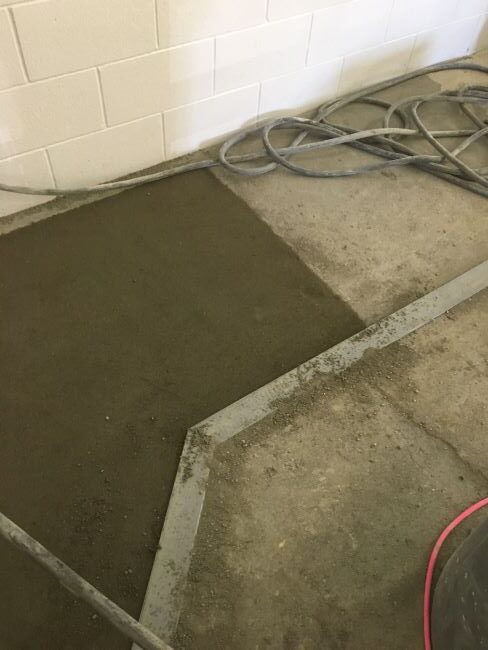
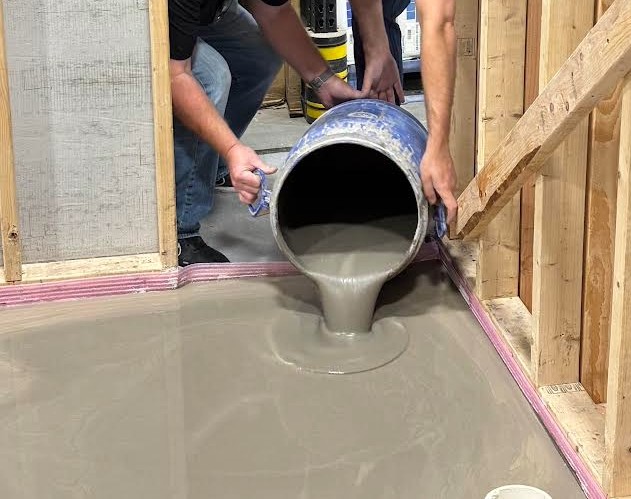
One practical approach that has gained support in industry discussions is the concept of depressing the slab by approximately 2”–2 1/2” and allowing the tile installer to place a mortar bed to create the final flat substrate.
This method can provide several advantages: it gives tile installers greater control over the finished surface, supports the flatness tolerances required for modern tile formats, and helps clarify responsibility for substrate preparation. In some cases, it can also reduce conflicts related to flatness expectations after concrete placement.
The cost of correcting slab irregularities
Cost considerations further reinforce the importance of achieving flatness as early as possible. Correcting slab irregularities after placement can become significantly more expensive as variation increases.
For example, flowable hydraulic cement underlayment or self-leveling materials applied at 1/8” thickness may cover approximately 46–48 sq. ft., while coverage can drop to 23–24 sq. ft. at 1/4” thickness. Greater deviation from the plane may also introduce the need for mechanical grinding to address ridges or transitions, adding both time and expense to the project.
Collaboration and communication equal better outcomes
These realities highlight the need for stronger collaboration among specifiers, architects, designers, concrete contractors, and tile professionals. Clear communication about performance expectations and a shared understanding of how substrate conditions impact installation quality can help prevent costly corrections and jobsite friction.
Industry conversations on this topic are not new. At a concrete contractor’s forum in Michigan attended by tile professionals several years ago, participants discussed the depressed slab approach and recognized its potential benefits as a forward-looking solution. While no single method is appropriate for every project, open dialogue between trades can lead to better specifications and more predictable outcomes.
Ultimately, successful tile installations depend on thoughtful planning, realistic specifications, and mutual respect among project stakeholders. As tile sizes grow and tolerances tighten, the industry has an opportunity to align practices more closely with field conditions, ensuring that quality expectations are met efficiently and consistently.
Ed. note: For more information, visit pages 52, 54, 56, and 57 in the NTCA Reference Manual.

James Woelfel
James Woelfel is the President of Artcraft Granite Marble and Tile in Mesa, Arizona. As a third-generation family business, Artcraft Granite, Marble & Tile Company is an NTCA Five-Star Contractor Member and his company has proudly worked with integrity for more than 85 years in providing quality craftsmanship in tile and stone installation. Woelfel is also Chairman of the NTCA Technical Committee since 2007 and is a voting member of the TCNA Handbook and ANSI A108, 118, and 137.1 Committees. He served as president of the NTCA from 2015-2017, was the 2011 recipient of the NTCA Tile Person of the Year Award and the 2019 recipient of the NTCA Ring of Honor. Woelfel is also an NTCA Recognized Consultant and a highly-rated speaker at industry shows such as Coverings, The International Surface Event (TISE), and Total Solutions Plus.