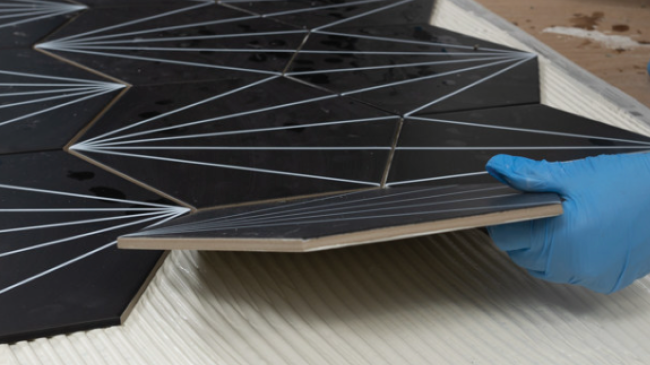
Tile adhesive standards help ensure that adhesives, such as thin-set mortars or mastics, meet minimum performance requirements for reliably bonding tiles to surfaces. These standards test factors such as bond strength, water resistance, open time, slip resistance, flexibility, and more.
There are two main systems:
ANSI Standards (used mainly in the U.S.)
These come from the American National Standards Institute (ANSI), often under the A118 series (e.g., A118.1, A118.4, A118.15). They focus on materials like cement-based mortars, epoxies, and organic adhesives. Testing often uses shear bond strength and sideways stress, which mimic real-world forces like foot traffic or temperature changes.
In simple terms:
- ANSI A118.1: Basic dry-set (cement) mortar—standard performance for normal use.
- ANSI A118.4: Latex-modified (polymer-added) mortar—better flexibility and strength than basic cement ones.
- ANSI A118.15: Improved high-performance modified mortar—even stronger bond, often for demanding jobs (large/heavy tiles, exterior, etc.).
- Letters added (recent updates): E = extended open time, T = nonslip/sag-resistant (good for walls), H = for large/heavy tile, F = fast-setting.
- Higher numbers or “improved” mean stronger, more reliable adhesives for tougher conditions (e.g., wet areas, heavy traffic).
EN Standards (used in Europe and often internationally)
The main one is EN 12004 (aligned with ISO 13007). It classifies adhesives with a code like C2TES1.
The code breaks down like this:
First letter = type of adhesive:
- C = Cementitious (most common; powder mixed with water, like thin-set mortar).
- D = Dispersion (ready-to-use, like mastic/pre-mixed).
- R = Reaction resin (epoxy or similar; very strong and chemical-resistant).
Number = basic performance:
- 1 = Normal/standard.
- 2 = Improved/higher strength (e.g., better bond after water, heat, or freeze-thaw exposure).
Optional letters (extra features):
- T = Reduced slip (doesn’t sag on walls).
- E = Extended open time (stays workable longer, e.g., 30+ minutes).
- F = Fast-setting/early strength.
- S1 = Deformable/flexible (bends ≥2.5 mm; good for substrates that move slightly).
- S2 = Highly deformable (bends ≥5 mm; best for big movement, like wooden floors or exteriors).
Examples:
- C1 = Basic cement adhesive (minimum for simple indoor jobs).
- C2TE = Improved cement, slip-resistant, extended open time (great for walls or larger tiles).
- C2TES1 = High-performance flexible cement adhesive (common for demanding installs like porcelain on floors/walls).
ANSI emphasizes shear strength and real-world stresses, while EN uses tensile pull tests and offers more detailed optional traits, like deformability. Many modern products meet both (or equivalent) requirements for global use.
In simple terms, these labels tell you whether an adhesive is basic (cheap but limited) or premium (stronger, more forgiving, and longer lasting in tough spots). Always match the standard to your project (e.g., use higher-rated products for large tiles, wet areas, or exteriors) to avoid failures such as loose tiles. Check product data sheets for exact compliance!
Tile contractors should treat ANSI (A118 series) and EN 12004 (or ISO 13007) standards as the minimum performance floor—not the full decision tree. These labels guarantee a product meets tested bond strength, flexibility, slip resistance, open time, etc., but contractors should combine them with job-specific assessment, the TCNA Handbook (the U.S. “bible” for installations), manufacturer technical data sheets (TDS), local codes, and experience to avoid failures, callbacks, and liability.
In the U.S., the 2026 TCNA Handbook is the primary tool. It cross-references ANSI standards, provides numbered installation methods (e.g., F111, F122), environmental exposure classes (Res1 dry residential, Res3 wet, Com heavy commercial, etc.), product selection guides, substrate flatness requirements, and coverage rules (80% mortar contact in dry areas; 95%+ in wet/exterior or with natural stone). For internationally sourced or imported products, EN codes help quickly assess performance. Many modern adhesives list both ANSI and EN ratings.
Step-by-step decision process contractors use
- Read the full job specs—tile type/size/weight, substrate, location/exposure, traffic, any membranes/heat/chemicals, timeline, and architect/engineer requirements.
- Consult the TCNA Handbook (or equivalent regional guide) for the recommended installation method and required adhesive performance.
- Check product TDS. Confirm it meets or exceeds the needed ANSI/EN class, is approved for the exact substrate/tile/combination, and note any restrictions (e.g., “use only unmodified ANSI A118.1 over this membrane”).
- Factor in practical site conditions—crew skill, weather, schedule (need fast-set F or extended open time E?), cost vs. warranty value.
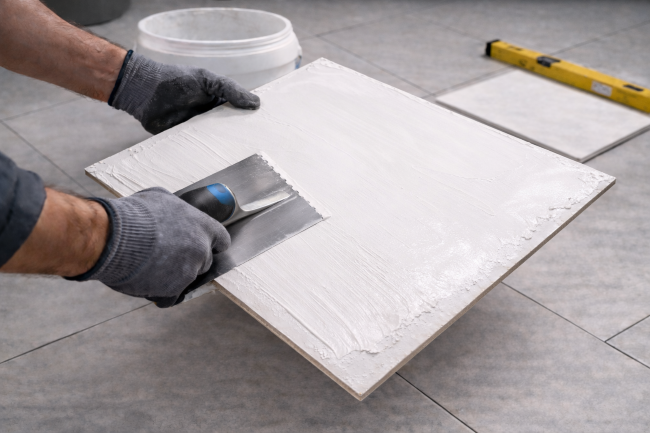
- Verify coverage and workmanship. Per ANSI A108.5 and TCNA Handbook: full notch trowel, back-butter large/heavy tiles, proper movement joints (EJ171).
Key factors that drive ‘what to use where’
Contractors evaluate these from multiple angles:
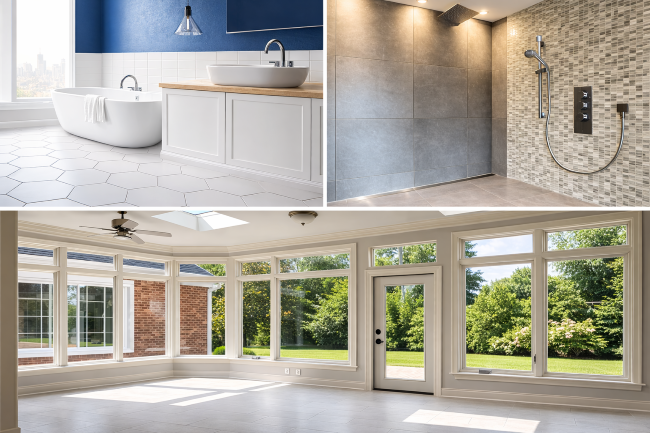
- Tile characteristics: Porcelain (low absorption) needs better adhesion/flexibility than ceramic. Large-format tile (facial dimension greater than 23”) or >5 lbs/sf “LHT” requires improved mortars and back-buttering to prevent voids/lippage. Natural stone or glass may require white, non-staining, or specific chemical treatments.
- Substrate: Rigid concrete/cement board = standard OK. Wood/plywood, old tile, or gypsum = flexible modified (A118.4/15 or C2 S1/S2). Must be flat, clean, and sound (ANSI tolerances).
- Exposure/location:
- Dry interior walls/floors (light traffic): Basic is often enough.
- Wet areas (showers, tubs): Polymer-modified + waterproof membrane (A118.10).
- Exterior/freezing: Improved with freeze-thaw resistance.
- High-traffic commercial: Higher-bond, plus crack isolation if needed (A118.12).
- Radiant heat: At least S1 flexible.
- Chemical exposure (kitchens, pools): Epoxy (A118.3 or R2).
- Other nuances: Wall tiles need non-sag (T). Big jobs need longer open time (E). Fast-track = fast-set (F).
- Budget vs. longevity—cheap, basic adhesive can lead to expensive failures later.
Real-world examples of what contractors choose
Here are common scenarios with recommended minimum standards. (Always check exact product approval.)
- Residential bathroom floor on concrete slab (porcelain, medium size): ANSI A118.4 modified or EN C2TE—good balance of strength, flexibility, and water resistance. TCNA Handbook method F113 or similar.
- Shower walls (ceramic or porcelain): ANSI A118.4 or A118.15 + waterproof membrane, or EN C2TES1. Non-sag (T) critical for vertical.
- Large-format porcelain (24” x 48″ or bigger) on wood subfloor: ANSI A118.15 improved (or with H designation), or EN C2TES2 highly deformable. Often paired with an uncoupling membrane (e.g., Strata_Mat) to handle wood movement. Back-butter and full coverage essential.
- Exterior patio/deck (freeze-thaw cycles): ANSI A118.15 or EN C2 with proven freeze-thaw performance. TCNA exterior methods: consider crack-isolation membrane.
- Commercial kitchen floor (heavy traffic, chemicals): ANSI A118.3 epoxy (chemical-resistant) or high-performance modified, or EN R2T.
- Wall tile over drywall (dry area, small-medium ceramic): ANSI A118.4 or even A136.1 organic mastic (but not for floors/wet). EN C1T or C2T for non-sag.
- Tile over tile (renovation): EN C2S1 (flexible improved)—at minimum—bonds to old surface well.
- Glass tile or translucent stone: White version of ANSI A118.4/.15 to prevent discoloration.
Edge cases & considerations:
- Very large/heavy tiles (>30cm x 60cm or thick stone): Always improved, plus mechanical anchors if vertical; S2 for maximum movement.
- Radiant heat or exterior on wood: Highly deformable S2 or ANSI A118.15 equivalent.
- Spot-bonding (globs on back): Strongly discouraged in U.S. (leads to failures); full trowel only.
- Old or problematic substrates (cracked concrete, deflection > L/360): Add crack isolation or uncoupling membrane regardless of adhesive.
- Fast-track or cold weather: Fast-set F versions.
- Sustainability/green specs: Low-VOC, eco-labeled products that still meet the same performance classes.
How contractors stay current and confident
- Buy the latest TCNA Handbook (~$50–$80), which is updated every year. 2026 is the current publication.
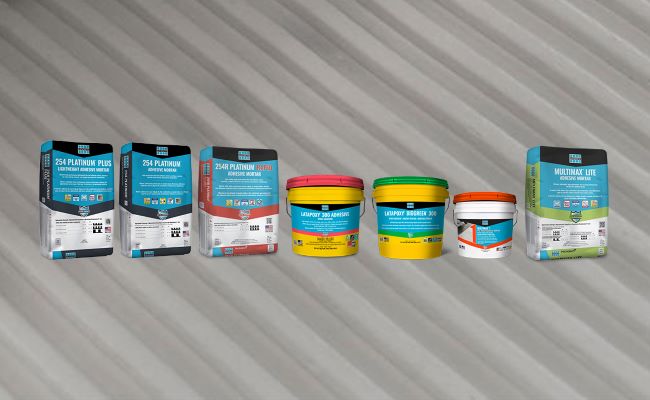
- Manufacturer tools. LATICRETE, for example, offers free selection charts, apps, and webinars that cross-reference its products to standards.
- Training—manufacturer certification classes, National Tile Contractors Association (NTCA) programs.
- Specs & bids. Architects often say, “per TCNA Handbook method X using adhesive meeting ANSI A118.15,” and the contractor picks a compliant product.
- Testing—on critical jobs, pull tests or mock-ups.
- Warranties. Most manufacturers require exact compliance and the proper method for 5–25+ year warranties.
Why this matters in practice
Choosing correctly prevents 90%+ of common failures (loose tiles, cracking, efflorescence, water intrusion). Wrong choice (e.g., basic mastic in a shower or non-flexible on wood) leads to callbacks, lost profit, lawsuits, or insurance issues. Premium adhesives cost more upfront but save time/money in the long term and protect your reputation. In competitive bidding, knowing standards lets you justify higher-quality (and higher-margin) products when specs or conditions demand it.
Bottom line for a contractor: Standards are your safety net and marketing tool (“We use systems compliant to ANSI A118.15”). But real skill is in the assessment—read the job, read the book, read the bag/TDS, then install per the method. When in doubt, call the manufacturer’s tech support or consult ANSI or the TCNA Handbook resources. This approach keeps installations lasting 20–50+ years with minimal issues.

Ron Nash
Ron Nash is an innovative and uplifting leader, currently serving as the President and COO–North America of LATICRETE, a renowned company in the construction industry. With a passion for driving positive change, he has played a pivotal role in shaping LATICRETE's success. Before assuming the role of President in July 2021, Nash demonstrated his exceptional capabilities as the SVP of Sales & Marketing, where he spearheaded sales, product development, and marketing operations. His visionary approach, end-to-end management of all sales activities, and architectural specification support in the North American markets have contributed to the company's continuous growth and adaptability. Within LATICRETE, he has received prestigious accolades, including the Captain Don Peak Award for Exceptional Leadership and the Timothy J. Alper Award for Outstanding Customer Service. His dedication to fostering strong relationships and driving customer satisfaction sets him apart as a true leader in the industry. Nash’s expertise is also valued beyond his company's walls, as he actively serves on industry boards such as the National Tile Contractors Association (NTCA).