
On tile projects, whether large or small, residential or commercial, the tile industry has always been pushed to complete a project faster, better, and less expensively. However, the statement “haste makes waste” is lurking in the background ready to wreak havoc on the finished product.
This is due to some time-saving economies that cut corners. We all know that this is a recipe for failure, but there are recently developed products and practices that can provide shorter schedules without sacrificing quality.
Artificial intelligence
AI is a buzzword to those involved with this new tool—and a fear factor to those who are not. It calls to mind Franklin D. Roosevelt’s famous quote from his 1933 first inaugural address: “The only thing we have to fear is fear itself.” He was urging people to move from the paralysis that gripped the United States during the Great Depression to overcome their fears and do something, get involved.
The same is true with artificial intelligence (AI). The public can sit back and say, “This is scary,” or jump into it and find out what it is and how it could assist in daily activities.
There are software packages available that can manage the daily tasks of creating shop drawings, creating and sending RFIs (requests for information), installation layout and tile cutting schedules, waste reduction, and improved work efficiency. The real beauty of these systems is that the information is filed efficiently and stored in the cloud for easy access by all who are a part of the project.
For instance, when looking at a tile installation, once the measurements are determined, the data is loaded into the AI software, which yields an incredibly detailed plan for the cuts around the perimeter of the room, as well as the cuts around offsets and angles.
One may think that the software will take more time, but actually, it does not. Once measurements for the job are obtained, an installer using the pencil-and-paper method must determine the amount of tile needed, add a waste factor, and figure out the layout with balanced cuts on each side of the room. Using the software method, the entered data along with the project details provides a comprehensive list including the amount of tile required, the waste factor, the cut sizes as well as possibilities to reduce waste by using the leftover tile for smaller cuts.
Handling and cutting tools
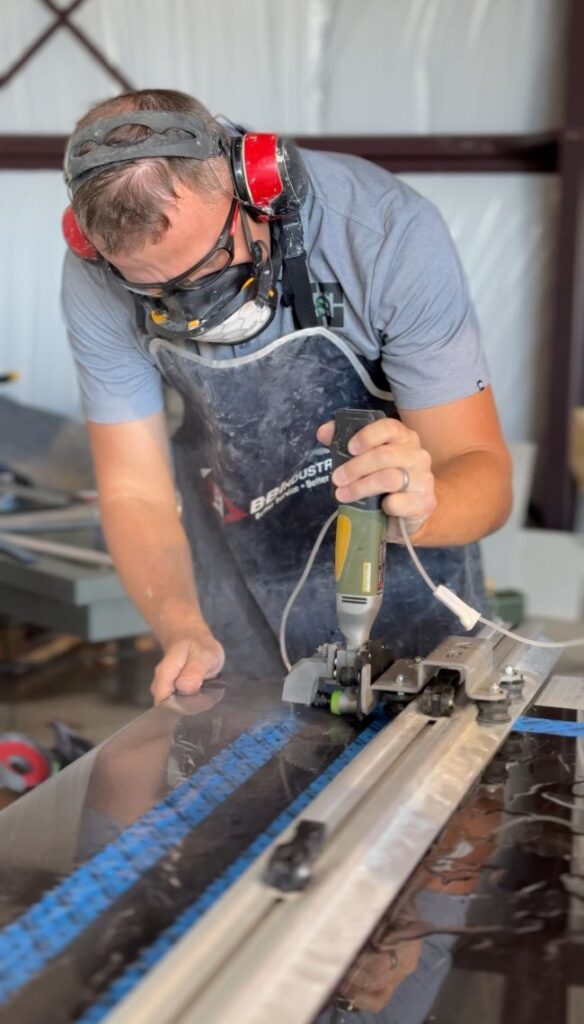
When gauged porcelain tile panels (GPTP) were introduced in the United States, there were extremely limited installation methods or tools available. Through the efforts of a small group of tile industry companies, installation methods were developed and evaluated.
Over the period of about two years, the American National Standard Institute (ANSI) standard A137.3 for Gauged Porcelain Tile Panels/Slabs (the product) and the interior installation standards ANSI A108.19 were established. Shortly afterward, the exterior installation standard, A108.20, was approved.
Without tools and procedures, the challenging work of innovation began. Aesop’s proverb, “Necessity is the mother of invention,” went into action by providing a whole new category of tools.
Suction cup frames—also referred to as racks—of various configurations allow the installer to safely unload the product from the crate or A-frame, move it to the fabrication table, and to the permanent location. These racks also stabilize the panels, which include 90-degree cut corners that can weaken the panel, making it susceptible to cracking if not transported in a flat plane.
Another great tool that assists in moving the panel to its location and manipulating the panel into position is the manual pump-up or electric suction cup.
Angle grinders have been a part of the fabrication business for years, but given the Occupational Safety and Health Administration (OSHA) regulations, airborne dust must be controlled. Adding measured amounts of water to the cutting tool has resolved that issue. Through this evolution, the much lighter and smaller long-neck angle milling and drilling tool was developed. Accordingly, the diamond cutting wheels also got smaller (11/2” to 2”) allowing for cutting tight radiuses and more intricate detail work.
Diamond sanding pads have been a part of the natural stone industry for years and were adapted for use on GPTP for hand sanding and polishing using grits from 50 to 3000. Likewise, diamond polishing pads for angle grinders provide a finished product in less time.
Sizing, cutting offsite, and prefabricated panels
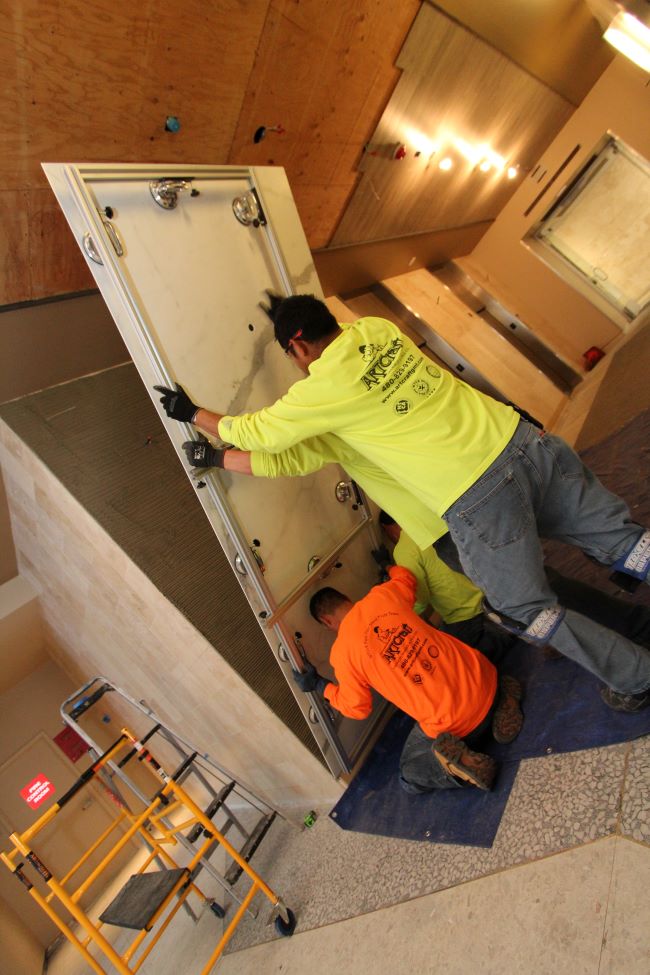
Tight delivery schedules have also required changes in the fabrication process. Many contractors are operating more effectively by getting detailed jobsite measurement and cutting the tile or fabricating panels in their shop as opposed to on the job. On wall installations, this is especially helpful since the installers can complete the fabrication process on a worktable rather than wherever space allows at the jobsite. This reduces back strain, knee issues, and fatigue while increasing productivity.
As an example, Dan Welch, CTI #1 and NTCA Five-Star Accredited Contractor, created Welch Tile Solutions (WTS), which manufactures prefabricated shower pans and wall panel systems. For more information, see the full article starting on page 60 in the December 2025 TileLetter.
In this new year, be open to trying new products and systems that can save time, produce high-quality work, and put more money in your pocket. The old adage “work smarter not harder” says it all.

Scott Carothers
Scott Carothers is the Acdemic Director for the Ceramic Tile Education Foundation (CTEF) and is responsible for the creation of the Certified Tile Installer (CTI) program, and is involved in the creation of the Advanced Certifications for Tile Installers (ACT) program as well as providing training to others in the tile industry.
Carothers has been involved in the ceramic tile industry for nearly 40 years and was the owner of a successful retail and installation firm prior to CTEF. He has served as President and Chairman of the Board of the National Tile Contractors Association (NTCA), Chairman of the NTCA Technical Committee, was named the NTCA Tile Person of the Year in 2005, and the NTCA Ring of Honor recipient in 2013. He is a voting member of the ANSI and the TCNA Handbook committees.