Protecting the future of the fabrication laborer
The subject of sustainability has been the topic of conversations for a number of years. It was first identified in 1987 by the United Nations Brundtland Commission that defined it as: “Meeting the needs of the present without compromising the ability of future generations to meet their own needs.”
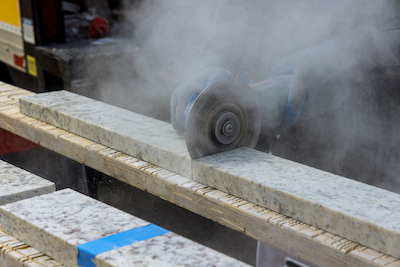
Currently, a substantial number of kitchen and vanity countertops consist of natural stone or engineered stone. These products, in and of themselves, pose no danger to the end user, but the manufacturing process to create them by drilling, cutting, grinding, and polishing causes the encapsulated silica to become airborne. This dust, if repeatedly inhaled by an unprotected fabrication worker, can potentially cause a serious – and often fatal – lung illness known as silicosis.
Using the Brundtland definition, we can connect sustainability to silicosis. “Meeting the needs of the present“ (the physical health of countertop workers), “without compromising the ability of future generations to meet their own needs.” Without corrective or protective action, fabrication workers can be compromised by silica dust particles. This could remove them from the workforce and hinder their ability to provide for their family’s needs.
Silica content of countertop materials
To gain an understanding of these products and the silica levels of each product, we need to review them. Limestone and marble generally contain less than 5% silica. Sintered stone – also known as ultra-compact – ranges from 5% to 11%. Granite can range from 40% to 50%, while engineered stone (quartz) products range from 90% to 97%.
Legislation history
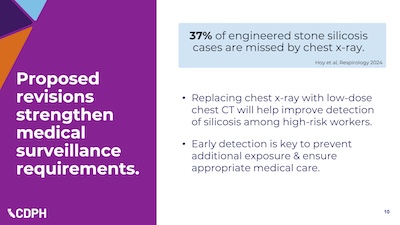
Australia was the first country to ban the use, supply, and manufacture of engineered stone products, including quartz countertops, due to the health risks associated with silica dust exposure. This ban was instituted on July 1, 2024. The intent was to protect workers in the countertop manufacturing industry from developing severe lung conditions, such as silicosis. This governmental decision was supported by health care providers, trade unions, and fabrication workers, stressing the crucial need to address this health hazard.
In the United States, current legislation includes the California Code of Regulation, Title 8, Section 5204, Occupational Exposures to Respirable Crystalline Silica. As stated by the legal firm Husch Blackwell, here are the key points of this legislation:
- On December 29, 2023, the California Occupational Safety and Health Standards Board instituted an emergency regulation to address occupational exposure to respirable crystalline silica. This regulation addressed additional safety requirements for businesses involved in cutting engineered stone, improved monitoring for workplace sites, and increased the ability for workers to report non-compliant employers. These emergency regulations became permanent in February 2025.
- The growth in cases of silicosis from exposure to engineered stone created a flurry of inspection activity in California. In 2024 alone, Cal/OSHA conducted 85 inspections related to silica exposure. These inspections resulted in 26% of the shops inspected receiving Orders Prohibiting Use (OPUs). These orders temporarily shut down equipment or processes that pose immediate safety risks until the issues are fixed. Additionally, citations were issued in approximately 95% of the closed inspections, with 53 out of 56 resulting in violations.
- In its most recent statement, Cal/OSHA noted the unique nature of the stone-countertop industry. Workers are particularly vulnerable because they are not represented by a labor union. Plus, they face the possibility of retaliation if they report workplace hazards to Cal/OSHA. Further, only 7% of the employees in the industry received workers’ compensation.
- Section 5204(3) of this legislation applies to high-exposure trigger tasks regardless of employee exposures, exposure assessments, or objective data. Cal/OSHA defines high-exposure trigger tasks as machining, crushing, cutting, drilling, abrading, abrasive blasting, grinding, chiseling, carving, gouging, polishing, buffing, fracturing, intentional breaking, or intentional chipping of artificial stone that contains more than 0.1 percent by weight crystalline silica. It also includes these activities conducted on other silica-containing products, including natural stone, that contain more than 10 percent crystalline silica by weight. High-exposure trigger tasks also include clean up, disturbing or handling of wastes, dusts, residues, debris, or other materials created during the above-listed tasks.
California Senate Bill (SB) 20
Senate Bill 20 (SB 20), introduced by Senator Caroline Menjivar on December 2, 2024, is titled “Occupational Safety: Fabrication Activities on Slab Solid Surface Products.” The proposed bill addresses the following impositions on the suppliers and manufacturers of stone slab products commonly used in residential kitchen countertop installation or customization. These regulatory changes included:
- Banning dry stone fabrication or cutting.
- Requiring wet fabrication methods. These include using constant running water on the entire surface being cut and the cutting equipment, water jet cutting, or submersion cutting.
- Licensing requirements for fabrication shops, requiring compliance with state occupational health standards.
- Certification requirements for fabrication workers under an authorized training curriculum.
- Prohibiting suppliers of slab products from working with unlicensed fabricators.
- Reporting requirements for state agencies on silicosis statistics, worker safety assessments, and the effectiveness of the new regulatory structure.
According to the California Legislative Information website, SB 20 has passed in the Senate Appropriations Committee and the full Senate. It then went to the Assembly (House) where it passed the Labor and Employment Committee. It is now before the Assembly Appropriations Committee, awaiting debate.
Fabrication safety
This bill has a significant impact for the tile installer using any of the above-listed products if the work performed falls under Section 5204 of the CAL/OSHA regulations. However, it does not apply to normal construction work on a jobsite falling under Section 1532.3 of the CAL/OSHA regulations.
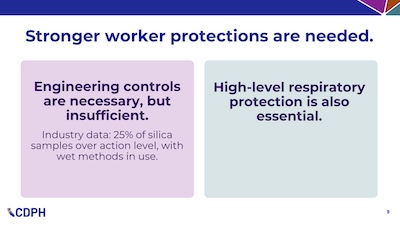
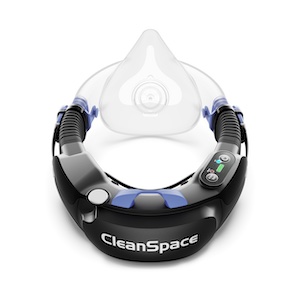
For fabrication work under Section 5204, fabricators are required to use PPE – which could include a powered air-purifying respirator (PAPR), HEPA filtered dust containment systems, site ventilation systems, along with wet cutting and wet grinding tools. Many of these measures greatly reduce the potential of airborne silica, protecting everyone.
Conclusion
This legislation is in progress and will, most likely, be modified in the future. The larger issue with this legislation is funding. SB20 includes a provision for funding the certification process that will help protect workers, if it can pass the Assembly Appropriations Committee, and if the Governor signs it into law. The bottom line is that fabrication workers need to be protected, having the opportunity to work in a safe and healthy environment.
Safety for silica workers translates to sustainability not only for the industry, but also for the lives of those involved in creating beautiful countertops for clients.
Medical studies and online safety course


The International Surface Fabricators Association (ISFA), in partnership with the Natural Stone Institute (NSI), has released the Yale Literature Review: Medical Studies. This report, the second part of a two-study series, thoroughly analyzes peer-reviewed medical research on the health impacts of respirable crystalline silica exposure in the surface fabrication industry. It builds upon the first part of the study, released in 2024, which detailed real-world silica dust levels in fabrication environments. This review provides fabricators with evidence-based understanding of silica exposure’s health consequences, empowering them with facts to enhance shop safety.
ISFA offers an online silica safety course, which has enrolled over 1,100 industry employees. Together with ongoing research, IFSA demonstrates its dedication to rigorous safety standards and proactive health education within the surfacing industry. This initiative is part of ISFA’s broader commitment to workplace wellness and continuous education. The full review and additional resources are available at isfanow.org/silica-RESOURCES.
In July, IFSA and OSHA established a formal Alliance under OSHA’s national Alliance Program. This voluntary, cooperative partnership pledges to elevate workplace safety, training, and safety culture across the surface fabrication industry. For more information, visit the isfanow.org website or view the story at https:/tinyurl.com/ISFAOSHAAlliance on TileLetter.com.
In addition, the Natural Stone Institute has a library of resources for preventing silicosis. Find it at https://www.naturalstoneinstitute.org/silica/.

Scott Carothers
Scott Carothers is the Acdemic Director for the Ceramic Tile Education Foundation (CTEF) and is responsible for the creation of the Certified Tile Installer (CTI) program, and is involved in the creation of the Advanced Certifications for Tile Installers (ACT) program as well as providing training to others in the tile industry.
Carothers has been involved in the ceramic tile industry for nearly 40 years and was the owner of a successful retail and installation firm prior to CTEF. He has served as President and Chairman of the Board of the National Tile Contractors Association (NTCA), Chairman of the NTCA Technical Committee, was named the NTCA Tile Person of the Year in 2005, and the NTCA Ring of Honor recipient in 2013. He is a voting member of the ANSI and the TCNA Handbook committees.