Our Technical story this month explores the methods and standards that helped Brekhus Tile & Stone in Denver, Colo., and Premier Tile & Marble Co., in Gardena, Calif., achieve precision installations that earned them Five-Star Grand Prize honors for Residential and Large Commercial, respectively.
This feature presents an overview of each project, followed by further exploration of the technical aspects by Scott Carothers. All 2025 TCNA Handbook details are courtesy of the Tile Council of North America.—Lesley Goddin

Brekhus Tile & Stone: Residential Grand Prize
Gaylord Street Residence
“Intricate” and “challenging” are two words used by Brekhus Tile & Stone to describe this project. The primary bathroom required extensive floor prep prior to the installation of 900 sq. ft. of carefully-sorted 12”x24” Breccia Fiore marble, including flattening the plywood subfloor with belt sanders and applying the appropriate MAPEI bond-enhancing primer and Ultraplan Easy flowable hydraulic cement underlayment (FHCU) to ensure a flat substrate. KERDI-BOARD provided a stable base for the shower walls, enhanced with the Schluter KERDI waterproofing system, and PMP EZ Mix deck mud was used for the shower pan. Dry layouts and daily approvals from the builder and designer ensured the desired pattern and aesthetic flow.
Meticulous preparation and execution were needed for the steam shower and dry sauna in the basement, so Brekhus again turned to the KERDI waterproofing system for the walls, ceiling, and benches and used EZ Mix for the shower pan. Both were tiled with X-Tone Blue Roma gauged porcelain tile panels (GPTP) and 47”x47” large-format tiles that required skilled cutting to vein match at all plane changes. The dry sauna features 4”x16” black porcelain tiles behind cedar slat walls, enhancing the wood aesthetic. In the steam shower, tiles were grouted with LATICRETE PERMACOLOR and sealed with LATASIL silicone sealant for waterproofing and movement accommodation. Precise layouts and cutting techniques ensured seamless vein matching, elevating the overall design.
The foyer’s stone tile installation showcases a custom stone carpet design made of Breccia Capriaia, Breccia Vino, Graniello Greige, and Serpeggiante, featuring intricate inlays with offset semicircles. A second medallion includes a Breccia Vino center with brass inlay details that were retrofitted with anchoring legs to ensure a secure bond to the mortar. The complex layout required precise coordination between the installer, superintendent, and fabrication shop. The entire process took three to four weeks of dedicated work. The end result showcases the beauty of stone and the skill of the installation team.
Unfortunately, due to the owner’s wishes, no images of this incredible project could be shared.
Technical details
The Gaylord project posed challenges in the design, fabrication, and installation of the tile used. This beautiful installation was the culmination of many hours of planning the finest details to yield a stellar residential project.
Jobsite issues: There were numerous issues with the existing structure in this remodel that had to be overcome prior to the tile installation. The removal of existing material required significant floor prep using MAPEI Mapecem Quickpatch in some areas. For areas needing a deeper fill, Primer T and Ultraplan Easy Flowable Hydraulic Cement Underlayment were used. The existing plywood floors were primed with MAPEI ECO Prim Grip followed by Mapeguard UM uncoupling membrane to support the intricate tile and stone installations.
Mockups: The complexity of the foyer’s stone pattern required a dry lay of the entire floor for approval from the owner and designer. The wide variation in the 900 sq. ft. of Breccia Fiore marble in the master shower and bathroom required sorting through multiple crates of product to find enough stone to complete the installation to the owner’s satisfaction.
Scheduling: Planning for the project started well in advance of the actual installation. The stone foyer floor, fireplace surround, sinks, and tubs were designed and fabricated in the Brekhus shop. Delivering these items and the other tile products created logistical problems since the entire home was going through a landscaping renewal. Getting to the house was one issue; getting inside was another.
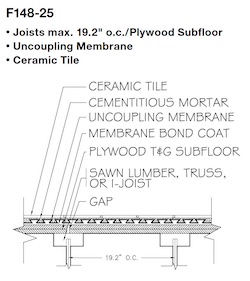
Specifications: All floors were installed using TCNA Handbook method F148. The shower walls included Schluter KERDI-BOARD with an integrated bonding flange drain.
Installation: The steam shower also used Schluter Systems’ design for residential steam showers. It was covered with GPTP using meticulous care to match the marbleized veining in the pattern from wall to wall and up the front of the seat, across the seat, and up the adjacent wall.
The foyer inlay included brass strips as part of the pattern. Brekhus engineered an anchoring system in-house to ensure that the brass stayed in place.
The three-to-four-week duration of the project did not include the significant amount of time spent on designing, planning, and fabricating. The foyer alone required three weeks to solve all the complexities of the many parts needed for the floor in order to deliver an unforgettable conclusion and customer satisfaction.

Premier Tile & Marble Co.:
Large Commercial Grand Prize
LA Clippers Intuit Dome
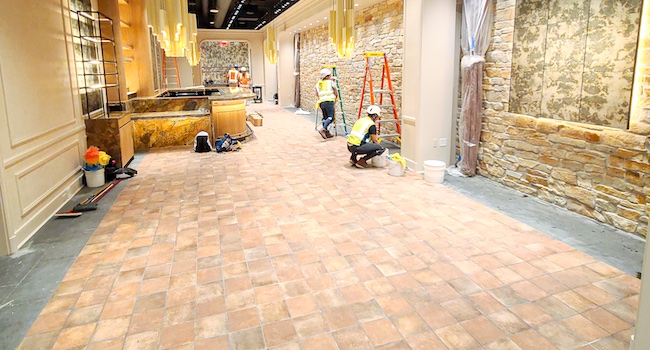
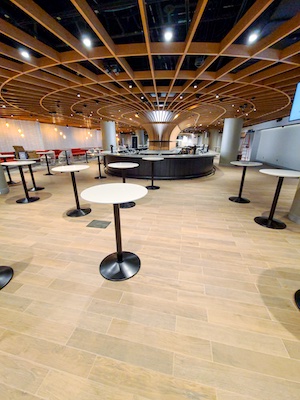
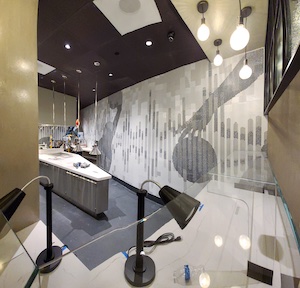
In 2022, tile installation began at the new LA Clippers Intuit Dome, starting with extensive floor and wall preparation to level the concrete substrates. After bringing surfaces within tolerance, LATICRETE HYDRO BAN waterproofing was applied, followed by flood testing and the start of tile installation—over 300,000 sq. ft. of floor tile with base, and wall tile that included ceramic, porcelain, glass, and stone tiles in sizes ranging from 1/2”x1/2” up to 5’x10’ GPTP. Custom mosaic patterns of basketball players now adorn many club areas.
Key installations included:
- The Clippers’ team hydrotherapy room, with 48”x48” wall tiles and penny rounds on the floor.
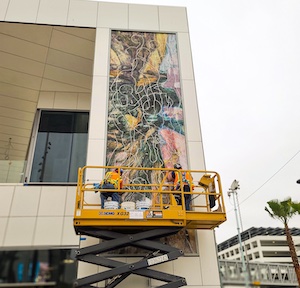
- Custom murals and mosaic artwork featuring basketball player motifs in clubs and the arena’s main intersection, as well as on the exterior.
- Over 20,000 sq. ft. of GPTP wainscot on Level 1 corridors.
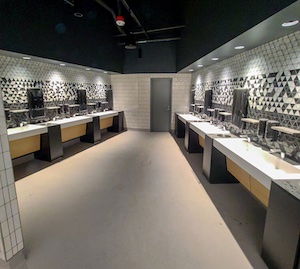
- Tile in all restrooms, as well as clubs, coaches’ restrooms/showers, the children’s play area, employee dining, visitor restroom/showers, suites, locker rooms, drinking fountains, breakrooms, concessions, and elevators.
“The project’s owner, Mr. Steve Ballmer, did not want customers to wait in line to use the restroom,” said Andrew Games, Premier Tile Project Manager. “Therefore, the Intuit Dome has massive amounts of restrooms, so nobody needs to wait. Every restroom received tile!”
To meet the summer 2024 deadline, the Premier Tile team pushed for weekly coordination meetings starting in December 2023, helping drive other subcontractors to stay on track, much to the appreciation of the general contractor. Their leadership was key in ensuring on-time completion.
LATICRETE setting materials were chosen for their durability and performance for all tile work.
“LATICRETE setting materials were used in the new Clippers Intuit Dome to provide a quality tile installation that will last for a lifetime!” Games said.
The tile installations contributed significantly to the cutting-edge, visually-striking design of what is now considered the most technologically-advanced arena in the world.
Technical details
The work that Premier Tile and Marble performed in the arena is almost unbelievable in both size and scope. This project was just under $12.7 million and included installation of over 300,000 sq. ft. of tile and stone, completed in 20 months with between 45 and 60 workers.
Jobsite issues: Premier had to overcome significant issues on the job. This included bush hammering and grinding an average of 1/2” from the recently poured concrete floors over a substantial area under numerous change orders. This alone took between four and five months to complete.
On one level, the restroom floors were very rough and out of tolerance by 1-3/8”. After the prep work was finalized, the substrates were modified to meet the ANSI required tolerance of 1/8” in 10’ for large-format tile and 1/4” in 10’ for smaller-format tile by using LATICRETE NXT patch.
Forty-six of the suites had been mistakenly coated with curing compound that had to be ground off to provide an adequate bond for the dry-set mortars used to set the tile.
In February 2023, heavy rains pummeled the area, flooding the arena interior. The affected areas on the lower levels included gypsum board walls that were prepped and ready for tile. The drywall contractor had to remove and replace these areas, which required change orders for Premier to again prep the walls for tile.
Shower trench drains: Premier discovered a design flaw in the detail of the shower trench drains that required the plumber to drill holes in every drain to allow weep water to escape. This modification had to be completed prior to Premier beginning their work.
Mockups: Due to the complexity of the layouts involved, Premier met weekly with the architect/designer to provide dry mockups, seeking signed approval prior to commencing the tile installation.
Scheduling: At the mid-point of the project, Premier realized that the undertaking would not be completed as scheduled in July of 2024. Working with the architect and other trades, Premier developed a plan to push the other trades to stay on schedule and allow Premier to finish on time.
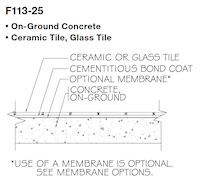
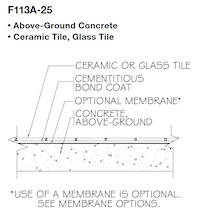
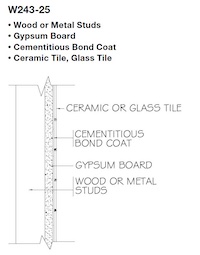
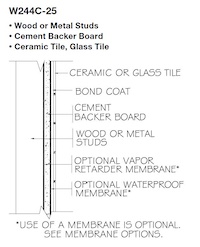
Specifications: The majority of the floor tile was installed using the Tile Council of North America (TCNA) Handbook method F113 (direct bond on-ground) and F113A (direct bond above-ground), whereas the walls followed WW244C (cement backer board with cementitious bond coat) or W243 (gypsum board with cementitious bond coat).
As with many large-volume projects that include many subcontractors, Premier did not enjoy the luxury of having designated work areas as directed by ANSI A108.02-4.3. Nevertheless, they pulled it off and completed the project on schedule.

Scott Carothers
Scott Carothers is the Acdemic Director for the Ceramic Tile Education Foundation (CTEF) and is responsible for the creation of the Certified Tile Installer (CTI) program, and is involved in the creation of the Advanced Certifications for Tile Installers (ACT) program as well as providing training to others in the tile industry.
Carothers has been involved in the ceramic tile industry for nearly 40 years and was the owner of a successful retail and installation firm prior to CTEF. He has served as President and Chairman of the Board of the National Tile Contractors Association (NTCA), Chairman of the NTCA Technical Committee, was named the NTCA Tile Person of the Year in 2005, and the NTCA Ring of Honor recipient in 2013. He is a voting member of the ANSI and the TCNA Handbook committees.