QUESTION
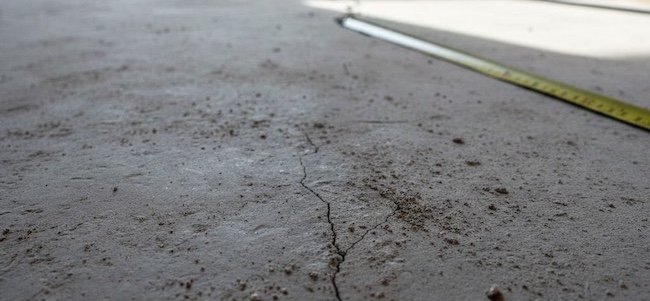
I am a member of the NTCA and recently looked at a tile installation project in an older home. The previous flooring had already been removed, and I noticed several cracks in the concrete slab along with a few other joints. I’m not sure if these are saw cuts, cold joints, shrinkage cracks, or something else.
My initial thought was to use a crack-isolation membrane, but I’m not sure if that is enough or if there are other considerations I should be looking at before I proceed. Can you please advise?
ANSWER
Thank you for your question—this is a common situation, and it’s good that you are slowing down to evaluate the slab before installing tile. Understanding the type of crack or joint is essential because not all slab movement can be treated the same way, and the wrong assumption can lead to a failure under your installation.
Cracks and joints fall into several categories, each with different requirements:
- Control (saw-cut) joints: These are planned and intentionally cut to control shrinkage cracking.
- Cold joints: Places where two concrete pours meet and are not monolithic. Cold joints are considered structural joints.
- Shrinkage cracks: Typically random, narrow cracks that result from curing stresses.
- Structural/active cracks: Cracks that exhibit vertical displacement, separation, or widening over time.
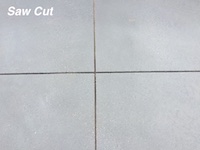
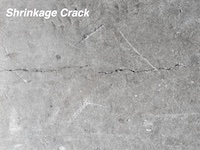
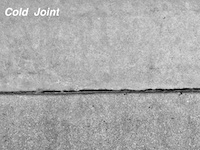
(Definitions of these terms can be found on page 438 of the 2025 TCNA Handbook.)
Before deciding on a tile method, determine whether what you’re looking at is non-structural shrinkage cracking or a structural joint that must be honored through the tile.
Requirements for joints per ANSI and TCNA
ANSI A108 and the TCNA Handbook are clear on this point.
2025 TCNA Handbook, Page 43:
“All expansion, control, construction, cold, saw-cut, isolation, contraction, and seismic joints in the structure should continue through the tile work, including such joints at vertical surfaces. If a proprietary crack isolation membrane is specified over a saw-cut joint to relocate a movement joint, contrary to EJ 171, the tile contractor is not responsible for cracking in the grout joints or tile over the saw cut, provided the tile, membrane, and other materials were installed correctly. This includes curling and/or deformation of the concrete occurring after the installation of the membrane.”
Evaluate for vertical movement
A quick assessment with a straightedge can reveal vertical displacement. Any crack with vertical movement falls into the “structural” category and cannot be tiled over, even when using a membrane.
Consider a crack-isolation membrane (when appropriate)
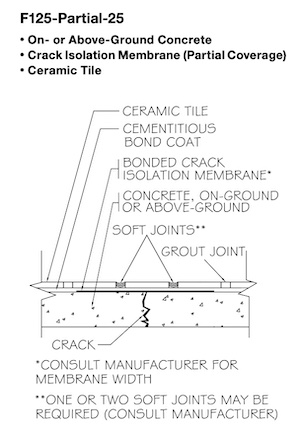
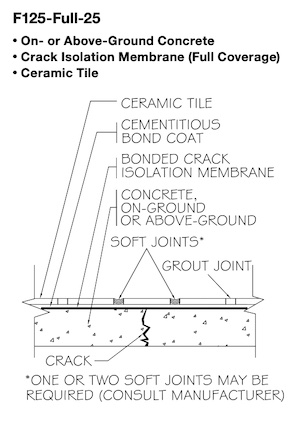
If the cracks are confirmed to be non-structural, a crack-isolation membrane listed to ANSI A118.12 may be appropriate. Membranes can help address in-plane (horizontal) movement, but cannot handle vertical shear or structural separation.
Please take a look at TCNA Handbook Method F125.
Provide a movement-joint plan
Regardless of slab condition, the installation must include field movement joints per TCNA EJ171, which requires:
- Movement joints at all perimeters and transitions.
- Movement joints through the tile above all structural and control joints in the slab.
- Interior field joints every 25’ and every 12’ for interior tilework exposed to direct sunlight.
Before moving forward:
- Correctly identify whether the slab contains shrinkage cracks, saw cuts/control joints, or cold joints.
- Honor all structural and control joints through the tile work—these cannot be bridged.
- Use an ANSI A118.12 crack-isolation membrane only for non-moving cracks.
- Consult the manufacturer of the crack-isolation membrane and follow their instructions.
- Implement movement joints per TCNA EJ171.
If there is any uncertainty about whether a crack is active or structural, perform additional evaluation or recommend that your client consult a structural engineer.