

President Trump has made it clear that immigration enforcement and deportation actions will increase under his presidency. In just the first few weeks of his administration, there was a noticeable uptick in activity by U.S. Immigration and Customs Enforcement (ICE). That level of activity is expected to remain consistent, with the possibility of an increase in worksite visits from ICE, particularly in the construction industry. Indeed, it is anticipated that the Trump Administration will increase Form I-9 audits to 12,000 a year (by comparison, the Biden Administration averaged less than 500 Form I-9 audits a year).
Self-audit and be prepared for an ICE visit
Employers in the construction industry need to be prepared if ICE arrives at a worksite. If the purpose of the ICE visit is to announce its intention to conduct a Form I-9 audit, the employer will have three days to produce the forms for the audit. In order to avoid a fire drill attempting to organize the company’s forms and make necessary corrections before the forms must be produced, construction industry employers would be wise to conduct their own self-audit without waiting for ICE to arrive. It is much easier to make necessary corrections without the pressure of having to do it company-wide over a three-day period.
But what if the purpose of ICE’s visit is to meet and interview your employees to determine whether they are legally in the United States? Are you required to allow ICE access to your employees?
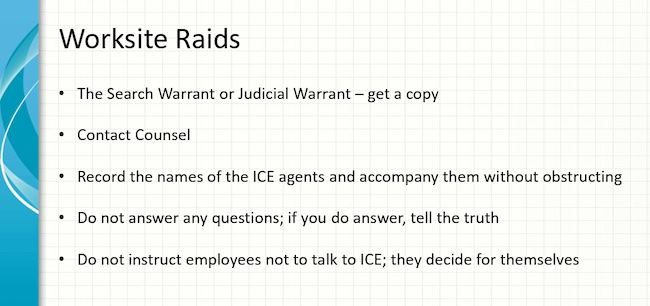
Warrant signed by federal judge needed for access to non-public worksite areas
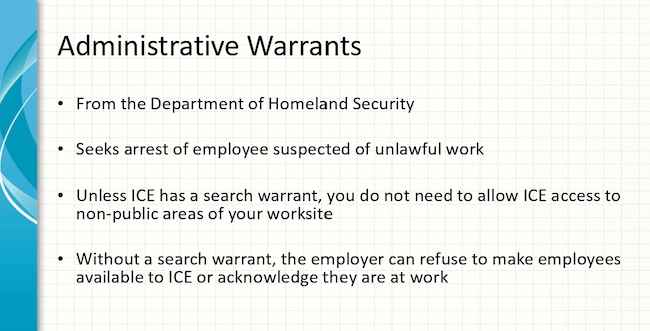
Employers are not required to allow ICE access to non-public areas of the worksite, unless the ICE agents have a search warrant signed by a federal judge allowing them access. This holds true even if the ICE agents have an administrative warrant from the Department of Homeland Security (DHS) for the arrest of an employee (employers are not required to provide ICE access to non-public areas in response to an administrative subpoena from DHS). Construction employers can require the agents to obtain a search warrant signed by a federal judge as a condition to access non-public areas of the worksite. Construction employers will not, however, be able to deny the ICE agents access to public areas of a worksite.
If access is granted
If the ICE agents do have a search warrant, access must be granted. In those instances, legal counsel should be contacted immediately. The employer should make a copy of the search warrant. The ICE agent should be accompanied by the employer during the search, and the employer should object if the scope of the search exceeds what is permitted by the warrant.
During the search, the employer is under no obligation to answer any questions. Similarly, employees also have the right to remain silent–although, the employer should not instruct the employees not to answer ICE’s questions or to flee the worksite. It is ok for the employer to tell its employees it is up to them whether to speak with the ICE agents.
In response to an administrative warrant seeking an employee, it is important that employers know they are under no legal obligation to bring the employee to the ICE agents. Indeed, the employer is under no legal obligation to let ICE know whether the employee is even working that day.
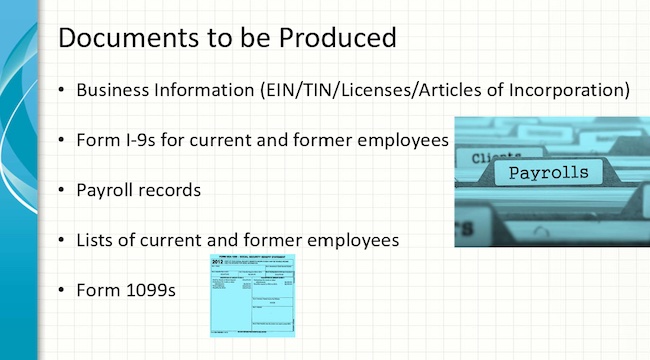
The importance of preparing for a Form I-9 audit
It is important that all employers in the construction industry prepare for a Form I-9 audit and the possibility of ICE showing up at one of its worksites, with or without a search warrant. If you would like assistance in conducting your own Form I-9 audit, or if you have any questions about the company’s rights and the rights of its employees in the event of a worksite raid, you can contact Philip Siegel. You can e-mail Siegel at [email protected], or you can call directly at (404) 469-9197.



Philip J. Siegel, Esq.
Philip J. Siegel, Esq., is a partner and shareholder with the firm of Hendrick, Phillips, Salzman & Siegel. Siegel attended the University of Michigan in Ann Arbor, Michigan, graduating with distinction from the School of Business Administration, where he earned his B.B.A. Siegel received his law degree from Emory University School of Law. He worked in the public accounting industry as a state and local tax consultant for two years prior to commencing his career as a construction litigation and labor/employment attorney.
Siegel’s construction law practice focuses primarily in the areas of labor/employment law, including defense of OSHA citations, immigration compliance assistance, Davis-Bacon Act consulting, contract consulting, and construction litigation, including representation of general contractors, subcontractors and suppliers, all on a national basis.