QUESTION
I’m an experienced tile installer but new to jobs this large—about 6,000 sq.ft. My crew will remove the carpet and then grind old dried glue with a rented large floor grinder to prepare the slab for tile. The data sheet lists the grinder at a possible ~120 dB. What advice do you or other NTCA members have for protecting my crew and anyone nearby from possible hearing damage?
ANSWER
Thanks for reaching out to the NTCA Technical Team with your question about grinding concrete. 120 dB is loud! Noise at 120 dB is not just uncomfortable—it can cause permanent hearing damage quickly. OSHA (Occupational Safety and Health Administration) says you need a hearing protection program whenever workers are exposed to noise averaging 85 decibels (dB) over an eight-hour day. The legal limit is 90 dB for eight hours, which means this is the point at which OSHA rules kick in—it’s about compliance, not necessarily the point where hearing damage starts.
NIOSH (National Institute for Occupational Safety and Health), which is more protective, recommends keeping exposure at 85 dB for eight hours. For every 3 dB louder than 85, the safe time you can be exposed is cut in half.
Here are some best practices to consider for your job:
Engineering Controls
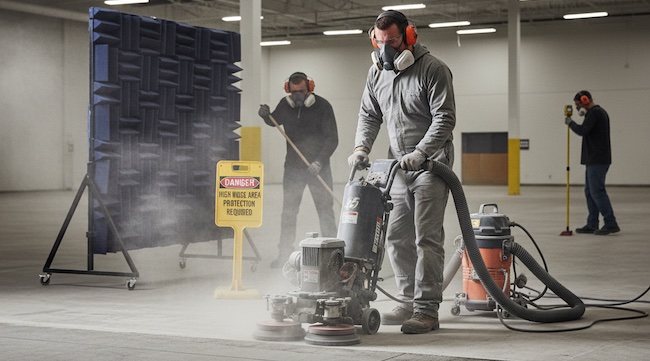
- Use quieter tools or grinders with noise-reduction features. (Larger grinders may be faster but not safer)
- Create distance or temporary acoustic barriers between the grinder and other workers.
- Maintain equipment—worn bearings or loose parts increase noise.
Administrative Controls
- Schedule noisy work when fewer people are present.
- Rotate workers to limit exposure.
- Post warning signs and restrict access to the grinding area.
- Consider monitoring noise levels with a sound meter or dosimeter.
Personal Protective Equipment (PPE)
- For 120 dB, single protection is insufficient. Use earplugs plus earmuffs for operators and anyone nearby. Foam earplugs (NRR 29–33) plus over-the-ear earmuffs (NRR 20–30) can reduce exposure to safer levels.
- Provide training on proper fit—real-world attenuation depends on correct use.
Hearing Conservation Program
- If you’re an employer, OSHA may require you to include monitoring, training, and audiometric testing for workers exposed to high noise levels.
- Keep records as required by OSHA.
Quick Example: Double protection can reduce 120 dB to ~85 dB, making long-term exposure safer. Fit and consistent use are critical–even a few minutes unprotected can cause damage.
Bottom Line: Hearing loss is permanent. Plan your work carefully: limit operator time, use double protection, create distance, and monitor noise. Incorporating these controls protects your crew’s health and your company from avoidable risk.