

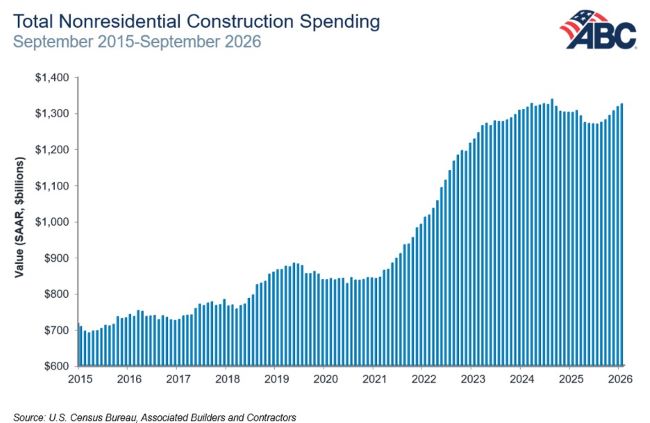
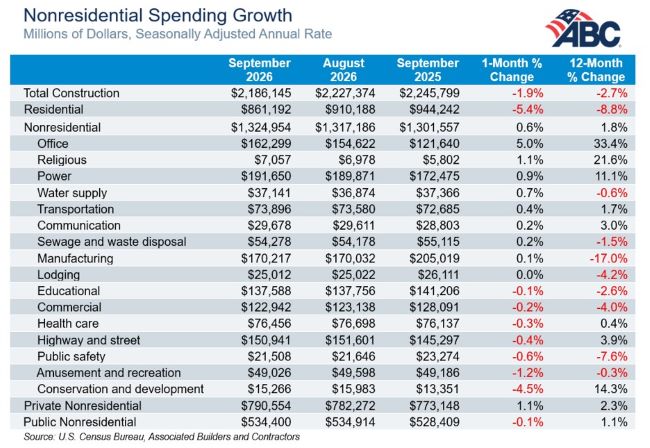
National nonresidential construction spending increased 0.6% in September, according to a new analysis by Associated Builders and Contractors (ABC) of data published by the U.S. Census Bureau. On a seasonally adjusted annualized basis, nonresidential spending totaled $1.325 trillion.
“Nonresidential construction spending grew for the sixth consecutive month in September,” said ABC Chief Economist Anirban Basu. “As has been the case for several months, data centers accounted for virtually all of that increase. Excluding data centers and the closely related power category, nonresidential spending actually fell in September. It’s increasingly difficult to contextualize the speed of the data center boom—spending in the category jumped another 8.6% in September and has grown at a 217% annualized rate since May.”
Spending was up on a monthly basis in eight of the 16 nonresidential subcategories. Private nonresidential spending was up 1.1%, while public nonresidential construction spending was down 0.1% in September.
“Given the recent rise in treasury yields and ongoing materials price escalation, momentum will remain narrowly concentrated in artificial intelligence-related segments over the next several months,” Basu noted. “While contractors remain busy in the aggregate, according to ABC’s Construction Backlog Indicator, current market dynamics will continue to favor larger contractors who are far more likely to be involved in data center and power projects.”
Visit abc.org/economics for the Construction Backlog Indicator and Construction Confidence Index, plus analysis of spending, employment, job openings and the Producer Price Index.
About Associated Builders and Contractors
Associated Builders and Contractors (ABC) is a national construction industry trade association established in 1950 with 67 chapters and 24,000 members. Founded on the merit-shop philosophy, ABC helps members offer a robust employee value proposition, develop people, win work, and deliver that work safely, ethically and profitably for the betterment of the communities in which ABC and its members work.








 of data published by the U.S. Census Bureau. On a seasonally adjusted annualized basis, nonresidential spending totaled $1.325 trillion.)