The session, “Global Inspirations, Case Studies, Engaged Porcelain Slab Design and Installation,” presented as part of the educational programming at Coverings 2025 in Orlando, brought together leading experts Steve Clem, Principal of TVS Design in Atlanta, and Sean Gordy from Gordy Tile Company, Inc. in Covington, Ga., to discuss their collaborative approach to large-scale porcelain slab projects.
I had the opportunity to moderate this session, which highlighted the intricate relationship between design professionals and specialty subcontractors, emphasizing how their synergy leads to successful and innovative installations.
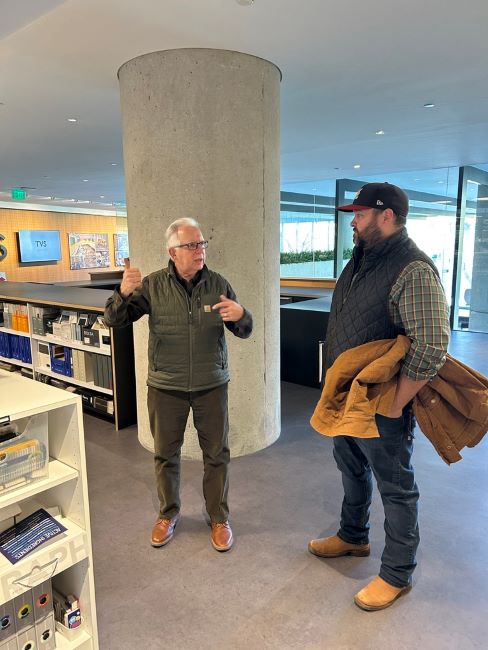
Clem, with 47 years at TVS as an architect and interior designer, shared his international experience and the importance of skilled trades. Gordy, a third-generation tile professional, offered an installer’s perspective, underscoring the challenges and triumphs of working with gauged porcelain tiles and slabs. The discussion revealed how this close partnership—often rare in the industry—fosters remarkable results and pushes the boundaries of porcelain application in diverse architectural settings.
The collaborative advantage
Clem opened by stressing the crucial role of strong relationships with subcontract trades in achieving project success. He noted that while general contractors manage projects, it’s the people who do the work—the specialty subcontractors—who are key. This philosophy has led to a long-standing and productive partnership with Gordy, which is a unique and invaluable collaboration that transcends typical industry dynamics wherein architects often work primarily with suppliers and subcontractors are more aligned with general contractors.
This integrated approach, as evidenced by their case studies, ensures meticulous attention to detail and shared understanding of quality expectations from conception to completion.
Harris Cherokee Casino Resort Expansion
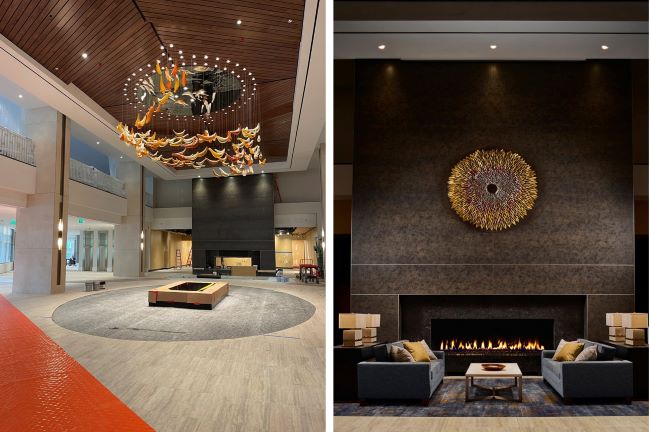
Gordy presented the Harris Cherokee Casino Resort Expansion, a 2021 project featuring nearly 8,000 sq. ft. of 6mm gauged porcelain slabs. This project showcased significant challenges, particularly regarding material efficiency and clarifying architectural layouts. The standout feature was the installation on 30’-high columns in the grand lobby, requiring precise cuts and strategic joint placement. Due to limited material availability, Gordy’s team meticulously planned layouts to maximize every piece, finishing with only half a slab left.
The project also utilized over 3,000 lineal feet of metal trims for accents and joints, demanding an exceptionally flat substrate and stringent accountability from other contractors to ensure perfect alignment. The use of Schluter® QUADEC in joints required alternative lippage tuning methods, demonstrating the need for adaptability and problem-solving on-site. The unrectified Neolith Tile on the fireplace demanded in-field cutting and micro-beveling for a seamless appearance.
This project served as a prime example of overcoming logistical hurdles and material constraints through careful planning and skilled execution.
Appliance showroom floor application
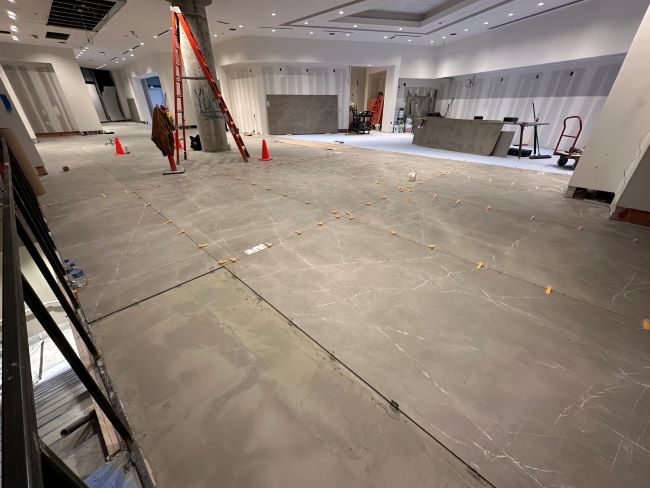
A current project, an appliance showroom, demonstrated the less-common application of 6mm porcelain slabs on the floor. With about 6,700 sq. ft. of full-panel (63” x 126”) porcelain, this project highlighted the material’s suitability for high-traffic floor areas, defying common reservations.
Logistics were a major challenge, requiring booming A-frames of material through windows onto the second floor due to a lack of other access. Work proceeded in phases to accommodate other trades, primarily the millwork contractor, demanding precise upfront layout and preparation to maintain workflow continuity.
Gordy detailed the extensive floor preparation: removing old adhesives, mortars, and membranes, followed by priming, self-leveling, and applying liquid crack isolation. The installation technique involved “walking in” the large slabs to ensure full mortar coverage and air expulsion, a method that Clem affirmed as highly effective.
This project exemplified the meticulous preparation and specialized techniques required for successful large-format porcelain floor installations.
TVS Design former office building repositioning
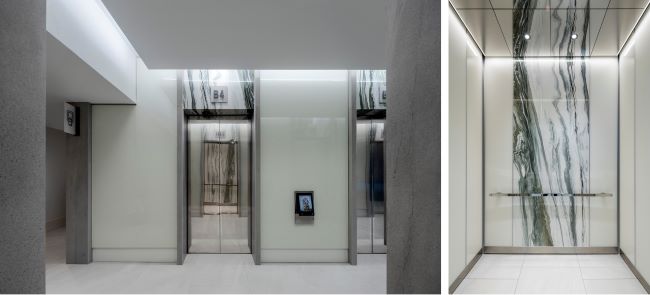
Clem shared a project with personal significance: the major overhaul and repositioning of TVS Design’s former office building, originally designed in 1989. This extensive renovation involved removing existing stone flooring and cladding to implement a new image using thin porcelain tile on three levels of flooring and extensive vertical wall surfaces. Turner Construction served as the general contractor, with Gordy Tile collaborating with Atlanta flooring contractor DCO Floors.
The project, a recipient of the Ceramics of Italy tile competition’s top commercial project in North America in 2023, featured over 12,000 sq. ft. of slabs on walls, columns, and soffits.
A standout detail was over one mile of quirk miter corner details, a technique borrowed from stonework but applied to porcelain. This involved polishing both edges of the tile to achieve the same gloss level as the face, creating an elegant open reveal. Gordy pointed out the effort involved: effectively polishing over two miles of tile edges.
Clem emphasized that this project showcased the super flatness achievable with porcelain and demonstrated how a skilled installer like Gordy could execute complex details that other tile managers deemed impossible, serving as a model for future projects.
The design also incorporated subtle illusions, such as polished stainless steel in elevator cabs to create a flowing ribbon effect, avoiding tile on moving parts.
This case study powerfully illustrated the transformative potential of porcelain when coupled with expert craftsmanship and innovative detailing.
Key installation insights and practices
Throughout the case studies, both Clem and Gordy provided valuable insights into the technical aspects of porcelain slab installation:
- Material efficiency: Strategic layout planning is crucial, especially with custom or limited material runs, to minimize waste.
- Substrate preparation: Achieving a perfectly flat and sound substrate is paramount for large-format porcelain, often requiring extensive cleaning, priming, self-leveling, and crack isolation.
- Specialized tools and techniques: Tools like the Euro notch or zipper notch trowel ensure proper mortar coverage. The “walking in” method for large slabs effectively expels air and ensures full adhesion.
- Collaboration: Early engagement and continuous communication among designers, architects, and installers are vital for clarifying drawings, solving on-site problems, and ensuring design intent is met.
- Industry standards: Adherence to standards like ANSI A108.19 for gauged porcelain tile panels and slabs is essential, though practical challenges often require creative solutions within these guidelines.
- Innovation: Adapting traditional techniques, such as the quirk miter, and developing new ones continuously pushes the boundaries of tile installation.
The session provided a compelling overview of the design and installation of gauged porcelain slabs, powerfully demonstrating the value of deep collaboration between design professionals and specialty subcontractors.
Steve Clem and Sean Gordy’s partnership exemplifies how shared expertise, meticulous planning, and a commitment to quality can overcome complex challenges, transforming architectural visions into stunning realities. From maximizing material efficiency in casinos to executing intricate details in corporate lobbies and pioneering floor applications, their case studies underscore the versatility and aesthetic potential of gauged porcelain.
Their work not only sets new benchmarks for installation quality but also inspires broader industry adoption of this innovative material. The ongoing dialogue and mutual respect between designer and installer, as championed by Clem and Gordy, is a blueprint for future success in the dynamic world of architectural surfaces.

Bart Bettiga is the Executive Director of the National Tile Contractors Association. Bettiga is a member of the Board of Governors of Coverings, one the largest tradeshows in North America. He has over 30 years of experience in the tile and stone industry and has served as the NTCA Executive Director since 2002. He is a well known speaker and author on ceramic tile and natural stone distribution and installation. He oversees the financial operations of the NTCA, TileLetter and the Ceramic Tile Education Foundation.