
The Detroit Athletic Club (DAC) was founded in 1887 and reorganized in 1913 by prominent automotive and industrial leaders in the city to broaden its scope to include other recreational and social functions. A seven-story clubhouse was built in 1915 on Madison Avenue in the sports and theater district of Detroit. It houses athletic facilities including a fitness center, swimming pools, courts, and a bowling alley, and social spaces including restaurants, bars, ballrooms, boardrooms, and guest rooms for overnight stays.
More than the amenities, the DAC prides itself on providing an environment where members can forge relationships, support each other, and generally enhance their lives. The DAC was recognized as the No. 1 athletic club in the United States by the Club Leaders Forum and Advisory Board of Platinum Clubs of America. A few notable club members include Henry Ford, Baseball Hall of Famer Ty Cobb, and racing mogul Roger Penske.
The project and contractors
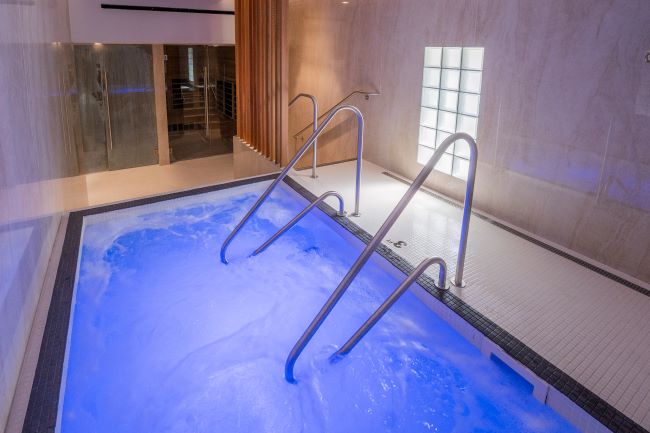
In early 2024, the DAC planned an $11M renovation project that included an overhaul of the main kitchen, improvements to guest rooms, and virtually complete reconstruction of the women’s locker room. The locker room features various wet areas including floors, showers, a steam room, and a jetted-tub deck. Given the overall footprint of the wet areas, a history of leaks that were addressed with band-aid repairs, and the presence of a ballroom with ornate hand-painted ceiling directly below, all areas of the locker room that had any risk of water exposure were designated to receive waterproofing. The locker room renovation was completed between May 2025 and September 2025.
Robert Offer, Superintendent at the construction management firm Frank Rewold & Sons, Inc., and Matthew Bontomasi, Vice President of Operations at the tile contractor Wolverine Stone Co., shared their experience on the project. It is worth noting that both firms have been in business for over 100 years—a fitting match for a client like DAC with its own deep roots in Detroit history.
Offer and Bontomasi knew the stakes were incredibly high and that the execution would be challenging. As Offer put it, “Projects like this are like remodeling the Smithsonian with Abraham Lincoln looking over your shoulder, asking if you’re done yet.” A club like the DAC is unable to shut down in part, let alone entirely, during renovations, and consequences of failure would be catastrophic. There would be no second chance. Therefore, they needed to use a system that would guarantee success. Together, they brought Schluter-Systems to the table for the project and the DAC agreed.

Floors
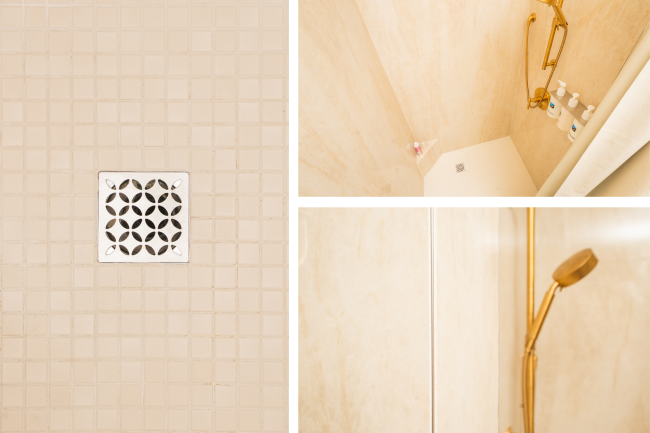
The existing mortar bed and mosaic floor application were torn out, exposing the subfloor of concrete poured over steel decking. A new mortar bed was installed to provide the necessary slopes and a stable substrate for the Schluter-KERDI bonded waterproofing membrane. A total of six Schluter-KERDI-DRAIN bonding flanges were installed in the mortar bed, some with grates for drainage and others with cleanout covers to provide additional access to the plumbing. The KERDI membrane was bonded to the mortar bed and drains, then carried 12” up the walls.
Once the floor was waterproofed, it was time for a water test to validate the application. The wet area was flooded with 3” of water and left to stand for 24 hours—directly above a ballroom where preparations for a $1M+ wedding were already underway. The system had to hold.
Showers and steam room
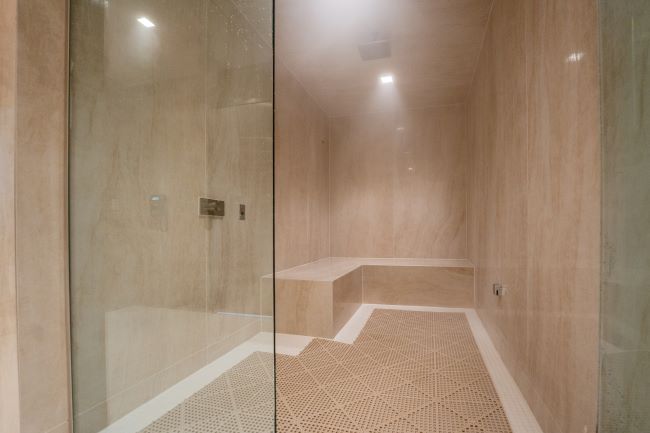
Showers were completely reconstructed and waterproofed using the Schluter shower system, including the KERDI-DRAIN and KERDI membrane installed over a mortar base on the floor and backerboard on the walls. The same approach was taken with the steam room, apart from using the KERDI-DS membrane. KERDI-DS meets the requirements for “low perm waterproof membranes” and is suitable for continuous-use steam rooms as defined in the TCNA Handbook for Ceramic, Glass, and Stone Tile Installation.
Schluter-Systems representative Josh Lewis worked closely with the contractors to support the planning and execution of the steam room. Once again, the guiding principle of the project was no second chances. The showers and steam room simply had to be successful. Any required repairs after the locker room was put back in service would create inconvenience that would not be acceptable to the DAC and its members.
Tile installation
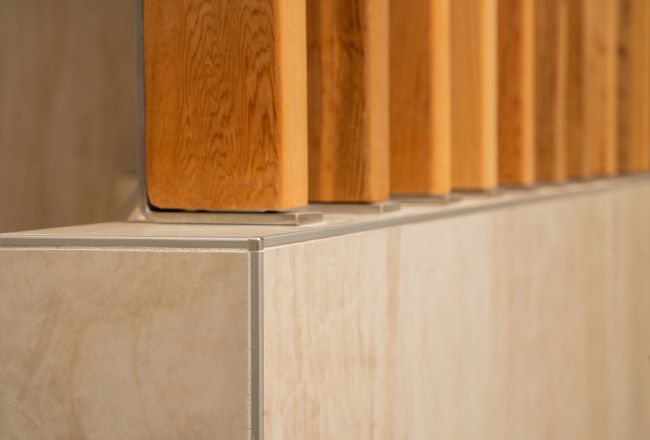
Tile installation on this project had its own challenges. While floors and shower bases were finished with mosaics, walls were finished with 5’ x 10’ gauged porcelain tile panels from floor to ceiling. Handling these enormous panels is difficult in general and was complicated on this project in various ways. Fabrication was performed in an outdoor station that required temporary closure of two lanes of traffic, and the panels were loaded through a 6’ x 6’ window at a height of 40’ in the air. Maneuvering and installing the panels in the tight quarters of the locker room was difficult as well.
Wolverine used Schluter-FINEC-SQ outside corner profiles to finish and protect the panel edges. The FINEC- SQ profile has a minimal reveal that suited the application and will prevent damage at corners that could otherwise require repairs that are simply not practical.
Closing
The DAC women’s locker room renovation project was extraordinarily challenging given the construction environment, timeline, and consequences of any failures or required rework. Success hinged on thorough planning, exacting execution, and using the best products for the job. Schluter-Systems is grateful to have been given the opportunity to support this exciting project and excellent partners by providing a robust waterproofing system that fit the needs of the project and allowed the installers to fully leverage their skills and deliver high-quality work on schedule.
By the way, the water test passed without incident. Four months later, the women’s locker room at the Detroit Athletic Club reopened on schedule: pristine, fully waterproofed, and ready for another century of use. Below, the ballroom ceiling remained exactly as it had been: ornate, hand-painted, and untouched.

Lesley Goddin has been writing and journaling since her first diary at age 11. Her journey has taken her through a career in publishing and publicity, landing her the editor position of TileLetter and its special publications in 2006. Her goal is to educate, inspire, recognize and encourage those in the tile industry -- especially the tile and stone contractor.