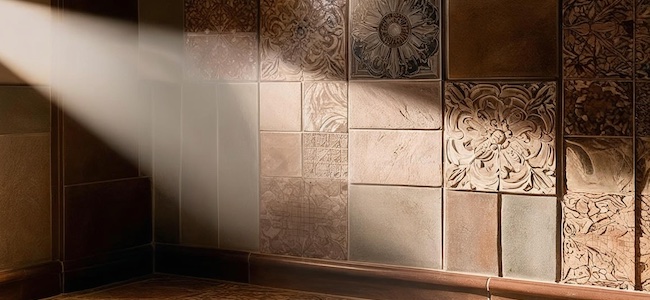
Tile and stone are amazing materials that elevate any project, when specified and installed correctly.
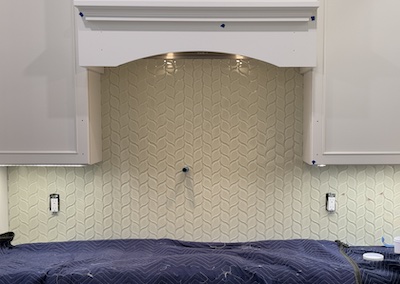
But carefully curated lighting can further enhance these luxury, high-performance materials. Let’s explore some ways lighting can be used to increase the artisan quotient of a tile or stone installation.
Davi Santos, of Davie Mac Tile in Weymouth, Mass., recently posted on the TCNA Tile Pro Network Community about how lighting impacts the appearance of tile installations, especially materials like glass.
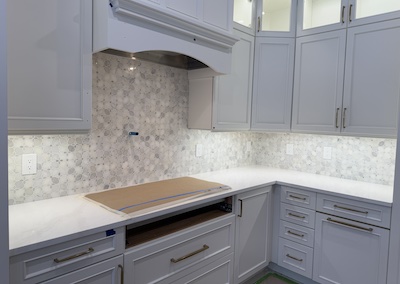
He talked about how a soft, neutral-looking glass mosaic for a recent kitchen backsplash project looked beautiful in the showroom. But once installed under actual client lighting, the play of warm lighting from the range hood imparted a yellow cast to the tile and contrasted with the cooler under cabinet lighting that gave the glass a greenish tint.
“We hadn’t talked much about how lighting affects tile beforehand,” he said. “The client picked the tile based on a sample, and I trusted her vision. But when she saw it in place, she realized it just wasn’t what she had imagined. So, we removed the tile and started fresh – this time with a marble mosaic that worked better with the space and the lighting.”
This experience led Santos to bring up the importance of lighting in early conversations with clients. “I ask how the space is lit, whether their lighting is already installed, and if they’ve looked at their tile choice under similar conditions,” he added “ It’s not my job to make decisions for them – but it is my job to help them avoid surprises after the tile goes up.”
Backlighting
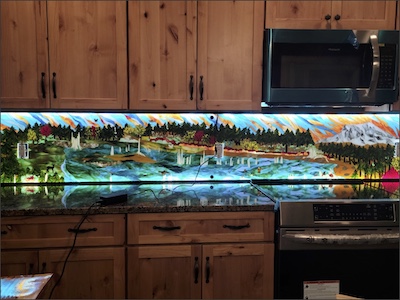
Another approach to lighting is to illuminate or backlight the project. Lisa Bustamante of award-winning Custom Mosaic Creations in Troutsdale, Ore., creates gorgeous hand-cut glass backlit backsplashes. She was inspired to backlight her creations by a local builder at her client’s open house viewing of her Under the Sea-themed mosaic. His suggestion was to install the mosaic on a clear acrylic substrate and add LED tape lighting around the perimeter. Bustamante took this to the next level, adding aluminum U-channel around the perimeter to hold the LED lights in place and frame the project.
She had another chance to backlight a glass mosaic for her Mount Adams Fly Fishing mosaic. Her client wanted to research his own lights and chose 24 volt LEDs, which created a bright white 6000K light. She went with model 2835 since the lights are closer together, and the 4 amp power supply was a better choice for consistent lighting for a 9 ft. mosaic.
Fiber optics
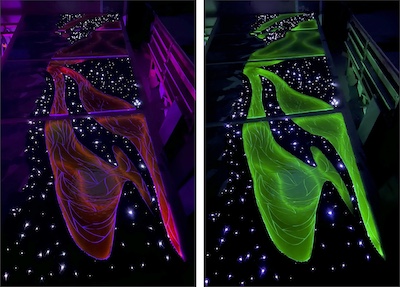
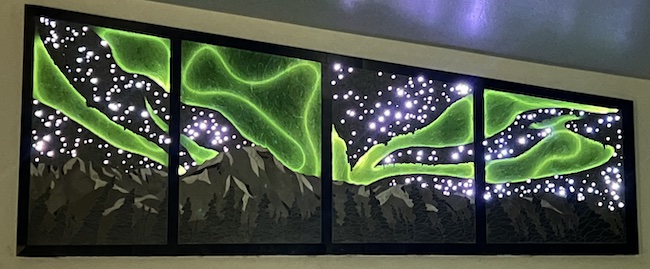
Joshua Nordstrom, artisan tile setter extraordinaire from Tierra Tile in Homer, Alaska, took a different approach for his 16-ft.-long “Aurora” mosaic project. His original plan was revised several times but it resulted in an amazing project.
“Try and think through every small detail of the project, have a good plan going in, and be open to the plan changing a little along the way,” he said. He suggested making samples and reaching out for help for aspects of the project that seem foreign to you, such as reaching out to a lighting manufacturer for guidance.
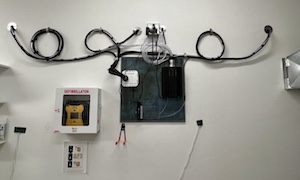
Nordstrom originally planned on using LEDs, but the client nixed this idea. Nordstrom pivoted to fiber optics. “But I knew absolutely nothing about them other than the light source is completely separate from the actual light that is visually seen,” he said.
He learned about them – fast. The fibers, which he called “glorified fishing line,” come in different sizes and run from the bulb, transmitting light to the ends of the fibers. Nordstrom experimented with different wattages of the light box until he got the right combination of power, fiber size and brightness to create the starry sky effect.
Once the client approved the plan, Nordstrom contacted the fiber optics company and learned about a “side glow” cable that transmits light off the sides vs. the ends of the cable, which was the perfect illumination for the glass to the aurora itself. This bundle of thicker fibers in a clear sleeve runs off a higher wattage lighting unit.
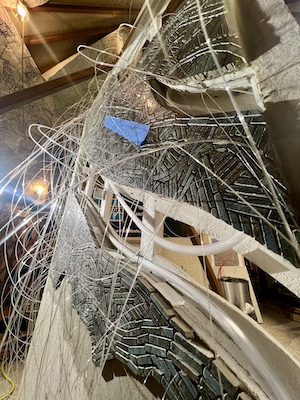
Nordstrom also had to switch the stained glass for the project. The original samples had a tie-dyed look but they were too opaque to let the light through. The lighting company recommended he use a semi-transparent solid colored glass.
“The glass that was used turned out to be perfect for the illusion of streaks of light pulsing in the aurora. It actually added an element that was not planned,” he said.
The project was installed up high on a wall in four sections, with fibers running out back through the wall to the light source. Three light sources were used: one for the auroras, one for the stars and one for the shooting stars – all with their own remote that controls the variety of colors.
“Be confident with your plan, and be willing to give some extra time that you might not have accounted for.”
Sculpting with light
Cameron Metheny, Principle of Cameo Studio Designs ALA, WBENC, WIL, NKBA – Commercial Tile in St Petersburg, Fla., wears many hats in this industry, including her role as a lighting designer extraordinaire, working her magic to empower lighting to not only enhance – but transform – a space.
“As both a lighting designer and tile installation business owner, I’ve always envisioned integrating lighting into the tile work itself,” she said. “This vision allows for the creation of an experience that goes beyond functionality – it’s about enhancing the design with a sense of atmosphere and dopamine-driven appeal.”
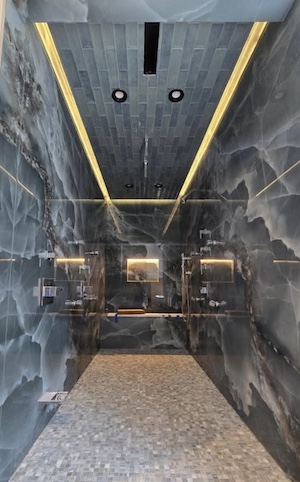
She recently partnered with CTI- and ACT-certified Joe Macaluso, Owner of Modern Room Remodels in East Hanover, N.J. Metheny focused on a layered lighting design for a stunning shower installation that resonated with the client on an emotional level. The project included:
• Cove lighting to create ambient illumination around the perimeter, adding softness and warmth.
• Ceiling can lighting for general illumination, ensuring the space was well-lit without overpowering the tiles.
• Niche lighting to highlight the architectural features and provide task lighting where needed.
The products specified by Cameo Studio Designs included:
• Waterproof COB (Chip on Board) lighting with track systems for flexibility.
• Dimmer capability to adjust the ambiance, allowing the space to be tailored to the client’s needs.
• Custom niche lighting to accentuate the focal points within the shower.
• 4″ waterproof can lights for task lighting and to ensure the space was both functional and beautiful.
Metheny notes that materials like waterproof LED products and dimmable systems provide flexibility in design and function. “Techniques such as integrating cove lighting, niches, and task lighting into the tile layout can significantly elevate the space,” she said. “Always ensure the materials are durable and suitable for wet environments, like waterproof COB lighting or custom fixtures designed for the specific needs of the installation.”


Products to enhance your project
Not sure what products to choose for adding a luminous dimension to your project? Here are just a few options you can choose from.
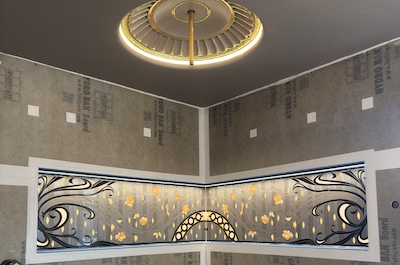
Illuminiche – Illuminiche low-voltage lighting solutions are designed and manufactured in the U.S., and feature a magnetic coupling system that allows for serviceable lighting and ease of placement for a range of lighting effects. Other features include integrated dimmer/driver switches, and three-color temperature range. Choose from stock and custom niches, architectural line lighting, back lighting, custom lighting like counter tops, artisan mosaic designs, and accent lighting as well as cut-anywhere COB for wet and dry areas. Products come with a 5-year manufacturer warranty.
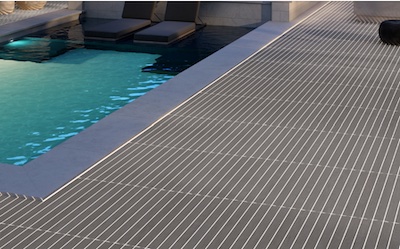
Emser Tile – Radiant Wall and Radiant Floor are part of an award-winning illuminated porcelain tile collection for walls and floors, part of the Enhance line. Radiant combines an extruded glazed porcelain stile with integrated LED lights that set surfaces aglow. Radiant Floor comes in six natural shades and two sizes, with channels that hold LED lights and drain water, and surfaces that feature a R11 anti-slip finish.
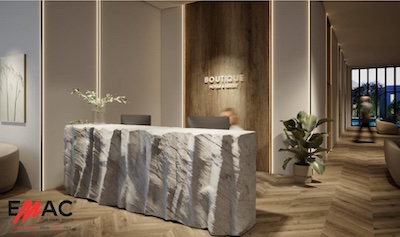
EMAC – EMAC’s Eclipse Sunset Collection infuses interiors with warm, soothing light, courtesy of LED strips or channels for lighting. Choose from the sleek Novoescuadra Eclipse Sunset corner profile; Novorodapie Eclipse Shadow slim, dual-color aluminum baseboard that creates a floating wall illusion; and Novotri Eclipse, multipurpose aluminum profile that functions as a decorative listel, minimalist baseboard, or ceiling trim.
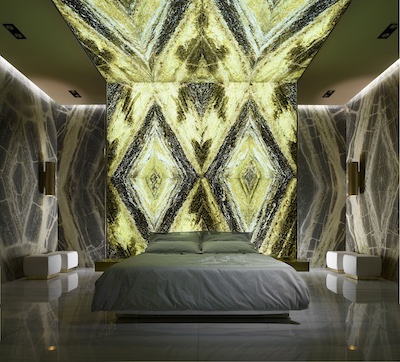
Antolini -If you are looking for granites, quartzes and marbles that are easy to illuminate, check out Antolini’s Alluminate and Allight lines. Alluminate is a process that reduces the thickness of the slab without altering its aesthetics or robustness, and Allight creates a translucent slab that combines natural stone and a glass backing. The backlit stones house dimmable RGB LED panels with low power consumption, and variable light colors and temperatures.

Lesley Goddin has been writing and journaling since her first diary at age 11. Her journey has taken her through a career in publishing and publicity, landing her the editor position of TileLetter and its special publications in 2006. Her goal is to educate, inspire, recognize and encourage those in the tile industry -- especially the tile and stone contractor.