
New partnership could be key to bolstering the domestic tile industry as a whole.
Attrition is impacting the domestic ceramic tile industry at both the production and installation level. A new initiative between U.S. tile producers and the state of Tennessee, where most factories are located, could be the key to solving both sides of the problem.
Spearheaded by the Tile Council of North America (TCNA), the Tennessee Workforce Development Project has united stakeholders from Tennessee’s nine tile manufacturers with state economic development and education representatives to create a curriculum that will be taught in technical schools across the state beginning this fall.
The initial focus is on shoring up the production side through education and training at the plant operator level—the largest staffing component and need—but the model is envisioned to be a blueprint for other areas of the industry.
During a Coverings panel earlier this year, representatives from TCNA and several of the U.S. tile producers involved gave an overview of the process and goals. They also alluded to the partnership’s potential impact on the industry as a whole.

Developing a culture of creation
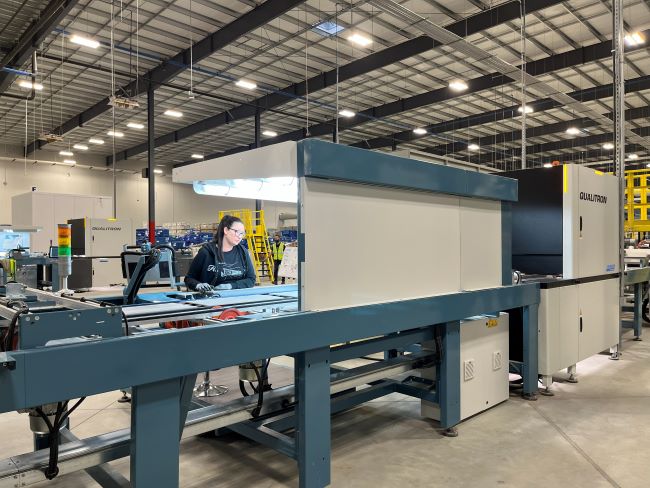
As with the installation side, the shortage of skilled ceramic tile factory workers is multifaceted. Experienced employees are retiring faster than they are being replaced. A general move away from the trades has diminished not only the number of candidates on the front end, but also the awareness of industry careers. And, as the nation has embraced college over technical paths, there can be a stigma associated with blue collar jobs.
Manufacturing and installing tile are technical processes, and the best way to learn is from an expert in the field. In countries like Italy and Spain, where the tile industry dominates, historic and cultural components help feed the industry. The work is considered a valued trade and the skills are passed from one generation to the next.
“It’s always a different day—there’s a different defect, a different opportunity, a different solution,” said Jed Durbin, who helped get Portobello America’s factory up and running as Vice President of Manufacturing and Outsourcing and is now a member of the board of directors. “So, the knowledge and the depth of the knowledge that you have in the tile industry is crucial. And that’s something that the U.S. doesn’t have. We hope to build that…with this initiative.”
Training and retaining homegrown talent
Attracting people to the industry is one thing; keeping them is another. And in tile’s fast-moving, high-tech production environments, it’s crucial to have experienced employees who can uphold best practices and troubleshoot should anything go wrong.
“This is one of our main priorities: to make sure that the knowledge that we are building here stays here,” said Renato Ramos, Head of Marketing and Transformation for Portobello America. Like many producers, the company brought in experienced specialists from around the world to help get the plant operational.
The pandemic hit U.S. manufacturing particularly hard. As of late 2025, the sector still had not fully recovered its pre-pandemic employment numbers, the National Association of Home Builders reports.
“Everything started with the acknowledgement that all of us as manufacturers—especially after all the disruption that COVID brought to our industry—had a problem,” said Filippo Sgarbi, CEO of Landmark Ceramics and current TCNA President. “And everything started from looking at the problem and realizing that the best way to tackle that was to approach it at an industry level instead of trying person-by-person, company-by-company to find solutions.”
Aligning values of industry and state
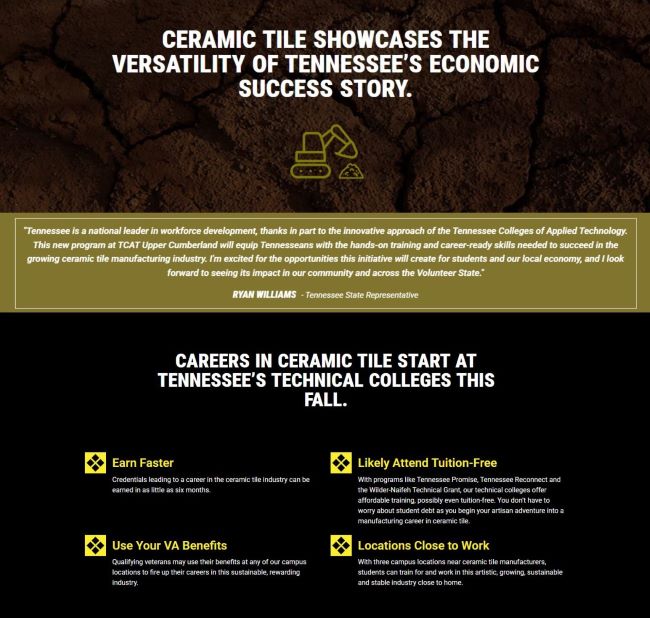
Tile’s artistry and performance characteristics have long been touted as meaningful differentiators on the consumer side, but such value propositions were largely lacking from other aspects of the industry.
The new initiative seeks not just to attract workers but to align with the right ones by imparting how the field can support them and their community, as well. “It’s not just about jobs, it’s not just about how you get paid; it’s about the values of our industry,” Sgarbi explained.
Stewardship, community, craftsmanship, legacy—those same values align well with the Volunteer State’s culture, which is rooted in heritage.
TCNA Deputy Executive Director Bill Griese stressed that the “mini-industrial revolution” in the domestic tile sector depends on building the culture. “If you look at any great industry in any great region of the world, there’s a culture associated with that industry,” he said. “The way they’ve achieved that culture is through initiatives like this, through…including the private sector, the public sector, but also academia in these efforts.”
Workforce development initiatives to the rescue!
Tennessee is already known as a business-friendly state, offering land deals, tax incentives, and infrastructure support. To help cement these investments, Gov. Bill Lee recently allocated $1 billion to workforce development initiatives. So, when Sgarbi and Michael Kephart, who is leading the Tennessee Workforce Development Project for TCNA, went to speak with state leaders, they found a receptive audience.
“They were able to put together, in a very short time, a team with a clear leadership from their side that started working with us in order to find the best way for them to help us,” Sgarbi said.
Enter the Tennessee Board of Regents (TBR), which oversees the 22 Tennessee Colleges of Applied Technology (TCATs) and 13 community colleges. Armed with the industry’s value proposition and TBR’s academic expertise, TBR quickly developed a plan to shore up the state’s ceramic manufacturing hub through a new Tile Manufacturing Operator career pathway at TCAT schools. The curriculum was finalized in partnership with the state’s eight tile manufacturers in April. It will be piloted at three TCATs this fall before spreading to the rest of the eight schools closest to the plants.
“There’s no coincidence that the colleges and universities in Bologna and Sassuolo support these kinds of initiatives,” Griese said, referencing the cradle of ceramic manufacturing in Italy. “It’s no coincidence that ITC [the Institute of Ceramic Technology] in Spain has programs dedicated to educating future workers and operators in the ceramic tile factories in Spain. So, that’s the missing link.”
The promise of TCATs
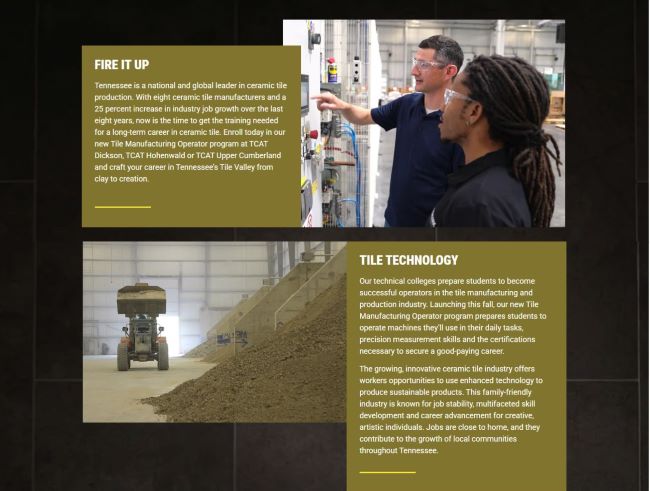
TCATs are attractive to the state’s students because they offer significant cost savings compared to universities, and they allow graduates to begin earning meaningful income in as little as six months.
To attract students to the new tile education program, TCNA is working with TBR to bring to life not just the tile industry’s career opportunities but also the quality of life they imbue.
“I know that I’m speaking to the choir when I say that the tile industry is incredibly unique in the benefit it offers employees to really grow and develop within their career,” said Ryann Coyle, Manager of Technical Marketing and Sustainability Initiatives for TCNA.
The promotional materials, including a microsite, social media, and video content featuring real stories from plant employees, are live, serving as a recruitment tool for the program—one of TBR’s four major workforce development priorities.
Pride and passion: the power of alignment
Baking the industry’s culture into that of Tennessee is seen as a powerful tool that will create something much bigger than a sustainable workforce: alignment. The power of alignment is passion, which fuels dedication, craftsmanship, innovation, heritage, promotion, and a shared identity.
“When Tennesseans travel to other parts of the world, they’ll be proud to say, ‘Oh yeah, I come from a state where all the tile is made,’” said Griese. “And they may not even be within that industry, but that’s the identity we want to create—and that’s the secret to industrial growth.”
Already there are ideas about how this could spawn even greater growth within the domestic tile sector, like new educational pathways for other production roles, ongoing training for existing plant operators, and coordination with other arms of the trade, plus the creation of a cluster of broader industry within the state.
“We’re going to make sure that every one of the eight manufacturing plants that’s involved aligns with their TCAT and aligns with this labor process coming in and is successful,” Griese said. “And beyond that, the state of Tennessee says to us, ‘So, what’s next?’
“I believe anything is possible,” he noted. “Because one of the best takeaways from this is that we now have a blueprint, a template…that I’m optimistic we can apply to other, not just trades within our industry, but other states as well.”

Jennifer Bardoner
After falling in love with ceramic tile as a writer for Floor Focus magazine, Jennifer Bardoner was lucky enough to land with the National Tile Contractors Association and its magazine, TileLetter. In addition to the sector's artistry and passion, she especially appreciates the camaraderie. The community mindset resonates with her—she spent nearly two decades as a writer and editor for her hometown newspaper and its lifestyle magazines, seeking to unite her local community through approachable storytelling.