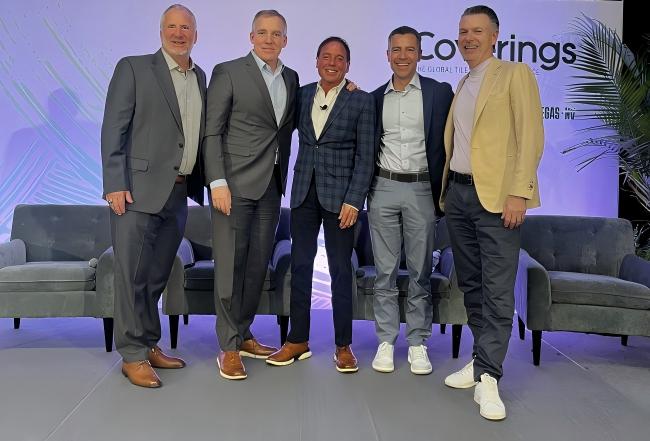
Leaders share real-time insights from Coverings 2026
At Coverings 2026 in Las Vegas, one question echoed across the convention floor: “What is truly happening in the tile industry?” To answer that question, the panel “Inside the Industry: Leaders on Tile Today” brought together some of the most respected voices in manufacturing, distribution, and strategic advisory, moderated by Bruce Zwicker, Owner of Zwicker Advisory and former CEO of J.J. Haines.
What emerged was not a narrative of decline, but one of recalibration. In a market shaped by volatility, shifting consumer behavior, and macroeconomic pressure, tile continues to prove its resilience. While many segments of the flooring industry have struggled to regain momentum following the post-COVID correction, tile has quietly outperformed. Flat performance in today’s market is not a sign of stagnation—it is a sign of stability. More importantly, it is a signal that the industry is positioning itself for the next cycle of growth.
Market reality: stability in a volatile environment
Tile is a great category for us due to good margins and lower claims. Tile is well diversified in the residential and commercial markets.
Raymond Mancini, Jr., CEO of UCX
Zwicker presented data during the discussion that reinforced a critical point: demand in the tile category has remained relatively stable in dollar terms, even as unit volume has declined.
This reflects pricing strength, product innovation, and continued relevance across multiple channels. Imports still represent a significant portion of supply, accounting for the majority of volume, yet domestic manufacturing is beginning to gain strategic importance.
The industry is no stranger to disruption. Since 2008, it has weathered waves of global competition, supply chain challenges, and economic uncertainty.
What makes the current environment unique is the speed at which conditions are changing. Tariffs, energy costs, and geopolitical tensions are influencing decisions daily. In this environment, businesses are being forced to operate with agility and clarity—balancing short-term pressures with long-term opportunity.
Innovation and design drive growth
The manufacturing capabilities of larger and thinner tiles have opened up greater opportunities for tile to dominate the market, especially in the exterior marke
Bart Bettiga, NTCA Executive Director
A major theme of the panel was innovation. Over the last decade, advancements in digital printing and manufacturing have transformed tile into a designdriven product category. Tile is no longer competing solely on durability, it is competing on aesthetics, versatility, and performance.
The development of large-format and thinner tiles has significantly expanded the application of tile, particularly in exterior environments and high-end design projects. These innovations are opening new markets and increasing per capita consumption. However, they also introduce complexity in installation, requiring a highlytrained workforce capable of executing at a higher level.
Economic pressures and consumer behavior
Tile remains a fashion-forward product. Due to discretionary spending in all of the three commercial, builder, and residential remodel segments, I think the industry has done a good job at differentiating itself [aesthetically], based on its historical characteristics of lifecycle and durability, which plays as a strength for all of us.
Scott Maslowski, Dal-Tile Executive Vice President of Sales and Operations
While innovation continues to push the category forward, macroeconomic conditions remain a significant headwind. Rising energy costs, inflation, and interest rates are influencing both business operations and consumer decision-making.
Flooring, particularly in the residential segment, is often a discretionary purchase. When uncertainty increases, projects are delayed, rather than cancelled. Consumer confidence has emerged as one of the most critical variables for our industry. Until interest rates begin to decline and affordability improves, many homeowners will remain hesitant to invest in large-scale remodeling projects. At the same time, there is significant pent-up demand waiting to be released.
Years of deferred spending, combined with aging housing stock and strong home equity positions, suggest that when conditions shift, the industry will experience a meaningful rebound.
Labor, backlog, and the risks ahead
I think this year will be a fight. There are new technologies and innovations on tile, so hopefully good headwinds become better.
Brent Emore, AHF CEO
From a contractor perspective, the conversation highlighted a shift in concerns. While labor shortages have dominated the industry for years, some contractors are now expressing concern about maintaining a backlog and filling schedules into late 2026 and beyond. This reflects the broader uncertainty in the market, particularly within certain commercial segments.
“The commercial side of our members has been good, but I am hearing they are worried about filling their backlogs in 2026 and into 2027,” said Bettiga. “High-end residential remodel seems to be holding steady.”
At the same time, there is a growing concern about the quality of labor entering the market. As cost pressures increase, there is a risk that less-qualified labor will be introduced, potentially impacting installation quality and long-term performance. Maintaining standards, investing in training, and reinforcing professionalism will be critical to protecting the industry’s reputation.
Consolidation and strategic positioning
Another major theme was consolidation. Across distribution, manufacturing, and retail, the industry is experiencing increased activity from private equity and large-scale acquisitions. This trend is reshaping the competitive landscape and creating both challenges and opportunities for independent businesses. Organizations that can differentiate through service, expertise, and relationships will be best positioned to compete in a more concentrated market.
Preparing for the next cycle
The overarching message from Coverings 2026 was clear: the tile industry is not waiting for certainty—it is learning to operate without it. The companies that will lead the next phase of growth are those that prepare now—investing in people, strengthening relationships, and embracing innovation.
At NTCA, we remain committed to supporting that journey. Through training, advocacy, and industry leadership, we will continue to equip our members with the tools they need to succeed. The demand will return. When it does, those who are prepared will lead.

Bart Bettiga is the Executive Director of the National Tile Contractors Association. Bettiga is a member of the Board of Governors of Coverings, one the largest tradeshows in North America. He has over 30 years of experience in the tile and stone industry and has served as the NTCA Executive Director since 2002. He is a well known speaker and author on ceramic tile and natural stone distribution and installation. He oversees the financial operations of the NTCA, TileLetter and the Ceramic Tile Education Foundation.