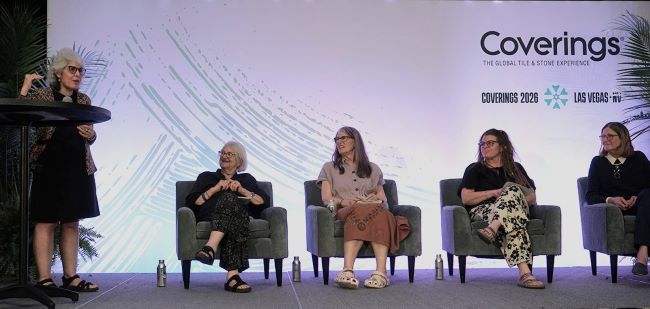
At this year’s Coverings show, four accomplished artisan women from across the tile industry came together for a panel exploring their individual specialties and the deep connections linking history, craftsmanship, artistry, and installation. I had the privilege of moderating the “Women Talking: Connecting History, Artistry & Industry” discussion, using the concept of Indra’s Net as a guiding metaphor. In this infinite web, each intersection of strands supports a jewel, which reflects all others. Within the tile industry every role, from preservation to production to installation, is interdependent, each contributing to a larger, unified whole.
The “jewels” sparkling on the panel included: Sheila Menzies, Co-Founder of the Tile Heritage Foundation; Katia McGuirk, Executive Director of TileWorks of Bucks County; Angie Ré, Founder of Unique Mosaics, LLC; and Jan Hohn, Owner of Hohn & Hohn, Inc. Together, their experiences illustrated how the industry thrives on collaboration, shared knowledge, and respect for both tradition and innovation.
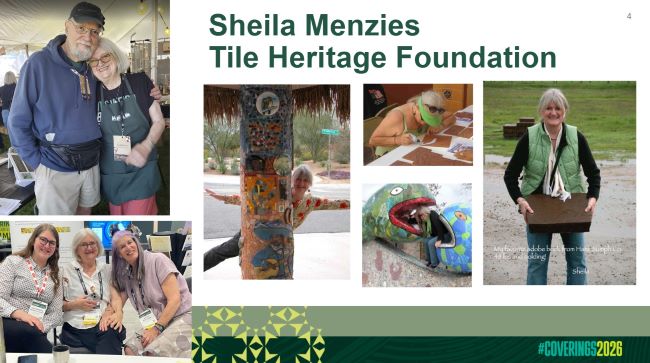
Menzies opened the conversation by recounting the origins of Tile Heritage Foundation, which she co-founded in 1987 with Joseph Taylor. At that time, she explained, there was no coordinated effort to preserve the history of American tile. Recognizing this gap, they stepped in as “guardians” of the industry’s legacy. Over the decades, the Foundation has grown into a vital resource, safeguarding archives and fostering awareness of tile’s cultural and artistic significance.
Today, the organization is evolving to meet contemporary needs. Here are some of the changes instituted within the last year:
• Relocating the bulk of its archives to the Tile Council of North America (TCNA) campus in Clemson, S.C., which will improve access for researchers, professionals, and the A&D community
• A redesigned website with expanded digital reach
• Additional board members to better represent the diversity of the industry
• The hiring of industry veteran Karim Motawi as Executive Director of Development to spearhead growth
At Coverings, the Foundation launched the National Tile Installation Registry. This platform allows both historic and contemporary tile installations to be publicly documented, creating a living record of the craft.
“These changes are an invitation to engage in more partnerships,” Menzies said. “We would like more people—installers, artists, manufacturers—to see themselves as contributors and to value themselves within the industry. They can have a sense of validation that is mirrored back for them by opening files at the Foundation.”
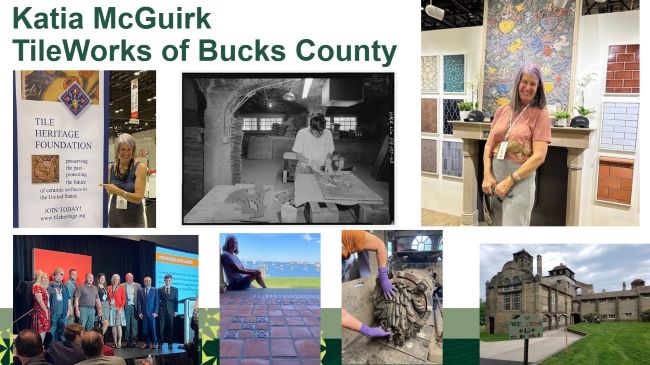
As Executive Director of TileWorks of Bucks County, McGuirk oversees a National Historic Landmark in Doylestown, Pa., that functions as both a working factory and a museum. The facility continues traditions established by Henry Chapman Mercer, an archaeologist-turned-tilemaker who built the factory around 1911-12. Mercer’s work, including extensive installations in the Pennsylvania State Capitol, reflected his belief in the dignity of labor and the value of handcrafted artistry at a time when industrialization threatened to overshadow it.
McGuirk noted that Mercer’s concerns remain relevant today, particularly in the context of emerging technologies like artificial intelligence. “Different technology, same question: what do we lose when we forget how to make things?” she asked.
At TileWorks, the answer lies in maintaining a balance between preservation and progress, just as its mission bridges artistry and industry. Modern updates, such as gas-fired kilns, coexist with traditional glazes, molds, and handcrafted tile.
Education and community engagement are central to this mission. TileWorks hosts events ranging from music festivals to hands-on workshops and holiday events, inviting the public to experience tilemaking firsthand.
TileFest, an annual event co-sponsored by the Tile Heritage Foundation (of which McGuirk is a board member) and held the third weekend of May, exemplifies this approach. It brings together tile makers, artists, collectors, designers, and the “tile curious,” blending marketplace activity with storytelling and learning. For the past few years, artisan tile setters who have completed the Artisans Revolution in Tile (A.R.T.) training program have fabricated a mosaic with power tools at the fest, wowing visitors with what can be done with tile. At TileFest, people come for the tile and leave inspired and with a sense of belonging.
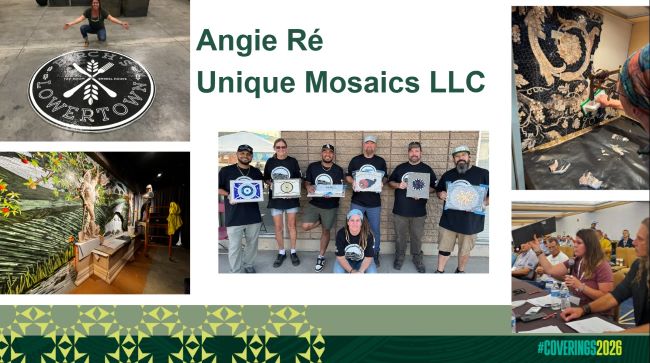
Ré’s journey highlights the transformation of artistry into a thriving business. Based in South Salt Lake, Utah, she creates award-winning custom mosaics from glass, stone, and ceramic. Her work spans styles from traditional Byzantine techniques to contemporary geometric designs, tailored to clients’ specific visions.
Ré began her career as a “starving artist,” working at her kitchen table with basic tools while juggling multiple jobs. Over time, she developed her skills and built a reputation for high-quality, intricate work.
Today, she collaborates with designers, homeowners, and architects, translating ideas into detailed mosaic compositions. Her process involves not only artistic interpretation but also technical decision-making, from material selection to tile flow and installation methods.
A key aspect of Ré’s contribution to the industry is her involvement in education and standards. Frustrated early on by a lack of resources for fledgling mosaicists, she helped develop guidance for mosaicists through her work with the NTCA Technical Committee. In collaboration with other experts, she contributed to an NTCA Reference Manual chapter on pre-mounting techniques, which allows complex mosaics to be assembled off-site and installed more efficiently as a unit. Pre-mounting reduces errors, saves time, and makes sophisticated designs more accessible for artisan tile setters and those working on traditional projects.
Adhering to industry standards is important to Ré. Whether creating or installing mosaics, she integrates best practices to ensure durability and quality. “I like to use proper national standards for tile installation when I am installing, whether I am building a pre-mounted mosaic or if I am installing it on-site,” Ré said.
Each fall, Ré carves out a weekend to share her expertise with a small class in her studio, but this December 7-11, she will instead teach a mural-building class at a location in Belize hosted by Mike Maness of iTile.
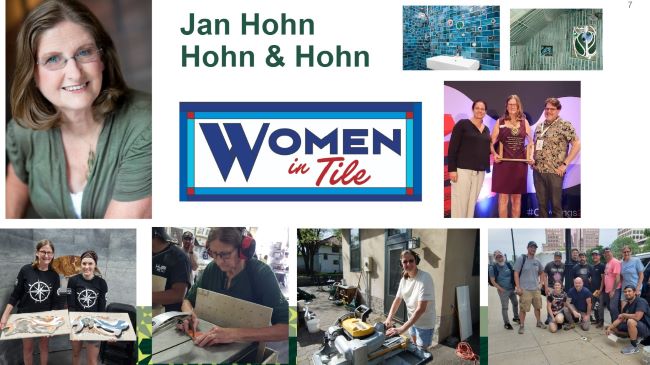
Hohn brought the discussion full circle by emphasizing the critical role of installation. As an award-winning contractor with more than three decades of experience, she understands that even the most beautifully crafted tile depends on proper installation to achieve its full potential. Hohn & Hohn, Inc., based in St. Paul, Minn., has built its reputation largely through word of mouth, reflecting the trust it has earned within its community.
Hohn has achieved several milestones in a traditionally male-dominated field. She was the first female NTCA member to attain the Certified Tile Installer credential (#211) and the first woman to serve on the NTCA Technical Committee. She is an NTCA Five-Star Accredited Contractor, a designation that recognizes exceptional craftsmanship and adherence to rigorous standards and positions her as a resource for other professionals who seek guidance. She also serves as the Community Outreach Chair for NTCA’s Women in Tile group.
Hohn appreciates the uniqueness of handmade tile but acknowledges its challenges. Variations in color, shape, and texture require careful planning and patience. To address this, she creates full mock-ups before installation, allowing her to balance color distribution and anticipate potential issues. While imperfections are inherent in handmade materials, she views them as part of their charm.
“When you put handmade tiles together on a backsplash, a hearth, a shower, a bathroom, you’re creating art,” she said. “It’s a one-of-a-kind installation. There’s never going to be another installation like it.”
Hohn is currently developing a comprehensive guidebook on installing handmade tile, building on her previous handmade-tile tip sheet in the NTCA Reference Manual. Her goal is to provide practical insights that help installers navigate the complexities of working with artisanal materials while maintaining high standards of quality.
During the panel’s question-and-answer session, an audience member with a background in mechanical engineering expressed appreciation for the discussion’s focus on creativity. She noted that technical fields often overlook artistic expression, and she found inspiration in the panelists’ ability to integrate both. This observation underscored the central theme of the conversation: the tile industry thrives at the intersection of technical precision and creative vision.
Watch the full panel discussion here.

Lesley Goddin has been writing and journaling since her first diary at age 11. Her journey has taken her through a career in publishing and publicity, landing her the editor position of TileLetter and its special publications in 2006. Her goal is to educate, inspire, recognize and encourage those in the tile industry -- especially the tile and stone contractor.