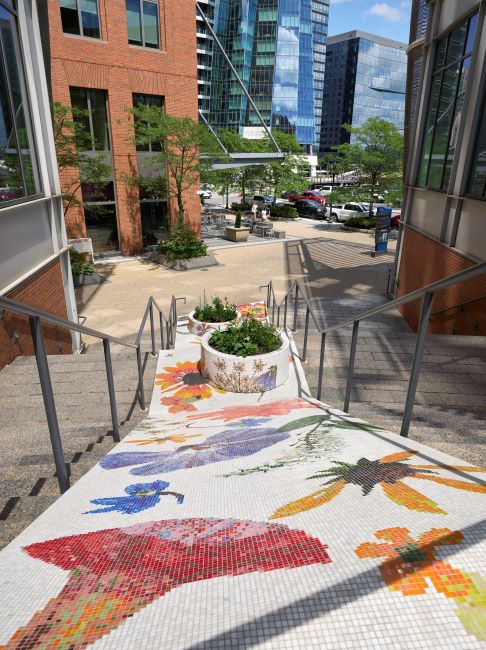
Artist Carly Glovinski has always been inspired by the fleeting beauty of nature. So when financial services firm Fidelity commissioned her to create a massive, three-story mural for Boston’s Seaport Square, Glovinski didn’t just paint a design; she grew it.
The project began with flowers Glovinski grew herself, pressing them to preserve their true shape, and using that as the inspiration to create a series of paintings. Instead of attempting to physically preserve the fragile plants, she recreated them in watercolor-like layers of acrylic paint on translucent paper, capturing their color, softness, and fleeting quality.
From paint to tile
Transforming a public space into a large-scale work of art required a nimble approach that accounted for the installation’s complexity and the precision required to execute it successfully.
Once the art itself was finalized, the paintings needed to be transformed into a format that could be applied to an outdoor installation designed to stand the test of time. To do so, Boston-based tile manufacturer Artaic digitally mapped and pixelated Glovinski’s paintings, converting them into thousands of tiny sections, each assigned a specific color.
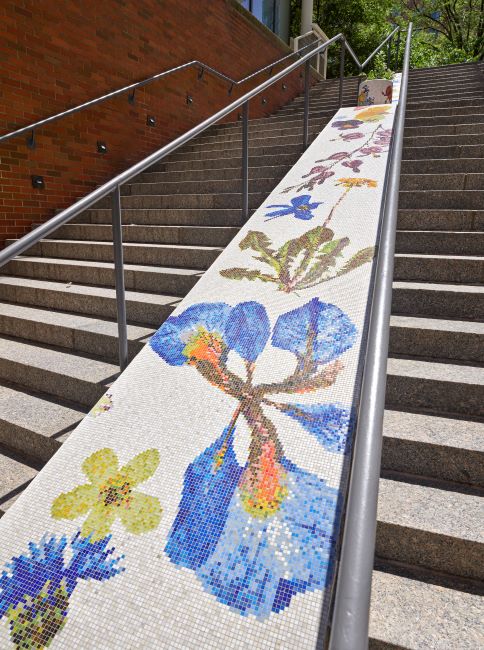
The vision became a reality when Artaic paired its digital tools and tile-making technology to create a mosaic with 37 glass colors depicting flowers such as pansies, daffodils, irises, cosmos, and dahlias across thousands of small tiles.
At the heart of the installation were construction materials hand-picked to support a comprehensive tile job—one that featured sloped surfaces and complex angles. The project team knew they needed high-performance materials, and found their solution in durable, high-strength adhesives and grouts that combine sag and stain resistance with excellent workability and long-term color consistency.
LATICRETE’s technical expertise, support, and solutions would prove to be instrumental in enabling crews to meet aggressive timelines and bring a local artist’s vision to life through an outdoor mural designed to serve the community for decades.
Vitreous glass, complex angles, and coastal environment test the materials
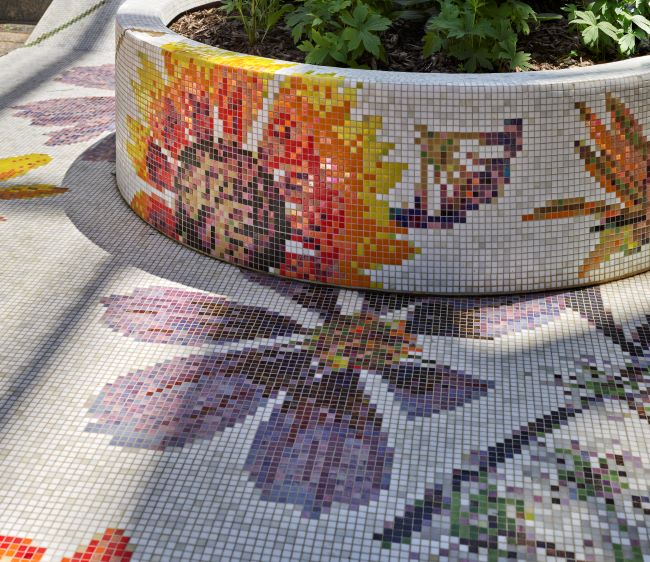
Inspired by Glovinski’s pressed flower paintings, the threestory mosaic needed to preserve the softness, movement, and layered detail of her original artwork while adapting it to a highly complex architectural environment. But there were challenges.
- Vitreous glass mosaic: The weight and density of Artaic’s 1/2” vitreous glass mosaic sheets created major installation challenges across the mural’s vertical and sloped surfaces. To prevent the intricate floral imagery and carefully-mapped grid from slipping, sagging, or shifting out of alignment before the adhesive could set, the installation demanded a specialized bonding solution.
- Sloped surfaces and complex angles: Glovinski envisioned the design wrapping vertically over the top surface of the stairs, which included level and sloped planes. Bringing this concept to life required on-site ingenuity and hand-built sections, supported by LATICRETE installation solutions that provided great workability along with the bond strength needed for the mosaic. The project’s uneven surfaces and angles required Artaic’s engineering team to carefully design and fabricate each section for a precise fit. Working across shifting elevations, tight transitions, and non-uniform substrates added complexity, as each panel needed to be digitally mapped and adjusted in real time to maintain alignment and continuity throughout the installation.
- Climate and seaside location: The Boston Seaport location exposes the mural to constant exposure from salt air, wind, moisture, and year-round coastal weather. These conditions can accelerate deterioration and test the longterm bond strength of tile installations. To withstand the waterfront environment, the installation required tile grouts and adhesives engineered for superior durability, chemical resistance, and long-term adhesion. In addition, the project was completed from May through July, while peak summer heat added strain to installation and field conditions.
LATICRETE system meets all challenges
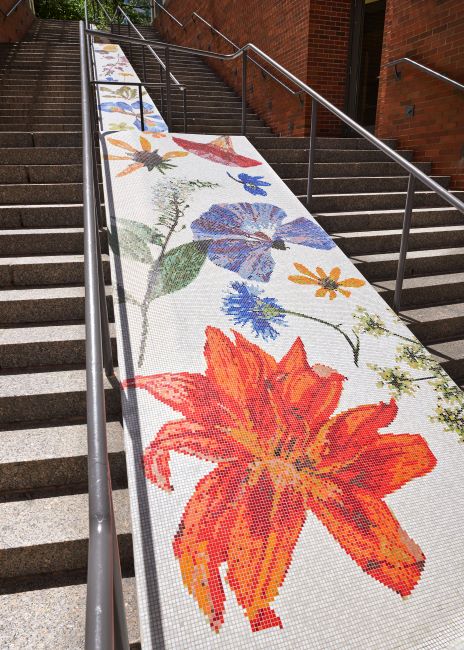
Artaic’s 1/2” vitreous glass was chosen for the intricate design due to its vibrant color, brilliance, and durability. Despite the mural’s scale and complexity, the tile installation had to be executed on an aggressive less-than-two-week timeline. To meet this demand, LATICRETE provided comprehensive technical support and recommended a highperformance epoxy system, a specialized bonding solution engineered for challenging substrates.
The installation began with crews grinding down the existing granite slab surface to correct imperfections and create a roughened profile for optimal bonding. Crews then applied a skim coat of LATAPOXY® 300 Adhesive to smooth out the prepared substrate. Because Artaic’s 12” x 12” tile sheets feature 1/2” vitreous glass squares, the installation required an adhesive with exceptional grab, zero vertical slip, and a rapid cure time.
To avoid any chance of efflorescence negatively affecting the floral design, the installation team was advised to use SPECTRALOCK® PRO Premium Grout for the mosaic tile joints and LATASIL™ 100% silicone sealant for the perimeter joints. Traditional cement-based grouts are highly susceptible to efflorescence—unsightly, powdery salt deposits that migrate to the surface. This LATICRETE recommended combination eliminated that risk while delivering the high bond strength and durability required.
Even with its high performance and chemical resistance, the adhesive is watercleanable, making it a more approachable, installer-friendly solution that simplifies application and cleanup, particularly important for detailed mosaic work.
“Low temperatures and strong winds off of the Boston Harbor sped up material behavior and shortened installation windows,” said Peter McKeon of LATICRETE. “That made fast, consistent, and predictable curing essential to keeping installation efficient without compromising quality, reliability, or long-term durability.”
LATAPOXY® 300 Adhesive conforms to ANSI A118.3 and ISO 13007 with an R2 classification, possesses a Health Product Declaration (HPD), and is UL GREENGUARD certified for low VOC emissions.
The project team also specified SPECTRALOCK® PRO Premium Grout to help preserve the Opelske mosaic’s visual integrity by delivering long-term color consistency and stain resistance across the intricate glass tiles. In the outdoor, moisture-prone seaport environment, its epoxy formulation resists cracking, shrinking, discoloration, and its antimicrobial properties help inhibit the growth of stain-causing mold and mildew, keeping joints clean and colors vibrant. Its durability helps to ensure the delicate floral imagery and nuanced palette of the mosaic remain sharp and cohesive, supporting the artistic intent of Glovinski’s pressed flower design while reducing long-term maintenance needs for the mural. The grout also supported a more sustainable installation, also backed by an HPD and UL GREENGUARD certification.
“I’ve been working with LATICRETE products for more than 25 years, particularly for my outdoor projects,” said Branco Perego, CEO of Nationwide Tile, the Lowell, Mass.based installation company. “Thanks to the expertise and guidance of the LATICRETE team, we selected a complete epoxy system for a durable, visually striking work of art engineered to last for years.”
“Loving up” Seaport Square
In Boston’s Seaport Square, Glovinski, Artaic, and LATICRETE have transformed the Westport Stairs into a vibrant garden passage that connects Westport Park to the harbor. Once a simple transition space, it now blooms with native plants like violets and columbines in circular tiled planters, layered with the floral-rich Artaic mosaic, engineered and installed to withstand the demands of a busy waterfront environment. The result softens the waterfront hardscape and brings a burst of seasonal color into a fast-moving urban district.
Officially unveiled in August 2025, Glovinski’s mural is dubbed “Opelske.” On Glovinski’s website, she explains this Norwegian word means “to love up…and cherish something into health and vigor,” borrowed from Celia Thaxter’s An Island Garden. The Opelske mural demonstrates how technical expertise, advanced installation systems, and skilled craftsmanship can successfully transform a delicate artistic concept into a permanent large-scale public work of art.

Lesley Goddin has been writing and journaling since her first diary at age 11. Her journey has taken her through a career in publishing and publicity, landing her the editor position of TileLetter and its special publications in 2006. Her goal is to educate, inspire, recognize and encourage those in the tile industry -- especially the tile and stone contractor.