Kitchens and bathrooms—especially showers—are among the most common areas in a home to receive tile. These wet environments pose unique challenges, because moisture can cause serious damage if installations are not executed correctly. Building a durable, waterproof, and high-performing shower is a critical skill for professional tile installers. Yet not all installers are fully versed in the essential principles and best practices required for long-term success in wet areas.
Classroom instruction: building the foundation
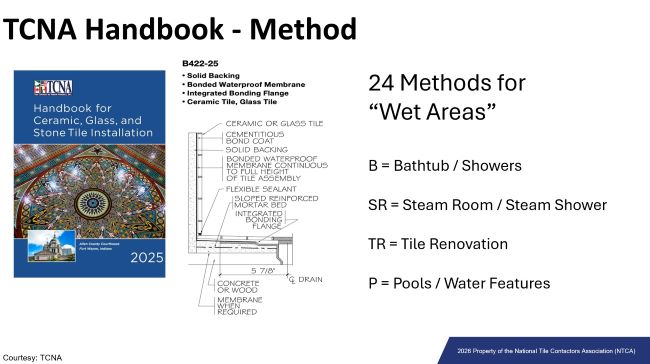
NTCA Training Department Manager Matt Welner explained that the workshop begins by clarifying the difference between complete manufacturer systems and time-tested methods published in the Tile Council of North America (TCNA) Handbook for Ceramic, Glass and Stone Tile Installation. Understanding this distinction is essential for making informed decisions about materials and installation approaches.
From there, instructors break down every required component of a shower system: walls, floors, shower pans, curbs, and drains.
“It doesn’t matter if it’s a $100,000 house or a $10 million house—every shower requires certain things: your walls, your floors, your shower pan,” Welner said. You’re going to have a curb. You’re going to have a drain. There are required components.”
The workshop also explores optional features such as niches, shelves, benches, grab bars, heated flooring, mirrors, towel hooks, and more. While these upgrades can increase profitability, they also introduce additional risk. Each penetration or added feature presents another potential failure point if not properly waterproofed and integrated into the overall system.
Instructors emphasize critical technical standards, including proper substrate slope to drain, wall flatness tolerances per ANSI standards, and best practices for correcting misaligned studs. Participants learn about different types of backer boards, including cementitious backer units, foam panels, and traditional mud methods, and how to select the right system for each application.
The TCNA Handbook’s Product Selection Guide is introduced as a valuable tool for choosing compatible tile, mortars, grouts, backer boards, and waterproofing membranes. By understanding how individual components work together, installers can avoid mixing incompatible materials that compromise performance.
TCNA shower methods and common failures
A major portion of the workshop focuses on shower pan construction methods outlined in the TCNA Handbook.
Instructors concentrate on three common approaches:
- B-421 (surface-applied membrane method)
- B-422 (bonding flange drain method)
- B-415 (traditional water-in/water-out method)
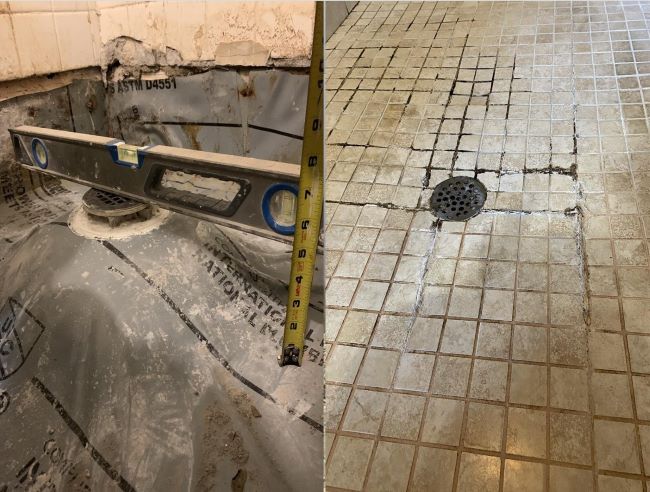
Special attention is given to B-415, one of the most frequently built—and most frequently failed—shower types. This traditional method often involves assembling components sourced separately from lumber and plumbing suppliers. While the TCNA Handbook outlines performance requirements and final assembly standards, it allows flexibility in how installers achieve the result. That flexibility can lead to inconsistencies.
Over time, informal tips and tricks passed between installers can distort best practices, much like a game of telephone, Welner said. Critical steps skipped or misunderstood can result in failures, particularly for less-experienced installers.
From there, the importance of conducting a flood test is stressed. Different kinds of drains and the corresponding TCNA Handbook methods are investigated while illustrating the proper way to build the shower.
Curbs, membranes, and vapor management
The curriculum continues with instruction on building shower curbs and on selecting appropriate waterproofing membranes and vapor retarders. Trainers reference the TCNA Membrane Selection Guide to help participants understand performance ratings and proper applications.
A key clarification involves waterproofing versus vapor management, and the special needs of steam showers. Welner pointed out that not all membranes that meet ANSI A118.10 waterproofing standards qualify as low-permeance vapor barriers. For example, steam showers require membranes with a perm rating of 0.5 perms or less. Simply knowing how to waterproof a standard shower does not automatically qualify an installer to build a successful steam enclosure, he said.
Clearly, one of the things needed in a tiled shower is, well, tile. Not all tile products are suitable for wet environments. The workshop guides installers to the best way to determine tile suitability, especially when using decorative, handmade, artisan, or crackle-glazed tiles that may have absorption or durability limitations.
The classroom portion concludes with mortar and grout instruction. Participants view NTCA’s “Trowel and Error” video, which demonstrates how to achieve proper mortar coverage. Then different grout types are reviewed, including drying and curing requirements.
Movement joints are also discussed, referencing EJ-171 guidelines in the TCNA Handbook. Proper placement of movement joints and attention to changes in plane are especially critical in showers, where temperature changes and structural movement can stress rigid tile assemblies.
Finally, trainers address maintenance, sealing requirements, and proper cleaning procedures to ensure long-term performance after installation.
Hands-on learning
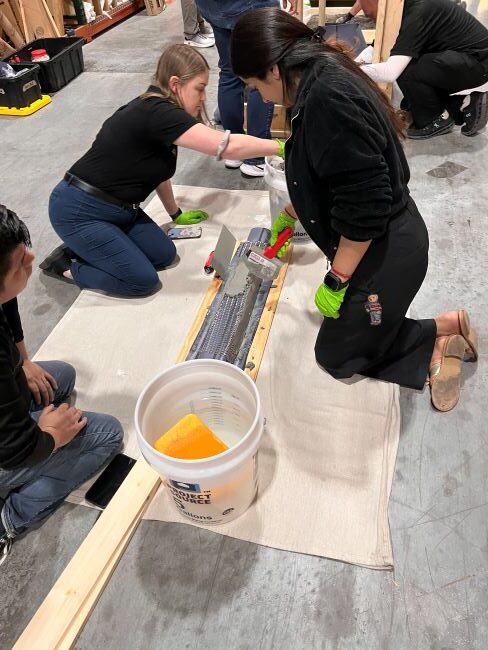
Beyond classroom instruction, the workshop includes hands-on modules that allow participants to practice techniques in a controlled environment. Depending on location, modules may include:
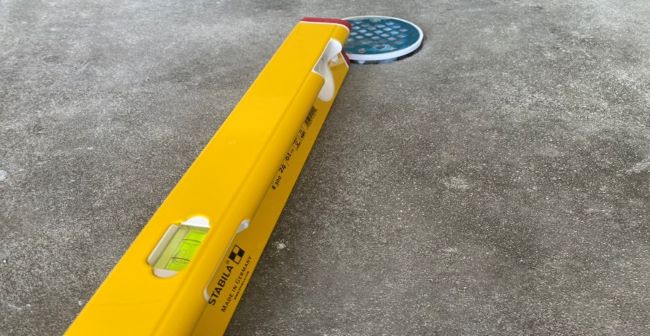
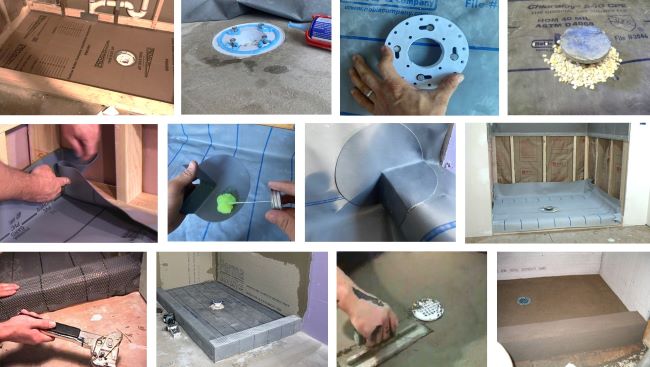
- Constructing a mud pan with a central bonding flange drain.
- Installing a B-415 PVC pan liner with a three-piece clamping drain.
- Cement backer board and foam wall installation.
- Sheet membrane installation.
- Liquid waterproofing membrane application over pre-installed cement backer board.
- Floating a shower curb.
The mud modules have generated particular interest. Even installers who may not regularly build mud pans value the opportunity to learn proper techniques in a safe, supervised setting. Practicing these foundational skills strengthens overall system understanding and craftsmanship.
Industry feedback and additional benefits
Industry professionals have praised the workshop’s clarity and depth. Woody Sanders of NTCA Five-Star Accredited Contractor D.W. Sanders Tile & Stone Contracting in Marietta, Ga., noted that the training benefits both seasoned installers and industry professionals in any role.
“The NTCA Technical Team does an excellent job demonstrating the true complexities of wet areas while breaking down tile industry standards (and in some cases, the lack of them), best practices, and manufacturer-developed systems,” he said. “They clearly explain how today’s wet-area products are designed to work, helping unwind the confusion and truly clarify the subject.”
As with other NTCA workshops, attendees have opportunities to ask questions and learn about professional credentials such as Certified Tile Installer (CTI) and Advanced Certified Tile Installer (ACT).
Additional benefits include networking with peers and vendors, discounts on NTCA membership, free meals, giveaways, and raffles.
Although relatively new, the Foundations of Wet Areas workshop has quickly gained popularity. It has already been requested more than 60 times for 2026 by hosts including Emser Tile, Floor & Decor, Daltile, and D&B Tile Distributors.
Find out where the NTCA Foundations of Wet Areas workshop will be in your neighborhood.

Lesley Goddin has been writing and journaling since her first diary at age 11. Her journey has taken her through a career in publishing and publicity, landing her the editor position of TileLetter and its special publications in 2006. Her goal is to educate, inspire, recognize and encourage those in the tile industry -- especially the tile and stone contractor.