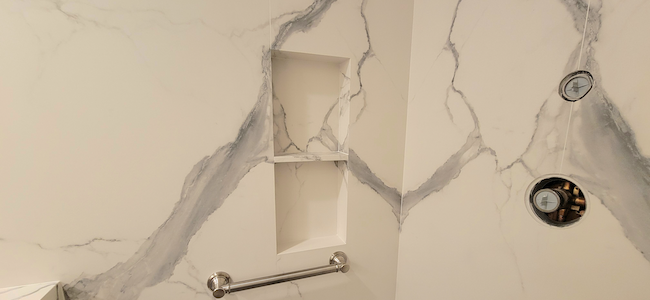
Most folks know the days of “matching” bullnose for your next tile job are just about gone. One current popular trend to replace the lack of matching trim is to miter the edges by various means to create a very narrow joint between the two pieces. There are many opinions in the marketplace on mitered joints, some strongly support this method while others oppose it.
Currently, none of the American National Standards Institute (ANSI) nor the Tile Council of North America (TCNA) documents offer any guidance on this topic. However, the National Tile Contractors Association (NTCA) Reference Manual chapter 9 – “Specialized Installation Procedures” – provides two pages of explanation.
It states, “Miters are typically used at wall returns, outside corners, curbs, benches, columns, recessed niches, and waterfall edges. The concern has become that miters have been taken to a level of tightness that, even though considered a mark of craftsmanship, the possible hazards to the end users and the longevity of the miter itself are being overlooked.”
The NTCA Reference Manual goes on to state, “The inherent nature of the materials being mitered often creates a sharp edge. This is especially true in wet areas where the possibility of slipping and falling could increase the chance of coming in contact with these mitered edges.”


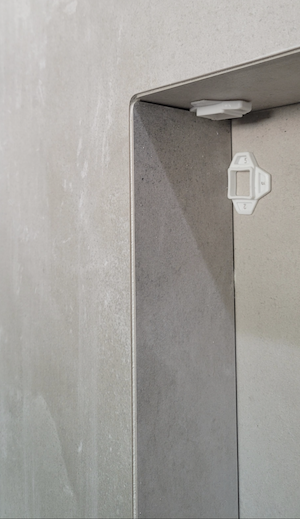
Mitered corners
The most common joints include the quirk miter, used especially in dimension stone projects, and fused miter joints are sometimes known as the knife edge miters.
The Natural Stone Institute (NSI) Dimension Stone Manual defines the quirk miter as “An external corner formed by two stone panels with beveled (usually 45°) edges and blunted, finished noses to reduce the chipping vulnerability of the sharp edges that occur in a common miter. This solution offers a way to strengthen the joint, reducing its vulnerability to breakage, and eliminates the sharp edge.”
Fused miters are formed by employing color-matched epoxies to the miter to fuse them together. This combination allows the miter to be shaped and smoothed to a degree that allows the miter to be fully supported, thus increasing the integrity of the junction, while decreasing the likelihood of breakage.
Besides dimension stone, porcelain tile meeting ANSI A137.3 standards and porcelain panels that are beyond the current standard (6.5 mm) that are 8 mm and 12 mm in thickness are being mitered.
Contractor opinions on miters
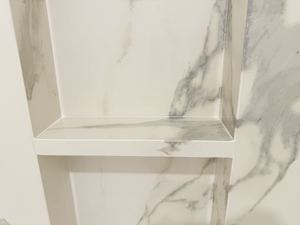
Woody Sanders of DW Sanders Tile & Stone Contracting, Inc. said, “My observations suggest that mitered edges, a technique first appearing on stone countertops (waterfall) and on gauged porcelain tile panels (GPTP), have increasingly found their way into ceramic and porcelain tile installations. This trend often serves as a substitute for traditional profiles or trim tiles that may not be readily available. While some consider mitering a hallmark of craftsmanship, I believe this practice introduces significant, and often overlooked, liabilities for installers.
“Unlike stone, which can be safely profiled to soften its edges, mitering GPTP, porcelain, and ceramic tile leaves several critical issues unaddressed,” he added. “The primary concerns include unsupported edges, increased vulnerability to chipping, and the presence of sharp edges. In my view, the resulting installation is not only less durable but also introduces a safety hazard in environments prone to slips and falls due to those sharp edges.
“One might argue that the latest practice of filling these mitered edges with color-matched epoxy and then shaping them post-hardening, addresses the safety concern,” Sanders continued. “While this might mitigate the sharp edge, it fails to resolve the fundamental problem of edge chipping. Furthermore, it ignores the crucial aspect of movement within the tile assembly. By fusing two pieces of ceramic or porcelain tile together with an incredibly strong bond, any movement will more than probably cause the tile to crack just beyond the miter point – which isn’t even the weakest point of the tile itself. For these reasons, I find the widespread adoption of mitering in tile installations illogical and risky. And I question why so many installers are adopting this as a standard.”
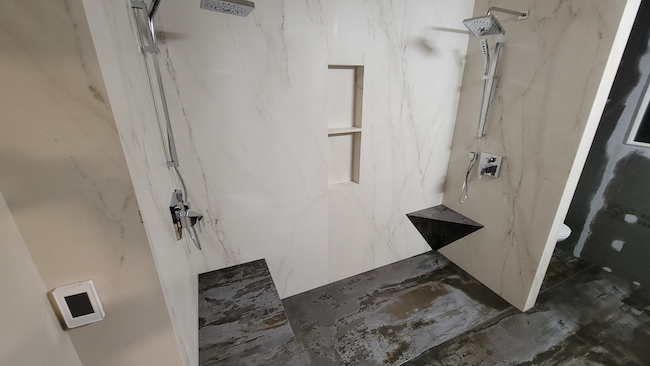
Pavlo (Pasha) Starykov of Star Tile and Stone, LLC took a different view. “Mitered edges provide a continuous look and great aesthetics that especially look great with large-format tile and panels. Such edges, when done professionally, are only one of the components of a bigger assembly that is capable of accommodating for expansion and contraction to eliminate tension in the outside mitered connection between the tiles/panels. For best results, the assembly must be constructed of foam backer board (it is usually not subject to temperature fluctuations), and a flexible mortar that conforms not only to ANSI A118.15 but ISO 13007 C2S1 or S2 (both S classifications stand for improved deformability). The tiles/panels must have a soft perimeter joint along the non-mitered sides.
“We usually don’t laminate the mitered edges with a knife-grade adhesive during the installation, and only apply it to the outside of the mitered edges (not more than 1/16″ to 1/8″ deep) after the mortar which was used to install the panels has dried,” Starykov added. “The space inside below 1/8″ from the edges is filled with the same flexible cementitious mortar that was used to set the tiles/panels. That step ensures that the mitered edges don’t have unsupported areas and are impact resistant. We only use knife-grade adhesives that have zero VOC for health considerations of both the installer and the end-user when the application is performed on-site.
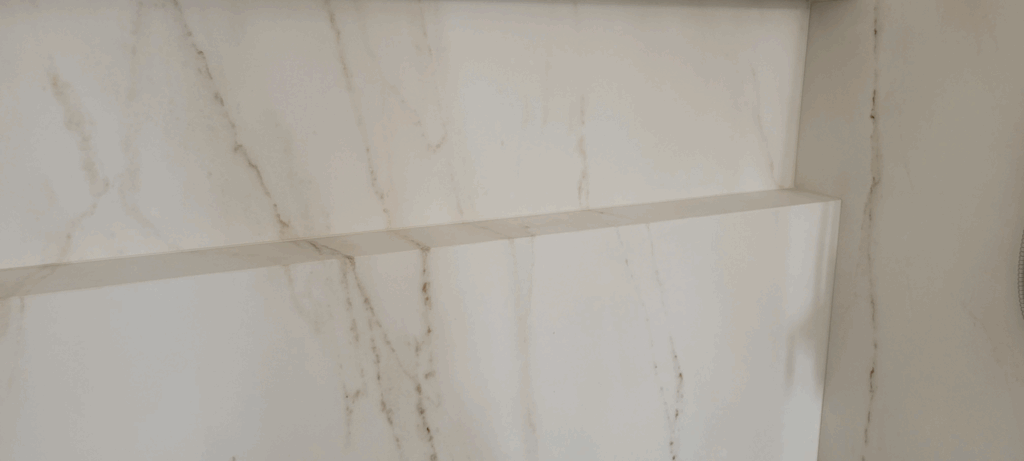
“Full laminating with a knife-grade adhesive is fully acceptable for smaller pieces like vanity/countertop self-edges, and similar custom products that will not be subject to expansion, contraction, and shear stresses,” he concluded.
Lee Callewaert of Dragonfly Tile & Stone Works, LLC enumerated the pros of mitering: “Seamless, clean aesthetic; eliminates the need for additional trim materials.”
Callewaert offered some other considerations. “[There’s a] need to consider the material you are using and whether it can withstand the fabrication of miters (durability). Consider the space and usage of the space. High traffic areas can be susceptible to damage, particularly when certain materials are used like polished porcelain and some natural stone, as they may be chipped or damaged. If you are mitering base and corners to the floor, think about the traffic and things like vacuums that could damage the mitered edges.
“You need to think about the maintenance,” he noted. “Also, when I am mitering corner edges, I think about the use of the space as it pertains to sharp edges and safety. Children’s shower? I always review the choices and the pros and cons with the client, to educate them. It’s a beautiful look and has often been preferred by our clients.”
The use of a metal or plastic profile is another method that can provide a functional and aesthetically pleasing finish. The difference here is that the tile or stone addressing the profile is cut at just under a ninety-degree angle to allow neat and tight fit to the profile, which eliminates a sharp edge.
When considering an edge treatment for a tile or stone installation, do your homework in advance so that all safety considerations – especially in wet areas – are addressed, as well as if the vulnerability and longevity of the joint will meet the needs of the application.
Photo credit: All images courtesy of Pavlo (a.k.a. Pasha) Starykov of Star Tile & Stone, LLC.


Scott Carothers
Scott Carothers is the Acdemic Director for the Ceramic Tile Education Foundation (CTEF) and is responsible for the creation of the Certified Tile Installer (CTI) program, and is involved in the creation of the Advanced Certifications for Tile Installers (ACT) program as well as providing training to others in the tile industry.
Carothers has been involved in the ceramic tile industry for nearly 40 years and was the owner of a successful retail and installation firm prior to CTEF. He has served as President and Chairman of the Board of the National Tile Contractors Association (NTCA), Chairman of the NTCA Technical Committee, was named the NTCA Tile Person of the Year in 2005, and the NTCA Ring of Honor recipient in 2013. He is a voting member of the ANSI and the TCNA Handbook committees.