Yes, you have to use all of them
While trying to come up with a new, exciting PowerPoint for our annual NTCA Webinar, I stumbled upon a veritable breadcrumb trail of “parts and pieces” to explore. These are essential items that are critical, and when they are omitted, forgotten, or value-engineered out of the critical path of installation, lead to trouble.
Play the right “board game”
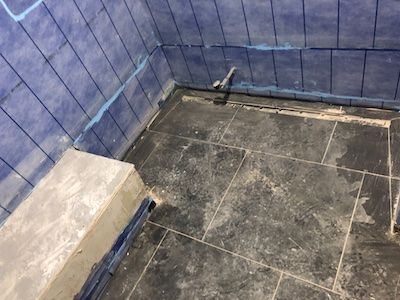
One might think that unacceptable substrate failures are confined to sketchy, low-budget remodels. But high-dollar, four-star hospitality projects have run afoul of successful, long-term performance, due to an unacceptable wall substrate being used. Not every cement backer board can be used outside. Not every lightweight foam board will hold up in a steam room. And the legion of tile industry organizations that weigh in against dry-wall or greenboard in wet areas should be a word to the wise. The correct tile substrate is a very important “part” of the wet area’s legacy performance and success.
Liquid or sheet membrane?
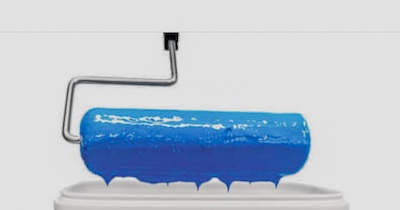
Everyone would agree that you need an effective and robust waterproof membrane for a leak-proof shower, right? Should you choose a liquid membrane, which is easier to apply (and sometimes lower in cost and performance metrics)? Or should you select a composite sheet membrane, with a somewhat higher material and labor cost, but often a faster installation time, and higher permeation and crack isolation attributes? I recommend taking a closer look at ANSI A118.12/high performance data and ASTM E 96 procedure E for permeation (.5 or lower). Then consider how well the membrane you plan on using meets the high-performance metrics of these two industry guidelines.
Curb your enthusiasm
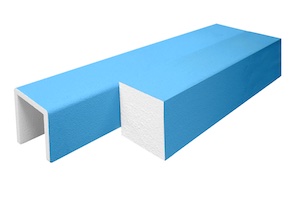
There was a time when building a shower curb was the domain of stacked 2”x4”, membrane, metal lath, and mud. A fair amount of competence and experience with “mud work” was – and is – needed.
Improperly-built shower curbs with incorrectly-installed metal lath may be anchored with staples, tack hammers, or galvanized nails that end up penetrating the curb membrane. Cut cementitious backer unit (CBU) serves as the curb sidewalls, and the curb-top ends up with anchor points for cement board strips penetrating the membrane.
A new “part” is called for: like a solid foam curb, which eliminates the heretofore mentioned punctured curb membrane. In addition, installation takes minutes, and the height, width, and length of each curb is remarkably consistent. Lastly, some pre-fab curb suppliers can offer custom sizing for the curbs as well.
To pea or not to pea
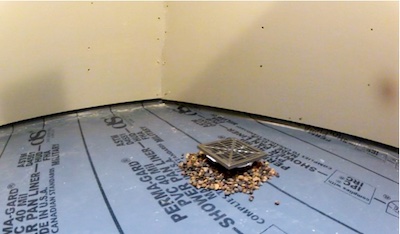
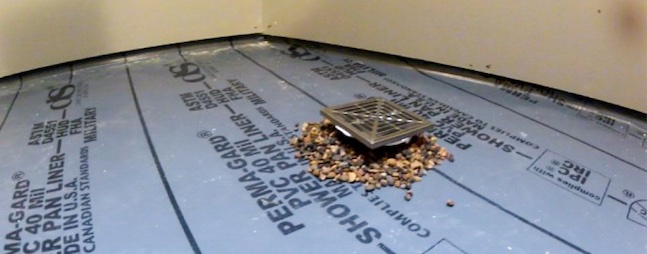
Many clamping ring drains with weep holes are part of commercial projects, including those in hospitality, multi-family, condominium, and institutional. So, how does one protect those weep holes? In theory, the “classic” best practice is crushed tile or pea gravel distributed over the weep holes. This method is devised to protect against the dry-pack mortar clogging things up.
But there is a better, more reliable way to do this: a positive weep protector. A variety of manufacturers offer prefabricated plastic collars that are designed to clip around the base, cover the weep holes, and allow residual moisture to exit the system.
Don’t get cornered
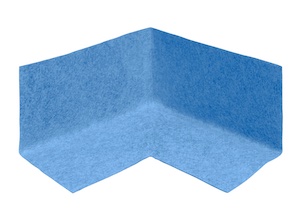
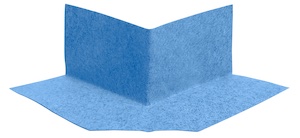
Prefabricated inside and outside corners can help ensure that these critical details are waterproof.
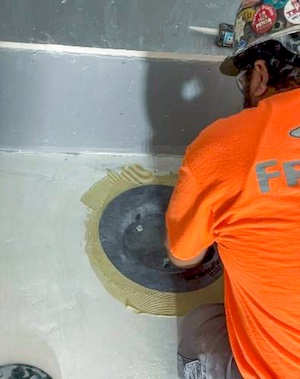
One of the main areas of failure inside shower pans occurs at the inside and curb corners. With the ready access to an assortment of thin-line prefabricated corners from various vendors, there is no reason to try and “handcraft” these critical installation details. Note that installation methods of these corner products may vary from vendor to vendor.
Flash in the pan
Where any type of waterproof membrane ties into the drain is the number one area of failure in shower pans. Using a drain flashing eliminates the time-intensive effort to get a sheet or liquid membrane to perform in this failure-prone detail.
Bonded, seamed, sealed
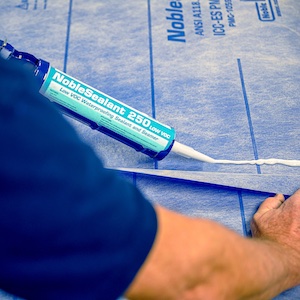
All ANSI A118.10 waterproof membranes are bonded. All sheet membranes are seamed, and many companies offer a proprietary sealant. The trouble begins when an installer assumes that the bonding, seaming, and sealing of one particular product is universal. I have seen many failures happen for this exact reason. Be cognizant of each brand’s unique proprietary installation methods and products.
Q/A-Q/C and training
Any project with a robust and enforced quality assurance/quality control program for waterproofing will have a higher level of installation quality as well as fewer failures. The same is true of training. Installer turnover, combined with new products, requires a repeated sequence of installation and product training. Remember, even the best baseball players go to spring training to work on the basics.
Some things never change. The temptation to save time or money by cutting corners will usually come back to haunt you.